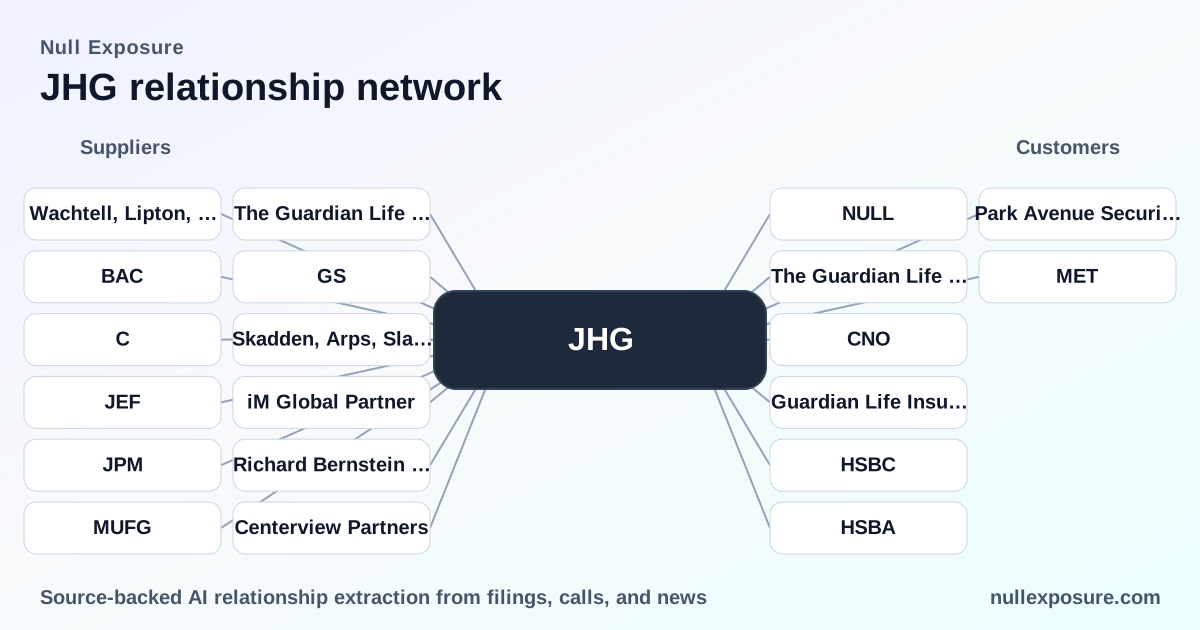
Janus Henderson (JHG) — supplier and advisor map for investors evaluating counterparty risk
Janus Henderson is a global asset manager that monetizes primarily through fee income on assets under management (AUM)—including management fees, performance fees and distribution fees paid to intermediaries—and supplements growth through strategic M&A and sponsored seed investments. Recent public reporting shows the company actively using advisory, legal and syndicated bank financing relationships to execute a take‑private transaction and to support product launches, while integrating boutique capability via acquisitions. For investors and operators, the critical lens is how distribution economics, third‑party service dependence and financing concentration affect earnings durability and execution risk.
For further detail and supplier analytics, visit https://nullexposure.com/.
How to read the supplier map: practical operating constraints that drive risk and opportunity
Janus Henderson’s disclosed relationships and internal excerpts reveal operational characteristics that directly affect contract posture and counterparty exposure:
- Usage‑based contracting for distributors. Distribution expenses are calculated on intermediary‑sourced AUM, indicating a pay‑for‑flow commercial model that ties sales expenses to underlying AUM levels rather than fixed retainer fees. This aligns Janus Henderson’s variable cost base with asset movement and distribution effectiveness.
- Distributor and service provider roles are core to revenue delivery. Financial intermediaries act as distributors while third‑party administrators and data vendors are integrated into valuation and performance reporting processes; these are economically critical for daily NAV production and client reporting.
- Active relationship posture and oversight. The firm performs daily price validation and annual due diligence on third parties, signaling a mature vendor governance model but also operational dependency on external price collection and validation processes.
- Concentration and execution risk around financing and advisors. The take‑private deal is financed by a syndicate of large banks and supported by prominent financial and legal advisors, creating short‑term concentration around credit execution and strategic advice.
These characteristics point to a business model that is execution‑sensitive (product launches, M&A, and financing) and revenue‑sensitive (distribution fees linked to flows). For a deeper supplier view, return to https://nullexposure.com/ for profile downloads and monitoring.
Detailed supplier and advisor relationships investors should track
The Guardian Life Insurance Company of America — FY2026
Guardian provided $100 million in seed capital to a Janus Henderson CLO ETF, reflecting a strategic distribution/seed partnership that accelerates product scale and fee capture. Source: InsiderMonkey report, FY2026 (https://www.insidermonkey.com/blog/janus-henderson-jhg-launches-janus-henderson-aa%E2%80%91a-clo-etf-1707123/?amp=1).
Goldman Sachs & Co. LLC — FY2025
Goldman Sachs is acting as financial advisor to the Special Committee overseeing the proposed take‑private transaction, positioning GS as a central strategic advisor on valuation and deal mechanics. Source: CityBiz report, FY2025 (https://www.citybiz.co/article/787239/janus-henderson-group-to-be-acquired-by-trian-fund-management-and-general-catalyst-for-7-4-billion/).
Skadden, Arps, Slate, Meagher & Flom LLP — FY2025
Skadden serves as legal advisor to Janus Henderson on the transaction, responsible for corporate governance, regulatory filings and transaction documentation. Source: CityBiz report, FY2025 (https://www.citybiz.co/article/787239/janus-henderson-group-to-be-acquired-by-trian-fund-management-and-general-catalyst-for-7-4-billion/).
iM Global Partner — FY2026
iM Global Partner agreed to divest its stake in Richard Bernstein Advisors to Janus Henderson in connection with the RBA acquisition, indicating a negotiated transfer of boutique capabilities and client relationships. Source: Funds Society, FY2026 (https://www.fundssociety.com/en/news/business/janus-henderson-acquires-richard-bernstein-advisors/).
Richard Bernstein Advisors — FY2026
Janus Henderson signed a definitive agreement to acquire 100% of Richard Bernstein Advisors, expanding macro multi‑asset and research‑driven capabilities within its platform. Source: Funds Society, FY2026 (https://www.fundssociety.com/en/news/business/janus-henderson-acquires-richard-bernstein-advisors/).
Centerview Partners — FY2025
Centerview is a long‑standing advisor to Janus Henderson, indicating continuity in strategic and M&A advisory selection amid transformational activity. Source: CityBiz report, FY2025 (https://www.citybiz.co/article/787239/janus-henderson-group-to-be-acquired-by-trian-fund-management-and-general-catalyst-for-7-4-billion/).
Wachtell, Lipton, Rosen & Katz — FY2025
Wachtell, Lipton is listed as legal advisor to the Special Committee, providing independent counsel for fiduciary and defense considerations in the transaction. Source: CityBiz report, FY2025 (https://www.citybiz.co/article/787239/janus-henderson-group-to-be-acquired-by-trian-fund-management-and-general-catalyst-for-7-4-billion/).
Bank of America — FY2025
Bank of America is part of the committed debt financing syndicate, underwriting leverage that supports the take‑private consideration. Source: Pulse2 announcement, FY2025 (https://pulse2.com/janus-henderson-to-be-acquired-by-trian-and-general-catalyst-in-7-4-billion-take-private-deal/).
Citi — FY2025
Citi is a member of the debt financing group providing fully committed financing for the transaction, increasing funding concentration among large global banks. Source: Pulse2 announcement, FY2025 (https://pulse2.com/janus-henderson-to-be-acquired-by-trian-and-general-catalyst-in-7-4-billion-take-private-deal/).
Jefferies — FY2025
Jefferies is part of the committed financing syndicate, contributing bank underwriting capacity to the deal financing package. Source: Pulse2 announcement, FY2025 (https://pulse2.com/janus-henderson-to-be-acquired-by-trian-and-general-catalyst-in-7-4-billion-take-private-deal/).
JPMorgan Chase Bank — FY2025
JPMorgan Chase is a lead financing bank in the committed debt syndicate, a pivotal counterparty for credit execution. Source: Pulse2 announcement, FY2025 (https://pulse2.com/janus-henderson-to-be-acquired-by-trian-and-general-catalyst-in-7-4-billion-take-private-deal/).
MUFG Bank — FY2025
MUFG is also a committed debt provider, diversifying the syndicate across global banking partners but keeping financing concentrated in a single transaction. Source: Pulse2 announcement, FY2025 (https://pulse2.com/janus-henderson-to-be-acquired-by-trian-and-general-catalyst-in-7-4-billion-take-private-deal/).
What this map means for investors and operators
- Revenue sensitivity to intermediary flows. Usage‑based distribution economics make revenue and marketing expense elastic to sales success; distributors are revenue drivers and retention levers. Protect against distributor attrition and competition for product shelf space.
- Operational criticality of third‑party services. Daily pricing, NAV calculation and validation rely on third‑party administrators and data vendors; these are single points of operational failure that require active oversight and redundancy.
- Execution risk concentrated in a short window. The take‑private transaction centralizes funding and advisory risk among a small group of banks and law firms—this raises short‑term deal execution and covenant design concerns that directly affect liquidity and corporate governance.
- Acquisition strategy increases capability but also integration risk. Buying boutiques like Richard Bernstein Advisors accelerates product and research breadth, but integration is performance‑sensitive and can affect near‑term cost and retention metrics.
Investors should monitor distribution channel retention, third‑party operational controls and the terms of the financing package as leading indicators of earnings durability. For monitoring tools and supplier exposure dashboards, see https://nullexposure.com/.
Bottom line and action steps
Janus Henderson’s supplier relationships reveal a business geared to fee capture through scalable product launches and intermediary distribution, supported by an active advisory and bank financing ecosystem for strategic transactions. The primary risks are distribution concentration, third‑party operational dependency, and deal execution concentration around credit and legal advisors. For investors and risk managers, the priority is continuous monitoring of distributor economics, third‑party service controls and financing covenants.
Explore supplier profiles, alerts and curated relationship analytics at https://nullexposure.com/ to translate this map into actionable monitoring.