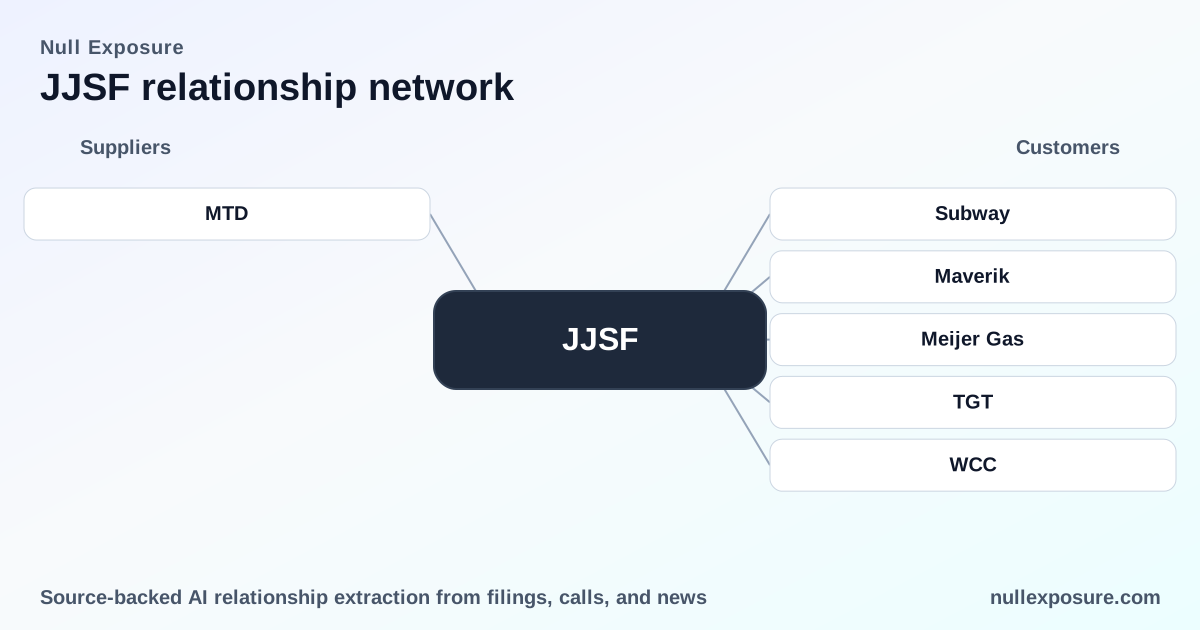
J&J Snack Foods (JJSF) — supplier relationships, contracts and what they mean for investors
J&J Snack Foods monetizes through branded frozen snack and beverage products, a mix of manufacturing and proprietary distribution (including The ICEE Company), and selective brand acquisitions and licensing deals that expand retail and impulse channels. Revenue comes from selling finished goods to national retailers, foodservice operators and distribution partners, while margins are driven by manufacturing scale, ingredient purchasing, and growing specialty beverage and frozen-dessert placements.
For a concise supplier-risk snapshot and ongoing monitoring, visit https://nullexposure.com/ for a full supplier relationship dashboard.
Recent transactional activity that matters to the supply chain
J&J Snack is actively consolidating adjacent snack brands, partnering on co-branded frozen novelties, and investing in inspection and distribution infrastructure. These moves change procurement patterns (ingredient and packaging demand), raise logistics load, and increase the strategic importance of certain service providers. Key takeaways: acquisitions and brand collaborations have both revenue and supply-chain implications; distribution and inspection contracts are material to operations.
Detailed relationship notes (one-paragraph summaries, source-cited)
Hain Celestial — Thinsters brand acquisition
J&J Snack purchased the Thinsters cookie business from Hain Celestial as part of Hain’s North American snacks divestiture, signaling continued M&A-driven expansion of JJSF’s branded snack stable. According to NJBIZ reporting in March 2026, the Thinsters transfer was completed to the Mount Laurel–headquartered company (NJBIZ, March 10, 2026).
Hain Celestial — confirmation from MillingMEA
A separate news account reiterated the transfer of the Thinsters cookie business to J&J Snack Foods, underscoring the public reporting consistency around the transaction. MillingMEA covered the divestiture in May 2026, noting J&J Snack as the acquirer (MillingMEA, May 3, 2026).
Hain Celestial — industry trade confirmation
Trade press also flagged the Thinsters sale to J&J Snack as part of Hain Celestial’s snack-business disposition, reinforcing that the transaction has been acknowledged across industry outlets. Snack & Bakery reported on the completion in March 2026 (Snack & Bakery, March 10, 2026).
WK Kellogg Co — ICEE co-branded product collaboration
J&J Snack’s ICEE subsidiary executed a co-branded frozen treat using the Froot Loops flavor in collaboration with WK Kellogg Co, demonstrating the company’s commercial strategy of leveraging licensed flavors to drive frozen-beverage and impulse sales. The Kellogg newsroom announcement was published in May 2024 describing the collaboration (WK Kellogg Co newsroom, May 22, 2024).
Mettler-Toledo Safeline / MTD — X-ray inspection systems
J&J Snack publicly referenced reliance on Mettler-Toledo Safeline X-ray inspection equipment in a case study tied to product quality and safety controls, indicating capex and supplier integration in production quality assurance. Snack & Bakery documented this case study in March 2026 (Snack & Bakery, March 10, 2026).
MTD (duplicate listing) — equipment and quality controls
A second entry reiterates the same relationship with Mettler-Toledo (MTD) for X-ray inspection systems, highlighting the operational emphasis on automated inspection across manufacturing lines (Snack & Bakery, March 10, 2026).
CTNM — license agreement reference in an SEC filing
A CTNM filing (10‑K, FY2024) references a “J&J License Agreement” granting an exclusive, worldwide license to develop, manufacture and commercialize PIPE‑307, which indicates J&J‑branded licensing activity documented in another company’s annual report (CTNM 10‑K, FY2024).
INSE — referenced as a key customer in a transcript
A company transcript for Inspired Entertainment noted strong relationships with key customers “like J&J and Accel,” indicating J&J Snack acts as a named commercial partner or customer in certain supplier ecosystems (Investing.com transcript, May 2026).
AVTX — contingent payment language naming J&J
Avalo Therapeutics’ FY2024 10‑K includes language that, if payment obligations arise from underlying agreements, “J&J and/or Apollo” could be required to make payments to ES Therapeutics, which signals J&J’s appearance as a contractual counterparty in third‑party filings (Avalo 10‑K, FY2024).
Company-level contracting posture and spend signals
- Framework contracting and outsourcing are part of the operating model. The company reports master service agreements for distribution and labor management, which indicates a preference for long-term operational frameworks with third-party logistics providers.
- J&J operates as both buyer and service consumer. The company uses forward purchasing for commodity inputs across 1–12 month horizons, and it engages third parties for transportation management and marketing research—an active buyer posture that balances price risk with operational continuity.
- Spend concentration exists around distribution. Public disclosures show multi‑year commitments and high single-vendor spend: annual payments to a distribution partner amounted to roughly $55.9–$71.4 million across recent fiscal years, and the company reports approximately $133 million of contractual commitments as of late FY2025.
- Smaller research/marketing vendor spend is immaterial but recurring. Historical payments to a market research provider were in the $76k–$113k range across FY2023–FY2024, illustrating a small but consistent external research expense line.
- Service provider relationships are material to operations. The combination of sizeable distribution payments and investment in inspection equipment points to two operational levers—logistics and food safety—that directly affect throughput, costs and recall risk management.
(These points are company-level signals drawn from public filings and disclosures; they are not assigned to a specific vendor unless explicitly named in the source.)
What investors and operators should focus on next
- Concentration risk in distribution: With tens of millions of dollars flowing to distribution partners and a master service framework in place, any provider disruption would have immediate logistics and cost implications. Assess counterparty financial health and run-rate exposure.
- Integration risk from acquisitions: The Thinsters acquisition increases SKU breadth and ingredient/packaging complexity; integration execution will determine margin upside or dilution.
- Quality and capex footprint: Public use of X‑ray inspection systems signals a capitalized approach to quality; investors should monitor capex cadence and maintenance/replacement schedules that affect near-term free cash flow.
- Contractual commitments: The cited $133 million of commitments requires scrutiny in scenario analysis—particularly in stress conditions where demand shifts would leave fixed-cost obligations.
- Licensing and counterparty exposure: Mentions of J&J in third‑party 10‑Ks and transcripts (CTNM, AVTX, INSE) indicate the company appears in multiple contractual roles beyond supplier/customer flows; understand the legal and contingent obligations embedded in these arrangements.
For deeper relationship mapping, supplier scoring and contract-level exposure analysis, consult the full supplier intelligence portal at https://nullexposure.com/.
Bottom line
J&J Snack is executing a classic branded food strategy: grow through targeted acquisitions and co‑branding while outsourcing non‑core logistics and investing in plant-level quality systems. The two dominant supplier risks for investors are distribution concentration and integration execution post-acquisition; both are measurable and controllable with proactive vendor management and capex discipline. Solid institutional ownership and modest dividend yield provide financial stability, but active monitoring of contractual commitments and supplier continuity is a prudent part of any investor due diligence.