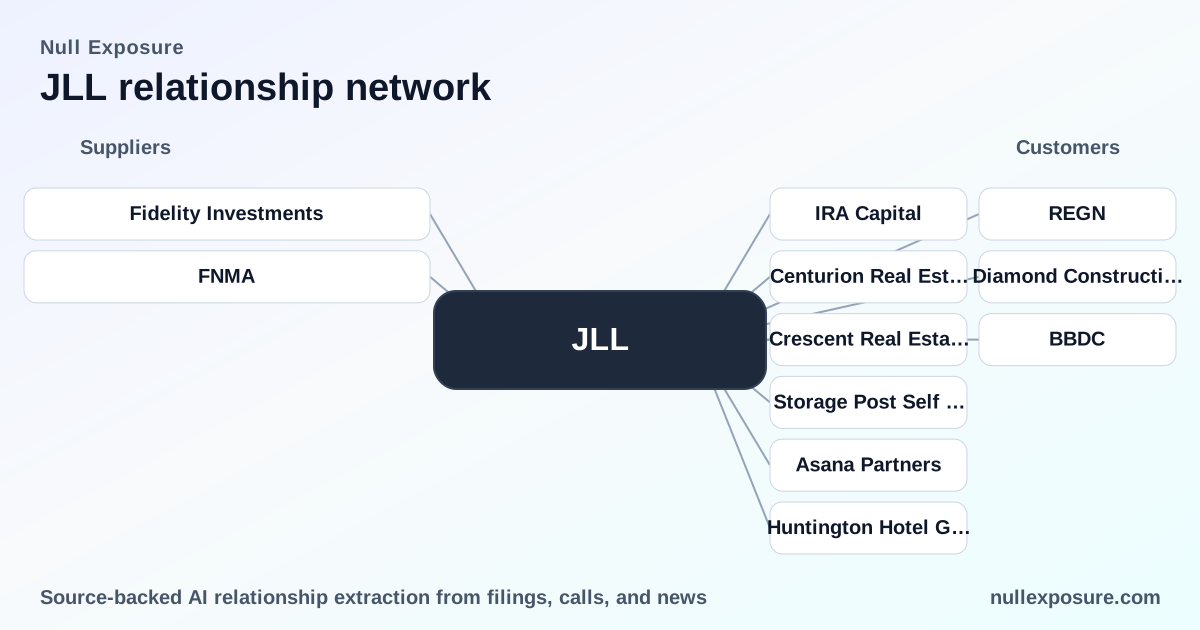
JLL as a supplier counterparty: financing relationships that move the cash line
Jones Lang LaSalle (JLL) operates as a global professional services and investment management firm that monetizes through fee-based real estate services, capital markets transactions, and investment management fees, supplemented by financing arrangements tied to asset-level activity. With roughly $26.1 billion in trailing revenue and a $14.2 billion market capitalization, JLL’s supplier and financing counterparties are operationally material because they support working capital, warehouse financing and capital markets execution — all of which affect liquidity and earnings volatility. If you want a concise map of counterparty exposure and contract timing, start here and follow the details on counterparties and contractual constraints. For a broader review of supplier risk across portfolios, visit https://nullexposure.com/.
How JLL earns its margin and why financing partners matter
JLL’s business model is predominantly fee-oriented: property and facility management fees, leasing and advisory commissions, and recurring investment management fees drive the bulk of revenue. Capital markets and asset transactions introduce financing flows — loans, warehouse facilities and repurchase activity — that can create concentrated exposure to specific financial counterparties and short-term liquidity requirements. JLL’s scale (reported revenue and a diversified geography) reduces single-market risk, but short-term financing lines and asset-level loans make counterparty terms and maturities immediately relevant to investors.
- Operational leverage: fee income is stable, but transactional financing amplifies cash flow timing.
- Counterparty criticality: warehouse and acquisition loans can be secured and covenanted, so counterparties materially affect JLL’s flexibility.
- Balance-sheet sensitivity: short-term facilities and repurchased loans influence reported cash flow and working capital in quarterly results.
If you want a direct supplier-risk dashboard for investment diligence, see https://nullexposure.com/ for available coverage.
The disclosed counterparty relationships you need to know
Fidelity Investments — acquisition loan for a retail center (2026)
JLL arranged a three‑year floating‑rate acquisition loan through Fidelity Investments on behalf of a borrower related to a retail center in Clifton, New Jersey; the facility demonstrates JLL’s role in sourcing institutional capital for property acquisitions. According to JLL’s newsroom announcement on March 10, 2026, the loan transaction was structured as a floating‑rate facility facilitated through Fidelity. (Source: JLL newsroom — acquisition loan announcement, March 10, 2026: https://www.jll.com/en-us/newsroom/acquisition-loan-for-retail-center-in-clifton-new-jersey)
Fannie Mae — legacy loan repurchase and asset sale impact (FY2026)
JLL disclosed that the company experienced an absence of cash outflow related to a 2024 loan repurchased from Fannie Mae, accompanied by cash proceeds in 2025 from the sale of the repurchased loan’s underlying asset, indicating JLL executed a repurchase and subsequent disposition that affected cash flow timing. This was noted in JLL’s 2025 financial results release. (Source: JLL press release — 2025 fourth‑quarter and full‑year financial results, March 2026: https://www.prnewswire.com/news-releases/jll-reports-2025-financial-results-for-fourth-quarter-and-full-year-302691479.html)
What the contractual constraints say about JLL’s operating posture
JLL’s public disclosures and transaction excerpts surface two company-level signals that matter for counterparty risk and liquidity planning:
- Short-term contracting posture: Company disclosures list warehouse facilities priced at SOFR +1.30–1.40% with expirations in September–October 2025, which indicates near-term rollover and refinancing risk for receivables-financing lines. This short-term tenor raises sensitivity to prevailing money-market rates during the 2025 refinancing window.
- Buyer / borrower role for warehouse lines: JLL describes lines of credit established to fund warehouse receivables that are secured by those receivables, signaling that JLL acts as the borrower of warehouse funding to finance receivables rather than solely as a fee agent. That structure concentrates risk around collateral quality and lender covenants.
Together these constraints imply a contracting posture that is operationally tactical and rate-sensitive, with a reliance on financial institutions for secured short-dated funding and a need to manage collateral quality and covenant headroom proactively.
Investor implications: what to watch and why it matters
For investors and operators, the combined picture of fee-based earnings with pockets of secured, short-term financing yields a few clear priorities:
- Monitor near-term expirations and refinancing terms. The SOFR‑based warehouse lines expiring in late 2025 require scrutiny: rolling these facilities at materially different spreads would affect financing costs and cash flow volatility.
- Track counterparty concentration and lender negotiation leverage. A handful of large financial institutions providing warehouse capacity creates concentration risk; adverse funding conditions could raise spreads or tighten covenants.
- Watch asset dispositions that interact with repurchased loans. The Fannie Mae repurchase and subsequent sale show how loan repurchases and asset sales can produce significant timing effects in cash flow and reported liquidity.
- Assess collateral quality and covenant language. Since these are secured facilities, the quality and valuation of underlying receivables drive how much liquidity JLL can extract in stressed markets.
If you need a focused counterparty exposure review or a tailored supplier risk brief, start the process at https://nullexposure.com/ — we map counterparty timing, concentration and contract terms that investors should watch.
Bottom line: stable fee engine, measurable financing frictions
JLL’s core fee-for-service model creates structural stability, while warehouse financing and loan repurchase activity introduce discrete, date-certain risks tied to counterparty terms and short-term maturities. The Fidelity transaction shows JLL’s role in placing acquisition financing with institutional capital; the Fannie Mae note shows balance-sheet activity that can affect cash flow timing. The company-level signals—short maturities on warehouse facilities and the borrower role for those facilities—are the precise items investors should watch heading into the late‑2025 refinancing window.
For investor diligence that goes beyond headlines and ties supplier counterparties to contract dates and cash‑flow impact, visit https://nullexposure.com/ for deeper supplier exposure intelligence and follow-up analysis.