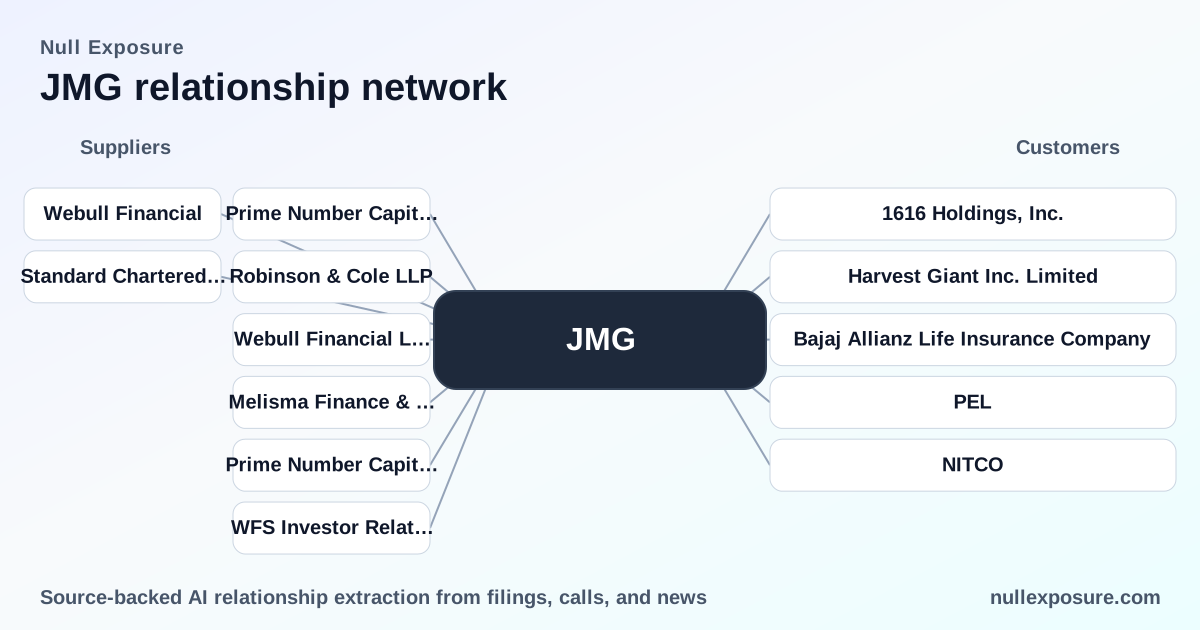
JMG supplier map: who moves capital and risk around this media operator
Journal Media Group Inc (JMG) operates as a diversified local-media company, monetizing through targeted advertising, print and digital subscriptions, and multimedia services that sell audience attention to local advertisers. The company’s cash flow model depends on repeat advertising contracts and audience distribution across print and digital channels; external suppliers and capital providers therefore shape financing flexibility and go-to-market execution. For investors and operators, the supplier list below highlights underwriting, legal, banking, and investor‑relations relationships that materially affect near‑term liquidity and market access.
If you want a consolidated view of supplier concentration and counterparty risk across similar issuers, visit https://nullexposure.com/ for comparative supplier intelligence.
What this supplier map tells investors about JMG’s operating posture
JMG’s supplier relationships show a mix of capital markets intermediaries and corporate service providers rather than operational vendors like printing or distribution. That pattern signals an operating stance that leans on periodic access to capital markets, formal investor communications, and bank-sourced receivables financing to bridge cash flow cycles. Key implications: capital access, reputational distribution, and short-term financing are the dominant external dependencies.
- Contracting posture: Relationships with underwriters and investor‑relations firms indicate discrete, transaction-driven contracting rather than ongoing multi-year supplier commitments.
- Concentration: Underwriting and banking counterparties are few and identifiable, creating single‑point relationship dependencies around financing events.
- Criticality: Legal counsel and banks are critical to deal execution and receivables liquidity—downtime or breakdown in those relationships would directly affect IPO or offering execution and working capital.
- Maturity: Engagements with established financial institutions and law firms indicate mature capital‑markets playbooks rather than ad‑hoc capital raises.
Visit https://nullexposure.com/ to get supplier maps for other spec targets and see where concentration risk is emerging across sectors.
The counterparties you should know (one‑sentence takeaways and sources)
Prime Number Capital / Prime Number Capital, LLC
Prime Number Capital is named repeatedly as a bookrunner/co‑manager on JM Group’s U.S. offering; Renaissance Capital and later press coverage list Prime Number Capital in both sole and joint bookrunning roles across reporting. According to Renaissance Capital and trading coverage (March 2026), Prime Number Capital participated centrally in the underwriting syndicate. (Sources: Renaissance Capital, TradingView coverage, first seen March 2026).
Takeaway: Prime Number Capital is a primary distribution partner for recent equity issuance, putting it squarely in the capital‑access loop for JMG.
Webull Financial / Webull Financial LLC
Webull Financial served as the lead manager and representative underwriter on the offering, and is referenced as a joint bookrunner alongside Prime Number Capital in multiple releases. GlobeNewswire’s December 11, 2025 announcement and reporting aggregated by Renaissance Capital confirm Webull’s representative role. (Source: GlobeNewswire press release, Dec 11, 2025; Renaissance Capital, March 2026).
Takeaway: Webull’s role as representative underwriter gives it strong influence over pricing, placement, and aftermarket distribution for equity transactions.
Robinson & Cole LLP
Robinson & Cole acted as U.S. securities counsel to the company in connection with the offering, supporting regulatory compliance and disclosure requirements for the US listing. This is documented in the GlobeNewswire release announcing the offering close on December 11, 2025. (Source: GlobeNewswire, Dec 11, 2025).
Takeaway: Robust U.S. counsel reduces execution risk on cross‑border securities work and indicates formal legal structuring for U.S. market entry.
WFS Investor Relations Inc.
WFS Investor Relations is listed as the company’s investor‑relations contact for the offering, providing a public interface to sell‑side and buy‑side stakeholders. The GlobeNewswire close announcement lists WFS Investor Relations as the IR provider. (Source: GlobeNewswire, Dec 11, 2025).
Takeaway: Outsourced investor relations centralizes messaging and improves market visibility during and after capital raises.
Standard Chartered Bank
Standard Chartered provides a factoring facility, with reported factoring outstanding of HKD 22.7M at FY2024 and HKD 27.3M at March 31, 2025, showing active receivables financing tied to working‑capital management. TradingView’s coverage of the company’s filing captures the facility and outstanding balances. (Source: TradingView summary of company filings, March 2026).
Takeaway: Receivables factoring with Standard Chartered is an important near‑term liquidity tool and introduces bank covenants and counterparty concentration into the financing stack.
Melisma Finance & Trading Private Ltd
A separate news report references Melisma Finance & Trading Private Ltd as the seller of a luxury apartment connected to private parties identified in reporting; the mention links to individuals associated with company leadership in external property transactions. This public reporting is reflected in LiveMint coverage (noted FY2022 reporting context). (Source: LiveMint coverage, FY2022 context; first seen March 2026).
Takeaway: This is an ancillary, reputationally relevant relationship showing connections to private transactions tied to executive circles; it is not presented as an operational supplier but is relevant for governance diligence.
Mid‑analysis: what risks and advantages flow from this supplier mix
- Advantage — Market access: The presence of active bookrunners and a named US securities counsel signals a structured capital‑markets approach that supports follow‑on financing and secondary market listings. This improves the company’s ability to monetize at scale when market windows open.
- Risk — Counterparty concentration: Equity distribution and receivables financing are concentrated among a small set of institutions; this amplifies execution risk if any counterparty withdraws or recalibrates pricing. Standard Chartered’s factoring facility and Webull/Prime Number’s underwriting roles are the most material single‑counterparty exposures.
- Operational leverage: Outsourced investor relations and legal services reduce internal fixed cost but increase reliance on external reputation management during earnings or fundraising cycles.
For a comparative supplier-risk scorecard and live updates on counterparty changes, go to https://nullexposure.com/.
Constraints and company‑level signals investors should model
No explicit constraint entries were recorded for these supplier relationships. As a company‑level signal, investors should assume:
- Deal‑driven contracting: Suppliers are engaged primarily for discrete financing and IR events rather than long‑term operational outsourcing.
- Liquidity sensitivity: Receivables factoring levels visible in filings demonstrate working‑capital dependence on bank facilities to smooth cash flow.
- Reputational linkage: Third‑party IR and legal advisors centralize external messaging, making the company’s public narrative dependent on those suppliers’ effectiveness.
These are structural features of JMG’s operating model that should be built into scenario analysis when stress‑testing covenant blowouts or market closure scenarios.
Conclusion — what investors should do next
- Prioritize monitoring of underwriting syndicate activity and Standard Chartered’s factoring balances, because changes there will be the fastest leading indicator of financing stress or improvement.
- Validate counsel and IR continuity around any future offerings to ensure transaction execution capability is intact.
For tailored supplier risk portfolios and comparative peer mapping, visit https://nullexposure.com/ — our platform aggregates counterparty exposure for investors evaluating issuer financing profiles.
Key takeaway: JMG’s external dependencies cluster around capital markets and short‑term financing; underwriters, counsel, investor relations, and factoring banks are the levers that will determine near‑term liquidity and market access.