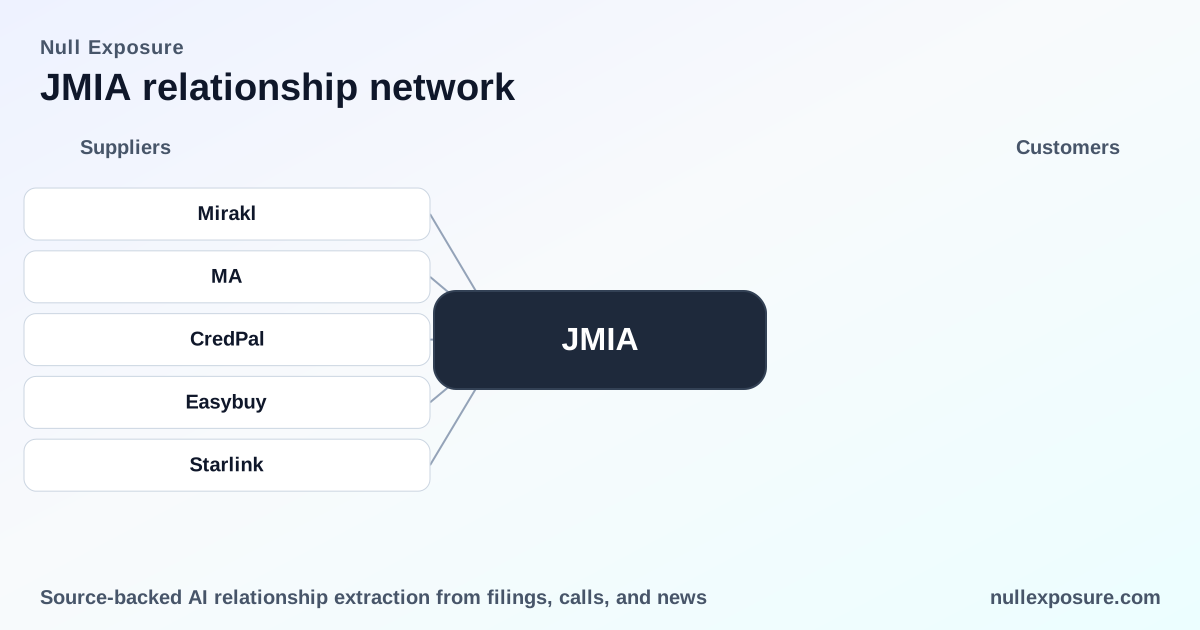
Jumia’s supplier map: what five commercial relationships reveal about execution and risk
Jumia Technologies AG runs a pan‑African e‑commerce platform and monetizes through a combination of first‑party retail sales, third‑party marketplace fees, payments and financial partnerships, and ancillary services such as logistics and advertising. Investor interest should focus on how Jumia stitches together third‑party technology and payments partnerships to scale gross merchandise value while containing operating leverage; the supplier relationships below reveal deliberate moves to professionalize marketplace operations, diversify payment rails, and support first‑party fulfillment in challenging connectivity environments.
Explore supplier intelligence at NullExposure
What the recent supplier activity implies about Jumia’s operating posture
Jumia’s public disclosures and media coverage show a company transitioning from ad‑hoc partner arrangements to a more modular, partner‑driven operating model. Implementation of commercial software, active reshaping of payment relationships, and new point‑of‑sale credit partnerships signal a hybrid contracting posture: Jumia invests in third‑party platforms where it improves speed to market and operational control, while retaining flexibility to change payment and financial suppliers when commercial terms or strategic direction require.
- Concentration and criticality: First‑party sales make up a material portion of revenue (49% in the referenced disclosure), so suppliers that directly affect fulfillment, payments or marketplace technology are commercially critical.
- Maturity: The rollout of third‑party marketplace tooling and multiple new BNPL partners point to a company moving from founder‑led ad hoc integrations to repeatable, enterprise vendor relationships.
- Supplier flexibility: Ending a legacy commercial agreement with a major card partner and adding BNPL providers shows active supplier management to optimize margins and customer acquisition.
These are company‑level signals drawn from the relationship evidence below rather than isolated contractual excerpts.
Five supplier relationships investors should know
Mirakl — marketplace platform implementation
Jumia implemented a Mirakl marketplace tool in the first half of FY2026, a deployment that required significant time to complete, indicating a deliberate, enterprise‑grade upgrade to marketplace operations. This rollout underscores Jumia’s intent to professionalize third‑party seller onboarding and fee capture. According to the Q4 FY2025 earnings call transcript reported on InsiderMonkey (March 2026), “we have rolled out a new tool from a company called Mirakl that was implemented in the first half of the year, took a lot I mean, it took some time.”
Source: InsiderMonkey Q4 2025 earnings call transcript (published March 2026).
Mastercard Asia/Pacific — former commercial payment partner
Jumia recently ended its commercial agreement with Mastercard Asia/Pacific, a strategic move that frees Jumia to pursue alternative payment relationships and reprice or restructure payment routing arrangements. Vanguard Nigeria reported that the termination “marks a strategic shift, allowing the company to explore broader partnerships with other payment service providers.”
Source: Vanguard Nigeria (August 2024) coverage of Jumia commercial arrangements.
CredPal — new BNPL partner in Nigeria
Jumia Nigeria launched a Buy‑Now‑Pay‑Later (BNPL) partnership with CredPal to expand consumer financing options and improve conversion on higher‑ticket items. SimplyWallSt noted the May launch of the CredPal arrangement as part of a two‑partner BNPL rollout.
Source: Simply Wall St coverage of Jumia (May 23 reporting).
Easybuy — additional BNPL provider to broaden checkout choices
Alongside CredPal, Jumia introduced Easybuy as a BNPL partner in Nigeria, signaling a play to diversify financing providers at checkout and reduce reliance on a single credit provider while increasing conversion and average order value. SimplyWallSt documented this dual BNPL launch on May 23.
Source: Simply Wall St coverage of Jumia (May 23 reporting).
Starlink — international partnership supporting first‑party sales
Jumia’s first‑party sales performance is supported by international partnerships “including Starlink” in Nigeria and Kenya, indicating use of satellite connectivity or related services to stabilize operations and service delivery in markets with uneven infrastructure. The Q4 FY2025 earnings call transcript cited by InsiderMonkey notes that first‑party sales, which accounted for 49% of total revenue, benefited from such partnerships.
Source: InsiderMonkey Q4 2025 earnings call transcript (March 2026).
How these relationships change the investment thesis
-
Professionalizing marketplace tech is a structural positive. The Mirakl implementation reflects a move to a standardized marketplace stack that improves seller scale, fee capture, and operational predictability — a direct lever on gross margin and the unit economics of third‑party sales. This is an execution‑oriented improvement to long‑term monetization.
-
Payments are an active battleground. The decision to end a commercial agreement with Mastercard Asia/Pacific and to introduce multiple BNPL providers signals Jumia’s willingness to reengineer payment economics and shopper financing. Payment partner churn reduces single‑vendor concentration but creates short‑term transactional risk during transition.
-
Consumer credit partnerships focus on conversion, not credit exposure. CredPal and Easybuy are distribution partnerships that push point‑of‑sale financing to consumers; the ambition is to drive higher conversion and basket size rather than to become a principal lender. That makes these suppliers strategically valuable but increases operational dependence on external credit underwriting.
-
Infrastructure partnerships support execution in difficult markets. Naming Starlink as an international partner tied to first‑party sales suggests Jumia is investing in connectivity to protect fulfillment and customer experience in Nigeria and Kenya — a practical mitigation of geography‑driven delivery risk. Operational continuity in core markets is directly enhanced by such suppliers.
See more supplier analysis at NullExposure
Investor risk checklist (decision‑ready)
- Supplier concentration risk: While BNPL additions reduce concentration, payment routing changes always carry short‑term processing and reconciliation risk; monitor volumes and transaction recovery post‑transition.
- Execution risk on integrations: Mirakl took time to implement; further enterprise integrations can compress near‑term margins or delay seller activation.
- Credit and collection exposure: Use of third‑party BNPL providers transfers credit risk off balance sheet but increases reputational and operational dependence on partners’ underwriting standards.
- Geopolitical and infrastructure exposure: Partnerships like Starlink reduce some country execution risk, but regulatory or licensing changes across African markets remain a systemic variable for Jumia’s operations.
Bottom line and next step for diligence
Jumia is actively reshaping the vendor landscape to professionalize its marketplace, diversify payment rails, and shore up first‑party execution in infrastructure‑challenged markets. These supplier moves strengthen the operational backbone but introduce transition and partner‑concentration tradeoffs investors must monitor closely. For investors and operators evaluating counterparty risk and commercial leverage, the next practical step is tracking post‑implementation KPIs: marketplace take rate, payment routing share, BNPL penetration, and first‑party fulfillment metrics over the next two quarters.
For deeper supplier intelligence and ongoing tracking of Jumia’s partner shifts, visit NullExposure and subscribe for alerts: https://nullexposure.com/.
Explore how supplier signals change investment outcomes at NullExposure