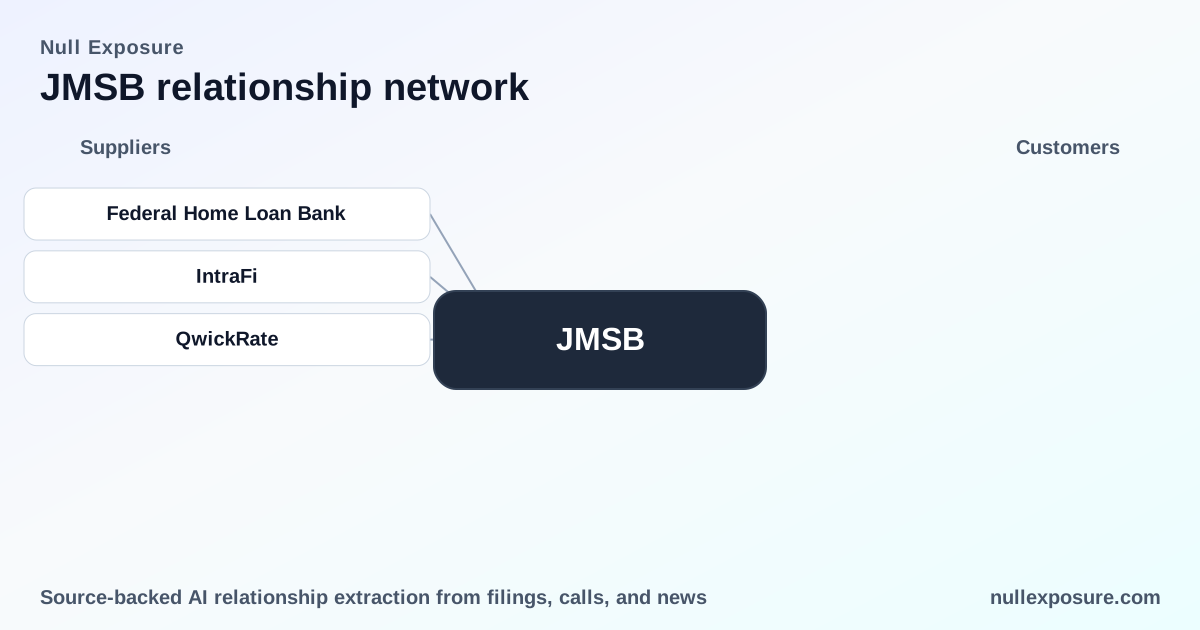
John Marshall Bancorp (JMSB) — supplier map and funding relationships that shape liquidity
John Marshall Bancorp operates as the holding company for John Marshall Bank, monetizing primarily through interest margin on lending and deposit funding and ancillary fee income from core banking services. The bank funds growth and manages liquidity through a mix of core deposits, brokered deposit platforms, and wholesale funding lines; these supplier relationships directly influence its net interest margin, funding cost, and balance-sheet agility. Investors should view JMSB’s supplier footprint as a funding- and deposit-management architecture rather than a vendor ecosystem.
Visit the firm overview and supplier intelligence at https://nullexposure.com/ for direct access to primary disclosures and relationship signals.
Why these supplier names matter to investors
John Marshall’s reported suppliers in FY2025 reflect three discrete functions: wholesale advances (Federal Home Loan Bank), insured large-balance deposit placement (IntraFi), and brokered/managed CDs and deposits (QwickRate). Together they shape short- and medium-term liquidity, pricing pressure on deposit costs, and counterparty concentration risk. A company-level constraint recorded in filings confirms that “the Company obtains certain deposits through the efforts of third-party brokers,” signaling an active posture toward brokered and platform-sourced funding rather than exclusive reliance on organically grown retail deposits.
- Contracting posture: These relationships are transactional and standardized — common in regional banking — with counterparties operating on established program terms rather than bespoke, bilateral procurement agreements.
- Concentration and criticality: Wholesale and brokered channels are critical to liquidity management; platform reliance elevates funding optionality but increases exposure to market access and rate competition.
- Maturity: The named suppliers are mature, widely used industry platforms and central funding utilities, indicating stability in counterparty selection but not insulation from broader market funding stress.
Explore a concise supplier dossier and primary-source links at https://nullexposure.com/ to track ongoing disclosures and relationship shifts.
The relationships disclosed in FY2025 — what the filings reveal
Federal Home Loan Bank
John Marshall reports FHLB advances of $56.0 million as of the referenced dates in FY2025, indicating an active wholesale borrowing relationship used to supplement liquidity. According to a company press release published Oct 29, 2025 via FinancialContent/BizWire, FHLB advances were $56.0 million as of September 30, 2025, December 31, 2024 and September 30, 2024, confirming a standing borrowing position across reporting periods. (Source: BizWire press release, Oct 29, 2025)
IntraFi
The company’s deposit reporting explicitly states inclusion of IntraFi accounts, showing usage of large-deposit placement or reciprocal deposit services to expand insured deposit balances and manage funding diversification. The FY2025 release notes “(1) Includes IntraFi ® accounts,” indicating IntraFi as a channel for insured deposit aggregation. (Source: BizWire press release, Oct 29, 2025)
QwickRate
John Marshall classifies a portion of its funding mix as QwickRate® certificates of deposit and brokered deposits, alongside federal funds and FHLB/fed borrowings, pointing to active use of brokered CD marketplaces for time-deposit funding. The FY2025 disclosure lists QwickRate within the composition of brokered deposits and short-term funding instruments. (Source: BizWire press release, Oct 29, 2025)
What the supplier mix implies for performance and risk
The supplier roster is tight and purpose-driven: FHLB for wholesale advances, IntraFi for insured deposit placement, and QwickRate for brokered CDs. This structure produces several investment-relevant implications:
- Funding flexibility at a price. Brokered deposits and marketplace CDs give rapid access to funds but typically command higher rates as competition for deposits intensifies; this impacts net interest margin and deposit-cost volatility. JMSB’s trailing P/E of 13.4 and price-to-book near 1.07 reflect modest market valuation relative to book capital and earnings, where funding cost dynamics can rapidly re-rate profitability.
- Liquidity management is centralized. The presence of FHLB advances confirms access to a reliable liquidity backstop used consistently across reporting periods, which is a stabilizing force in stress scenarios.
- Operational dependency on platforms. IntraFi and QwickRate are standardized market channels; they reduce originations friction but create counterparty and operational concentration that requires active monitoring by treasury and risk teams.
- Regulatory and market sensitivity. Brokered deposits draw regulatory attention during stress episodes; the use of these suppliers places JMSB in a funding profile that regulators and markets will scrutinize if deposit flight materializes.
Practical signals investors should monitor next
Investors and operators should track a narrow set of disclosures and market indicators to read shifts in JMSB’s funding posture:
- Changes in the level of FHLB advances in quarterly filings and the accompanying maturity schedule.
- Quarterly footnotes quantifying IntraFi and brokered deposits as a share of total deposits.
- Pricing spreads on brokered CDs sourced through QwickRate versus organic deposit beta.
- Regulatory commentary on brokered-deposit limits and any changes in program participation.
For direct access to the filings and a running log of supplier relationship changes, visit https://nullexposure.com/ and subscribe to supplier intelligence feeds.
Bottom line — actionable investor takeaways
John Marshall Bancorp runs a funding stack that blends dependable wholesale lines with platform-sourced deposits, giving management the tools to grow loans and manage liquidity while exposing the bank to deposit-cost sensitivity and platform concentration. Key takeaways:
- FHLB advances provide a steady wholesale corridor used across reporting periods.
- IntraFi and QwickRate participation shows active use of insured deposit placement and brokered CD markets.
- The company-level note that third-party brokers are used to obtain deposits is a clear signal of reliance on market-sourced funding channels.
If you are evaluating JMSB exposure, integrate supplier movement into your liquidity and NIM scenario planning, and use primary-source monitoring to detect funding-cost inflection points. For ongoing monitoring and supplier-level signals tied to financial filings, visit https://nullexposure.com/ to see the disclosures and relationship timeline.