Johnson & Johnson: supplier relationships, contracting posture, and commercial risk for investors
Johnson & Johnson operates as an integrated healthcare conglomerate that monetizes through three primary franchises—pharmaceuticals, medical devices, and consumer health—collecting revenue from product sales, licensing royalties, and strategic M&A that reshapes cash flows. For investors evaluating J&J as a counterparty or buyer of supplier-level risk exposure, the key commercial attributes are scale, vertical ownership of manufacturing, and a mixed contracting posture that combines long-term strategic commitments with shorter-term liquidity arrangements. If you need a rapid vendor-risk snapshot for J&J counterparties, start with a tailored supplier report at NullExposure.
Why this matters for investors: J&J’s supplier ecosystem influences product margins, launch cadence, and legal/counterparty exposure—each of which feeds directly into cash generation and valuation multiples. Below I map the observable supplier relationships from the available coverage, then translate company-level constraints and excerpts into practical risk signals for operators and portfolio managers.
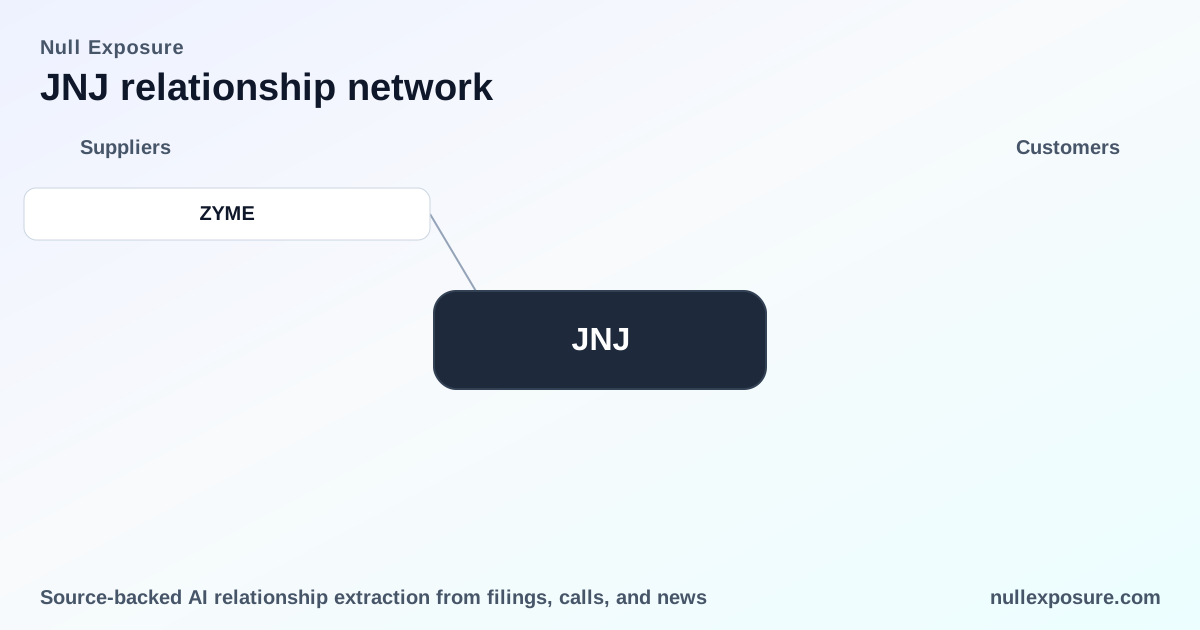
A single supplier relationship in the record: Zymeworks
Zymeworks — a licensor/licensee relationship with royalty implications
Zymeworks disclosed that future royalty streams tied to assets such as pasritamig under a license with J&J are encumbered by a royalty note, meaning certain royalty receipts can be assigned to service debt or meet creditor claims. This was stated in a Zymeworks FY2026 earnings call transcript published March 10, 2026 on InsiderMonkey. (InsiderMonkey, Zymeworks Q4 FY2025 earnings call transcript, March 2026.)
- The practical read for investors: royalty streams associated with Zymeworks’ licensed assets linked to J&J are potentially pledged or otherwise restricted, which reduces the transferability of anticipated cash flows and can complicate securitization or secondary monetization of those royalties. (InsiderMonkey, March 2026.)
What J&J’s company-level constraints reveal about its supplier posture
Below are consolidated signals drawn from J&J’s public disclosures and filings; these are company-level constraints and operating signals rather than attributes of any single supplier relationship.
Contracting posture: long-term strategic commitments alongside short-duration liquidity tools
- J&J issued senior unsecured notes of approximately $9.2 billion in Q1 2025 to fund the Intra-Cellular Therapies acquisition and for general corporate uses, reflecting use of long-term capital to finance strategic M&A and integrate new assets (company filing, Q1 2025).
- Simultaneously, the company maintained a $10 billion 364‑day credit facility secured in June 2025 that expires in June 2026, demonstrating short-duration liquidity management to smooth cash flows and support working capital (company filing, June 2025).
- Investor implication: contract duration risk is dual-track—expect long-dated strategic contracts and financing, but also rolling short-term facilities that can introduce refinancing risk into supplier relationship valuations.
Supplier roles and criticality: owner of capacity, but dependent on third parties for specific inputs and services
- J&J’s subsidiaries generally seek to own manufacturing facilities, yet the company also engages contract manufacturers and relies on third parties for certain raw materials, components and finished products (company filings, 2025).
- The company uses both internal IT systems and third-party vendor networks to process and store sensitive data—outsourced IT and service providers are integral to continuity and product delivery (company filings, 2025).
- Investor implication: criticality is high but concentrated—J&J’s preference for ownership reduces third-party dependency on core capacity, yet the firm still maintains concentrated, critical relationships with contract manufacturers and IT vendors that can be single points of failure for specific products.
Maturity and relationship stage: active, integrated supplier management
- Filings note that J&J “relies on third parties to manufacture and supply certain of our raw materials, component parts and products” and to allocate capacity to meet J&J’s needs, which signals active, ongoing supplier engagements rather than one-off procurement (company filing, 2025).
- Investor implication: supplier relationships are operationally mature and embedded in production planning, increasing the friction and cost of switching suppliers for non‑commodity inputs.
How to translate these signals into investment and operational actions
- Risk underwritten by long-term finance and M&A: The use of large, long-dated issuance for acquisitions ties supplier strategy to M&A integration risk—assess whether acquired supply chains introduce single-source vendors or immature third-party reliance that could compress margins.
- Short-term liquidity creates tactical counterparty risk: Rolling credit facilities can force rapid liquidity management; suppliers dependent on timely payments should model scenarios around covenant stress and temporary payment delays.
- Royalty encumbrances reduce monetization optionality: As the Zymeworks example shows, licensing receipts can be pledged, limiting the ability of counterparties to rely on those streams as collateral or to forecast unencumbered inflows.
For a concise, investor-grade supplier exposure summary tailored to your portfolio, visit NullExposure to generate a prioritized watchlist.
Practical due diligence checklist for J&J supplier exposure
- Confirm whether the supplier’s income streams are free and clear of encumbrances (especially royalties and licensing payments).
- Map the degree of J&J ownership versus third-party manufacturing for the product lines relevant to your exposure.
- Validate contract duration and renewal mechanics across both long-term strategic arrangements and short-term facilities that fund working capital.
- Stress-test counterparty cash flows against a scenario where issued debt or acquisition financing reallocates cash before supplier payments.
Closing: the investor takeaway and next steps
Johnson & Johnson’s scale and AAA credit profile give it structural advantages in procurement and access to capital, but its supplier landscape is not monolithic: long-term strategic financing, reliance on select contract manufacturers, and the capacity to encumber royalty streams are material risk factors that investors and operators must model into valuations and counterparty resiliency assessments. For deeper supplier-level intelligence and prioritized alerts tied to J&J counterparties, get started at NullExposure.