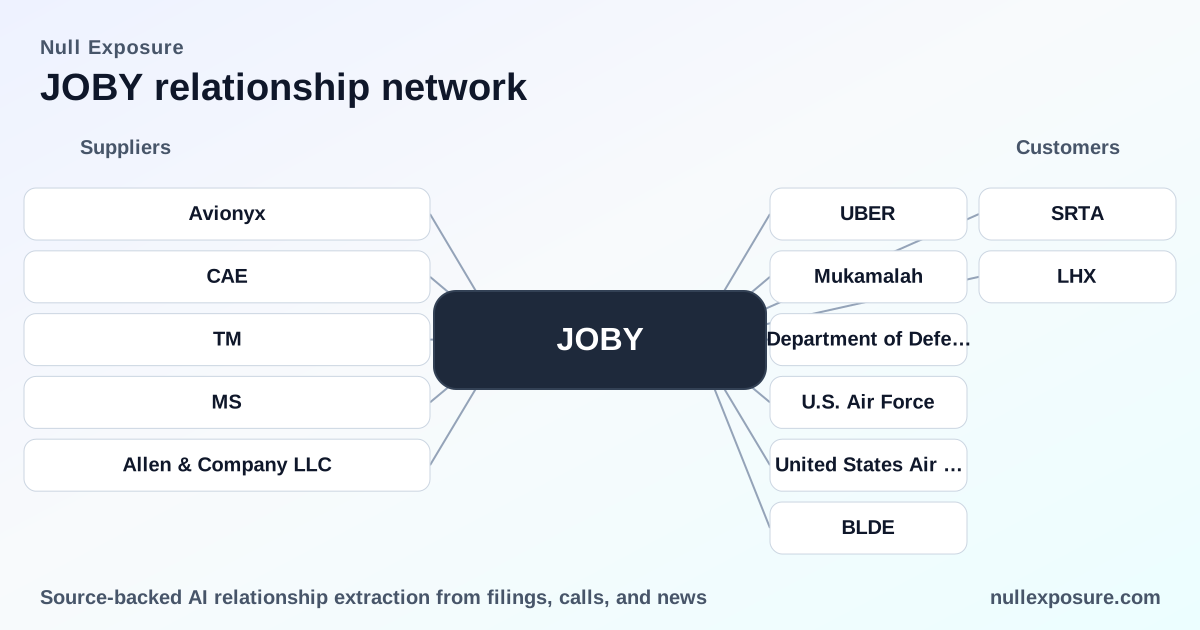
JOBY supplier relationships: who matters, what is at stake
Joby Aviation builds and plans to operate electric vertical take-off and landing (eVTOL) aircraft by combining in-house design and certification work with a small set of strategic external partners. The company monetizes through aircraft sales and a future air-taxi service model that depends on certified aircraft, trained pilots, and reliable, long-term component supply. Investors should evaluate Joby not just on technology progress but on supplier concentration, certification-critical relationships, and capital markets support that enable commercialization. Learn more background on supplier risk and counterparty exposure at https://nullexposure.com/.
How Joby’s operating model converts supplier ties into revenue capacity
Joby’s go-to-market requires three interlocking capabilities: certified flight software and systems, trained pilots and simulators, and repeatable production components. The supplier roster in recent disclosures reflects that architecture: software and testing partners support FAA certification; training partners secure operational scale; and industrial partners supply production-critical hardware under long-term arrangements. Financial relationships with underwriters and banks then provide near-term capital oxygen for production ramp and market launches.
Who Joby is working with — the relationship run-down
Avionyx — software testing partner turned acquisition
Joby first engaged Avionyx in 2021 for software testing and verification to support FAA flight-software requirements, and later announced an acquisition to embed that capability more tightly into certification programs. According to Joby’s FY2026 press materials, Avionyx had been under contract to assist with extensive review, analysis, and testing of onboard systems required for FAA certification. (Joby press release, March 2026)
CAE — simulator and pilot-training developer
Joby announced a partnership with CAE to develop and qualify flight simulation training devices that will be used to train commercially rated pilots for Joby’s eVTOL aircraft. This positions CAE as the training-platform supplier for Joby’s future operational rollout and underpins pilot pipeline reliability. (Joby press release on Part 135 certification, FY2026)
Toyota Motor Corporation — long-term manufacturer for powertrain and actuation
Joby signed a long-term agreement with Toyota to supply key powertrain and actuation components for Joby’s production aircraft, establishing Toyota as a manufacturer-level supplier for core hardware. According to Joby’s FY2026 communications, Toyota’s components are a production-critical input under a long-term supply contract executed in 2023. (Joby press release on first air-taxi flight in Japan; contract evidence referenced in FY2026 disclosure)
Morgan Stanley — lead underwriter and secondary-market participant
Morgan Stanley acted as a joint book-running manager for Joby’s public offering, and reporting around the same period highlights Morgan Stanley’s role in complex financing structures tied to the offering, including hedging and share-offloading arrangements connected to a related note issuance. Joby’s offering materials and market coverage in FY2026 document Morgan Stanley’s dual role on underwriting and hedging activity. (Joby press release on pricing of public offering; market reporting on the related note/hedge activity, FY2026)
Allen & Company LLC — co-manager on securities offering
Allen & Company LLC served alongside Morgan Stanley as a joint book-running manager on Joby’s public common-stock offering, providing syndicate support for capital raising during the FY2026 financing. Joby’s offering materials list Allen & Company in the underwriting group. (Joby press release on pricing of public offering, FY2026)
Operational constraints and what they signal for investors
Joby’s public disclosures surface several company-level operating characteristics that drive supplier risk and commercial execution.
-
Contracting posture — a mix of long-term manufacturing commitments and strategic partnerships. The Toyota engagement is an explicit long-term supply agreement for critical powertrain and actuation components signed in 2023, which signals deliberate supplier lock-in for production hardware rather than spot procurement. (Contract excerpt cited in FY2026 disclosures.)
-
Supplier roles and criticality — manufacturing and certification are distinct, mission-critical silos. Aircraft production depends on long-term component manufacturers, while certification depends on specialized testing and simulation partners such as Avionyx and CAE; both streams are critical path for revenue generation.
-
Concentration risk — a small set of deep partners drives execution. The current relationship map shows a concentrated supplier base for both hardware (Toyota) and certification/training (Avionyx, CAE), increasing single-counterparty impact on delivery schedules and costs.
-
Maturity and commercialization posture — moving from development toward operational readiness. The nature of contracts and certifications disclosed indicates a transition into production and commercial pilot training phases rather than purely R&D-stage engagements. This elevates the commercial significance of supplier performance and timing.
What these relationships imply for valuation and downside
-
Production dependency on Toyota is the clearest single-source risk. A long-term manufacturing agreement reduces supplier substitution risk but concentrates component delivery and quality risk with one partner; any disruption would directly affect production timelines and unit economics.
-
Certification partners are mission-critical for entry to service. Avionyx and CAE are directly tied to FAA certification and pilot readiness; failure to deliver certified software testing or qualified simulators delays revenue realization and increases cash burn.
-
Capital markets activity is actively supporting near-term liquidity needs. The underwriting and hedging actions involving Morgan Stanley and Allen & Company show Joby is using public markets to raise capital and manage financing risk, which investors should monitor for dilution and covenant exposure.
If you track counterparty concentration and certification timelines as primary risk vectors, you’ll find Joby’s supplier map and contracts essential inputs to any investment model. For a structured supplier exposure review and counterparty scoring, visit https://nullexposure.com/ to see how these variables are quantified.
Practical actions for investors and operators
- Stress-test cash flows against a delayed Toyota delivery schedule and a protracted FAA certification period; those two scenarios capture the most direct supply and revenue delivery risks.
- Monitor tranche releases and underwriting language in Joby’s financing documents for contingent hedging arrangements that can influence share supply and secondary-market dynamics.
- Track integration milestones for Avionyx and CAE deliverables as leading indicators for the company’s ability to meet pilot-training and certification checkpoints.
Learn how to build these stress tests into portfolio models at https://nullexposure.com/.
Bottom line
Joby’s supplier ecosystem reflects a clear strategy: lock long-term manufacturing for key components, embed certification capabilities through acquisition and partnerships, and rely on capital markets support to bridge commercialization. That structure accelerates scale if partners perform, but it concentrates execution risk in a small set of counterparties—chief among them Toyota for hardware and Avionyx/CAE for certification and training. Investors should weigh these supplier dependencies alongside technology and market assumptions when setting valuation and risk parameters.
For a deeper supplier-exposure analysis and ongoing monitoring tools, visit https://nullexposure.com/ and subscribe for updates.