St. Joe Company (JOE): How hotel operator partnerships drive value for a Florida real-estate platform
St. Joe Company builds, owns and operates mixed-use real estate in Northwest Florida and monetizes through land development, hospitality and residential asset sales, and ongoing property operations and management. The company leverages branded hotel partnerships to extract premium rents, accelerate project absorption and add amenity value to master-planned communities, translating development milestones into recurring income and episodic capital events. For an investor or operator assessing supplier counterparty risk and commercial leverage, the headline relationships with major hotel chains are critical evidence of distribution, brand alignment and project execution. Learn more about supplier intelligence and partner exposure at https://nullexposure.com/.
What the operating model looks like in practice
St. Joe is a developer-operator whose economics are a mix of one-time development gains and longer-duration operating cash flows. The company’s latest public metrics show $513m in trailing revenues, $194m EBITDA and a $4.09bn market capitalization, signaling a mid-cap real-estate operator with profitable operating margins (roughly 30% operating margin TTM). These numbers underline two structural characteristics relevant to supplier relationships:
- Contracting posture is project-driven and partnership-oriented. St. Joe executes discrete development projects and brings national hotel operators into those projects to provide branded hospitality components that increase land and residential values.
- Geographic concentration is high but counterparty concentration is low. The business is focused in Northwest Florida, so local demand and tourism cycles matter; conversely, St. Joe works with multiple large hotel operators rather than depending on a single brand.
- Commercial criticality is elevated for select assets. Branded hotels function as anchor amenities in resort and downtown projects; their presence materially affects leasing velocity and resident pricing.
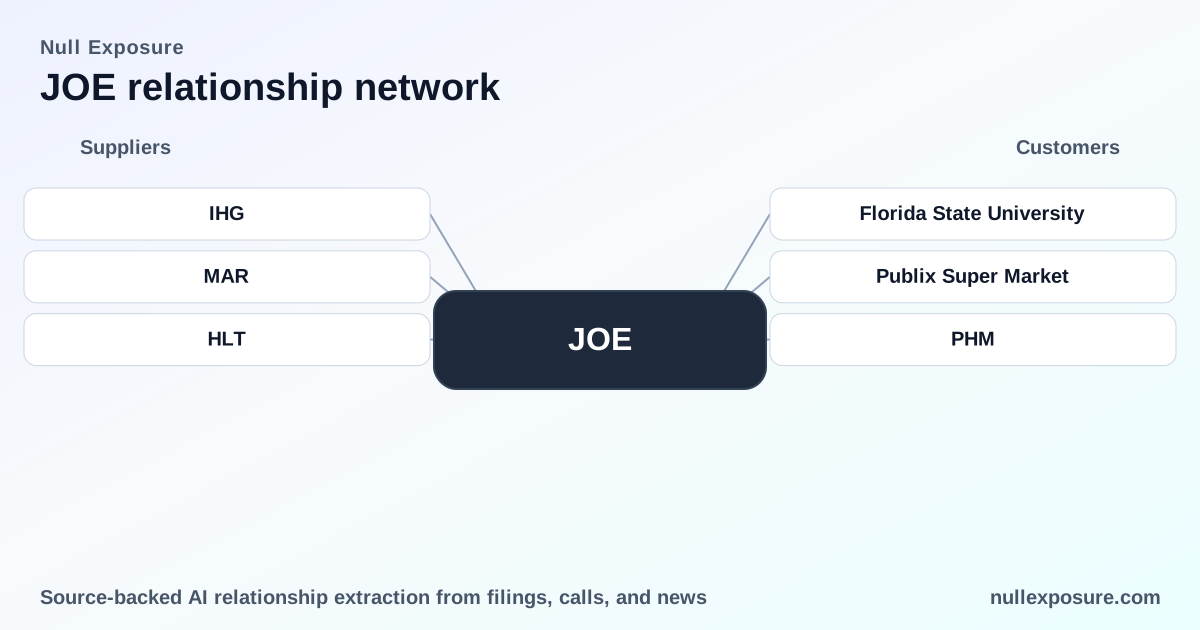
- Maturity and scale are sufficient to attract top-tier partners. Institutional-grade operators such as IHG, Marriott and Hilton executing openings on St. Joe land point to an established ability to deliver shovel-ready hospitality assets.
No supplier-related contractual constraints are disclosed in the available records for the supplier scope, which is a company-level signal that there are no public encumbrances or regulatory constraints reported against these supplier relationships.
The three hotel operator relationships and what they mean for investors
IHG Hotels & Resorts — Hotel Indigo Downtown Panama City Marina opened
St. Joe and IHG announced the opening of a 124-room Hotel Indigo Downtown Panama City Marina, which places an IHG boutique brand into St. Joe’s marina/downtown footprint and supports waterfront retail and residential pricing. According to a HospitalityNet announcement dated March 10, 2026, this opening enhances the mixed‑use value proposition for investors and elevates tourism demand in that micro-market.
Marriott — Residence Inn by Marriott cited as under construction
St. Joe is developing additional hospitality inventory including a Residence Inn by Marriott Panama City Beach, with other projects like Camp Creek Inn noted as under construction; these build-outs expand mid- to upper-tier lodging capacity that feeds both short-term visitors and long-stay demand tied to nearby residential product. A HospitalityNet release (March 10, 2026) references construction pipelines and planned opening timelines that support phased monetization of adjacent land parcels.
Hilton — Home2 Suites by Hilton Santa Rosa Beach opened
St. Joe and Hilton announced the opening of a 107-suite Home2 Suites by Hilton Santa Rosa Beach, inserting a Hilton extended-stay/upper-economy product into St. Joe’s resort cluster and helping to capture diverse traveler segments. HospitalityNet coverage on March 10, 2026 documents the opening, signaling successful execution of branded accommodation within the company’s coastal development corridors.
How these partnerships change the risk/reward equation
Branded hotel openings with IHG, Marriott and Hilton are value-accretive milestones for a developer like St. Joe, because they:
- Increase the attractiveness of surrounding residential and retail parcels through proven amenity delivery.
- Bring predictable operating partners with national distribution, which improves transient and group demand capture.
- Lower leasing risk for adjacent commercial tenants and support higher long-run rents.
Countervailing factors investors should weigh include geographic concentration in Northwest Florida, sensitivity to tourism cycles and construction execution risk. St. Joe’s valuation multiples—trailing P/E of ~36, EV/EBITDA ~19.3 and Price/Sales ~8—reflect a growth premium that necessitates consistent project delivery and stable hotel operating performance to justify the multiple compression risk.
If you want an operational deep dive on how branded hotel agreements affect capital recovery and leasing yields, visit https://nullexposure.com/ for supplier-level analysis.
Practical implications for contract and credit diligence
For funds and operators evaluating JOE as a counterparty or supplier, the presence of three independent global operators is a commercial positive: it reduces single-brand counterparty concentration and increases resale liquidity for developed assets. Due diligence should nonetheless focus on:
- The nature of each hotel arrangement (lease, management, franchise) and any revenue-sharing mechanics that impact cash flow capture.
- Timing and performance covenants tied to openings and occupancy thresholds.
- Local market demand elasticity given the company’s concentrated geography.
Because no supplier-specific constraints are recorded publicly, diligence can proceed without visible encumbrances but should validate contractual terms and any off‑balance-sheet obligations directly with company disclosures and counterparties.
Bottom line: what investors should act on
St. Joe’s branded-hotel relationships with IHG, Marriott and Hilton are strategic assets that enhance the company’s real-estate product mix and support higher-margin operating income over time. These partnerships diversify operator risk, accelerate monetization of land holdings and materially improve project economics, but investors must price in geographic concentration and execution risk given the company’s exposure to Northwest Florida tourism cycles. For ongoing monitoring and supplier-level insight, go to https://nullexposure.com/ to track counterparties, openings and contractual signals.
Key takeaway: branded hotel integrations are positive, measurable value drivers for St. Joe’s mixed-use strategy—confirm the contractual form and operating assumptions to translate those openings into durable cash flow expectations.