Johnson Outdoors (JOUT): Supplier posture, brand relationships, and what operators should price for
Johnson Outdoors designs, manufactures and sells outdoor leisure products across camping, diving, watercraft and marine-electronics categories and monetizes through branded product sales, authorized distribution and after-sale parts/accessories. The company's go-to-market is product-led: it develops or acquires brands, sells finished goods through retail and dealer channels, and captures recurring aftermarket revenue where durable equipment requires parts and service. Investors should value JOUT as a brand-and-product play with mid-single-digit operating leverage and exposure to leisure cycles rather than a pure commodity manufacturer. Learn more at https://nullexposure.com/.
How JOUT makes money and what that means for supplier risk
Johnson Outdoors’ revenue base was $625.7 million TTM with gross profit of $227.5 million and EBITDA of roughly $22.1 million, indicating modest absolute profitability and compressed operating margins. The business converts brand equity into sales: product development, manufacturing or contract manufacturing, and multi-channel distribution drive top-line realization, while aftermarket parts and accessories add margin stability. The company is asset-light relative to heavy industrial peers — margins and cash conversion reflect brand and distribution economics more than scale manufacturing advantages.
From an investor perspective, the key operating levers are brand health, channel mix (direct vs. retail/dealer), seasonal demand for leisure goods, and control of critical components and subcontractors. Johnson Outdoors trades at a market capitalization near $467 million with a forward P/E of 38.17 and a price-to-sales of ~0.75 — pricing that implies growth expectations but limited margin resilience today.
- Key financial signals: negative EPS (-$2.19 diluted), weak operating margin, but stable gross profit and meaningful institutional ownership (~75.8%) that indicates professional investor interest.
For additional supplier and relationship intelligence on JOUT, visit https://nullexposure.com/ for a deeper supplier mapping.
Supplier constraints and what they tell you about operating posture
Company-level disclosures flag low supplier concentration: the firm reported no suppliers that accounted for more than 10% of purchases. That is a structural signal about contracting posture and resilience:
- Concentration: Purchases are dispersed across vendors, reducing single-vendor procurement risk and giving Johnson Outdoors leverage in negotiations.
- Contracting posture: Distributed sourcing suggests standard commercial terms and the ability to substitute suppliers for non-specialized components; Johnson Outdoors likely negotiates multiple supplier relationships for commodity inputs.
- Criticality: While supplier concentration is low, product criticality remains—certain specialized components for marine electronics or diving equipment could still be single-sourced; absence of concentration on the purchase ledger does not eliminate functional single points of failure.
- Maturity: The disclosure of immaterial supplier concentration is consistent with a mature procurement program that tracks vendor spend and mitigates vendor concentration.
These constraints operate as company-level signals; they are not tied to any single supplier relationship unless the company explicitly names that vendor in the disclosure. For procurement and risk modeling, treat supplier concentration as an advantage but verify the supply chain for specialized subcomponents used in high-value SKUs.
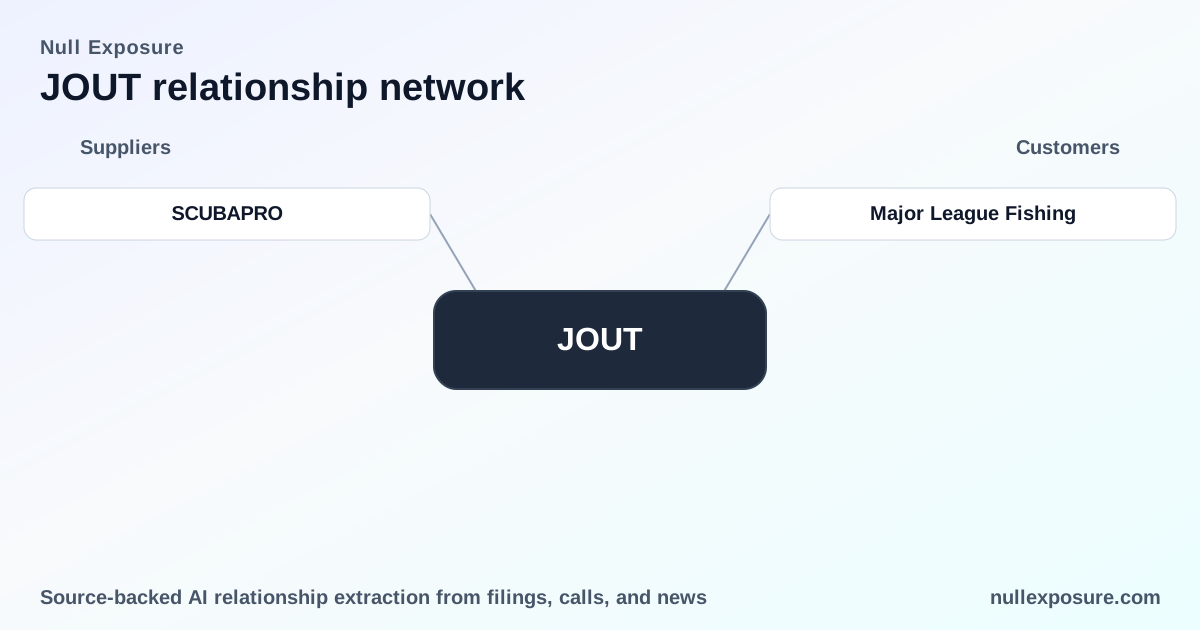
The relationship you need to know: SCUBAPRO
The Diving segment sells and distributes the SCUBAPRO brand as part of Johnson Outdoors’ product portfolio. According to the company profile on CNN Markets referencing FY2023, the Diving business is the channel through which SCUBAPRO-branded diving equipment is marketed and moved through dealer networks. (CNN Markets company page for JOUT, first noted March 2026.)
This is a commercial relationship internal to Johnson Outdoors’ portfolio: SCUBAPRO is a brand distributed by the Diving segment rather than an external supplier on which JOUT depends for raw materials. The practical implication: SCUBAPRO acts as a revenue-bearing asset, not a procurement counterparty, so its performance is measured in sales, gross margins and aftermarket attachment rather than supplier delivery risk. Source: CNN Markets (JOUT company page), FY2023 / first seen March 10, 2026.
What operators and investors should price into models
Operational and balance-sheet decisions should reflect these facts:
- Low supplier concentration lowers supply-side tail risk. Use a conservative but not punitive supply-disruption premium when stress-testing margins.
- Brand concentration and product criticality require margin protection. Even with dispersed suppliers, the business depends on brand health (SCUBAPRO in diving, other legacy brands in marine and camping); model scenarios should test a revenue decline of 10–20% in the most cyclical segments.
- Earnings recovery is the key value driver. With EBITDA near $22 million and negative EPS, valuation upside requires margin improvement, either through mix shift to higher-margin accessories/service, price realization, or cost reduction in manufacturing.
- Channel risk is real. Retail/dealer dynamics and seasonal inventory cycles influence working capital; forecast cash conversion and inventory turns tightly.
For procurement teams and operators, prioritize mapping for any specialized electronic components or life-safety parts in diving and marine electronics — these are the elements where supplier substitution is most difficult, even if aggregate supplier concentration is low.
If you want a full supplier risk profile and contract-level view to stress-test JOUT, see our mapping and supplier scoring at https://nullexposure.com/.
Final read and recommended actions
Johnson Outdoors is a brand-driven leisure manufacturer with dispersed supplier spending and modest current profitability. From a supplier-risk standpoint the company benefits from low vendor concentration, but investors must price in cyclical demand and the need for margin recovery. For operators, the critical next steps are rigorous bill-of-materials mapping for specialized SKUs and margin-focused channel management.
- Action for investors: stress-test models for margin recovery and brand resilience; prioritize scenarios where aftermarket revenue and parts drive margin expansion.
- Action for operators: validate alternate suppliers for specialty components and formalize inventory buffers for seasonal peaks.
For a deeper supplier and contract-level audit of JOUT and comparable leisure manufacturers, visit https://nullexposure.com/ — the platform provides relationship mapping and procurement intelligence designed for investors and operators.