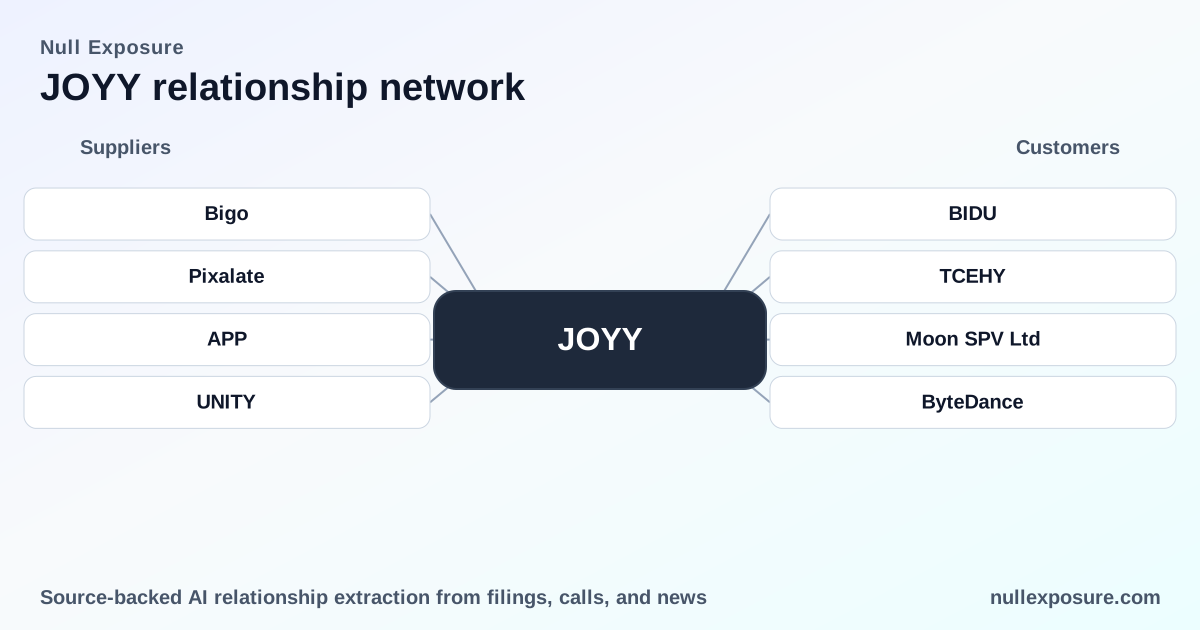
JOYY Inc.: Supplier relationships that power BIGO Ads and international growth
JOYY operates live-streaming and short-video platforms and monetizes primarily through in-app commerce, virtual gifts, and an expanding ad-tech stack that monetizes platform attention. The company owns the BIGO family of apps (the principal international distribution channel), has been scaling non-livestreaming ad revenue, and increasingly monetizes third-party inventory via mediation partnerships and fraud-monitoring integrations that boost ad quality and yield. For a concise vendor risk and opportunity readout, visit https://nullexposure.com/.
Why these supplier ties matter for revenue and margin
JOYY’s business model is twofold: content and commerce through its owned platforms, plus an ad-tech layer that converts scale into incremental advertising revenue. The 2025 operating narrative is clear — live streaming remains core, while BIGO Ads is ramping non-livestreaming ad revenue, delivering measurable top-line lift and improving operating leverage for the group. JOYY’s fiscal profile (Revenue TTM ~$2.12bn; EBITDA ~$147m) shows a company in transition from pure platform monetization to hybrid ad-tech operator, and the supplier relationships under discussion are directly material to monetization quality and growth.
From a contracting and operational posture standpoint, JOYY is vertically integrated where necessary (it owns Bigo) and selectively dependent on third-party ad partners for distribution and traffic quality. That posture reduces some vendor risk (owned distribution) while concentrating commercial risk in a smaller set of ad-tech partners whose integrations determine fill rates and CPMs. Our records show no flagged supplier constraints for JOYY, which is a company-level signal of no documented contract disputes or supply-side bottlenecks in our coverage — a suggestive indicator of operational maturity in supplier management.
Explore supplier intelligence and supplier risk dashboards at https://nullexposure.com/ for deeper vendor-by-vendor analysis.
Relationship rollcall — the partners that matter today
Bigo
JOYY acquired Bigo in 2018 for USD 2.2 billion, and Bigo is the primary international product family that underpins JOYY’s ad inventory and audience reach. A KR-Asia profile covering leadership developments referenced the 2018 acquisition and the centrality of Bigo to JOYY’s international strategy (KR-Asia coverage, March 2026).
Pixalate
BIGO Ads deepened an anti-fraud and transparency partnership with Pixalate to improve traffic quality and buyer confidence, bolstering the integrity of the third-party inventory JOYY monetizes. That commercial expansion was announced in a press summary published January 30, 2026, highlighting Pixalate’s role in monitoring invalid traffic for BIGO Ads (Sahm Capital press item, Jan 30, 2026).
AppLovin (APP)
JOYY reported that BIGO Ads has scaled third-party audience network traffic through integration with AppLovin MAX, extending monetization channels and increasing demand-side competition for ad placements. This integration is documented in JOYY’s second-quarter 2025 financial release, which described successful AppLovin MAX integration as a contributor to ad-tech growth (JOYY Q2 2025 press release, PR Newswire).
Unity (UNITY)
JOYY also integrated Unity LevelPlay mediation, enabling BIGO Ads to tap additional demand sources and optimize ad fill and pricing across mobile inventory. JOYY disclosed this mediation integration as part of its Q2 2025 ad-tech update, underscoring Unity’s role in scaling third-party traffic for BIGO Ads (JOYY Q2 2025 press release, PR Newswire).
What these relationships mean for investors — levers and risks
These supplier relationships convert into distinct operational levers:
- Revenue quality: Pixalate’s fraud monitoring increases buyer confidence, directly defending CPMs and advertiser spend. This is a quality-of-revenue signal.
- Scale and yield: Mediation with AppLovin MAX and Unity LevelPlay increases demand-side competition for ad slots and unlocks additional third-party inventory, which feeds BIGO Ads’ audience network and drives non-livestreaming revenue growth that JOYY reported in 2025.
- Control vs. dependence: Ownership of Bigo gives JOYY control of the user base and product roadmap, reducing dependency on platform suppliers, but the company is dependent on ad-tech partners for distribution and yield optimization of third-party inventory.
Key investor takeaways:
- Strength — diversified ad demand sources: Integrations with major mediation platforms reduce single-partner concentration and increase monetization options.
- Strength — active fraud controls: The Pixalate partnership is a direct response to institutional buyers’ demand for traffic transparency and protects ad pricing.
- Risk — reliance on ad ecosystem: Ad-tech integrations are material to growth; operational or commercial frictions with mediation or DSP partners would compress near-term ad revenue upside.
Tactical signals and company-level constraints
Our supplier capture shows no listed constraints against JOYY in this coverage window, which is a company-level signal of stable supplier relations and no reported supplier-imposed limits on capacity, licensing, or access. Combine this with JOYY’s institutional ownership (~65% institutions) and modest insider ownership (~2.6%), and the corporate profile signals an established, governance-conscious operator with an institutional investor base that expects predictable supplier management.
Practical next steps for investors and operators
- Monitor minutes and earnings commentary for pacing of non-livestreaming ad revenue and any new mediation or exchange partnerships that would further diversify demand.
- Watch third-party fraud metrics and buyer feedback after Pixalate’s implementation; sustained improvement in traffic quality will be a lead indicator of better CPM persistence.
- For operators and suppliers, explore partnership opportunities with JOYY’s ad stack where inventory scale aligns with demand — JOYY is actively expanding mediation and verification relationships.
For a deeper supplier risk assessment or to benchmark JOYY against peer vendor networks, visit https://nullexposure.com/ for enterprise-grade exposure analysis and supplier intelligence.
Bottom line
JOYY’s supplier roster — led by owned distribution (Bigo) and complemented by mediation partners (AppLovin, Unity) and fraud monitoring (Pixalate) — is structured to convert audience scale into higher-quality, more diversified ad revenue. That configuration materially upgrades JOYY’s monetization profile as it shifts towards non-livestreaming ad growth; investors should watch integration execution and traffic-quality metrics as the principal short-to-medium-term performance drivers. For ongoing tracking and supplier-level alerts, return to https://nullexposure.com/.