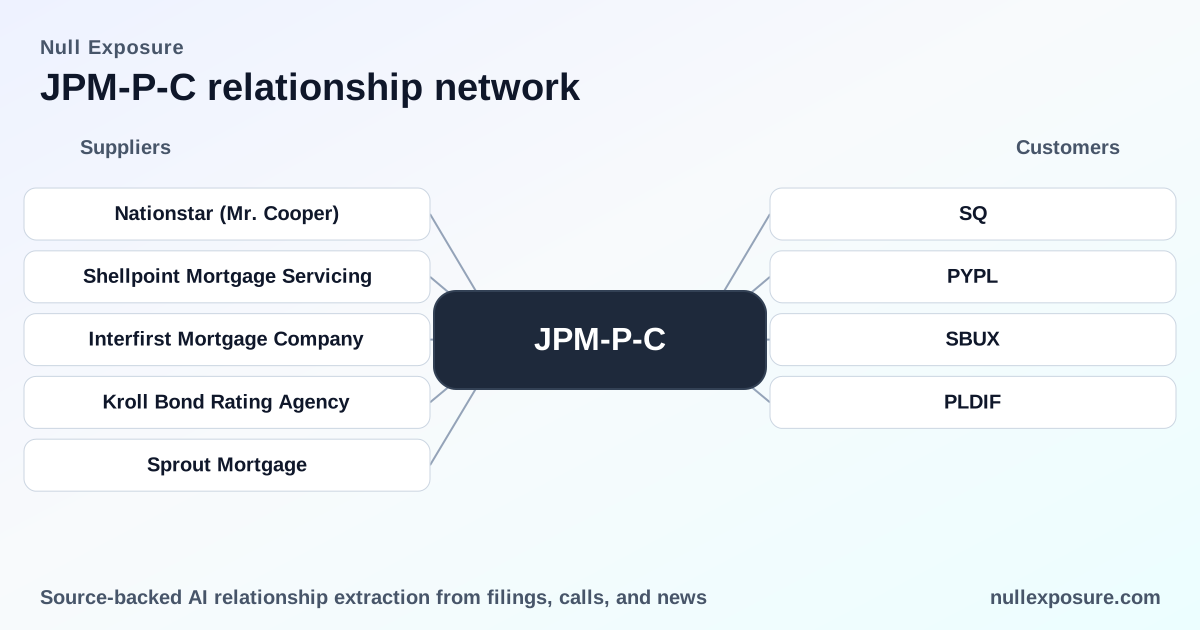
JPM-P-C: What JPMorgan’s supplier map around a DSCR MBS deal tells investors
JPM-P-C is a preferred security that represents ownership in JPMorgan Chase & Co., a global universal bank that monetizes through net interest income, fee-based investment banking and asset management, custody and treasury services, and principal markets activities. In the context of non-agency mortgage securitizations, JPMorgan acts as sponsor and arranger: it sources and packages loans, retains structural roles, and relies on external originators and servicers to populate and operate collateral pools — capturing underwriting and structuring fees while managing balance-sheet and reputational risk. For a concise view of supplier counterparties tied to a recent DSCR MBS execution, see Null Exposure’s research hub: https://nullexposure.com/.
Market takeaways up front: JPMorgan’s DSCR conduit model is execution-led and externally sourced, using third-party originators and servicers with targeted credit enhancement (including representation & warranty coverage) for selected originations. That model preserves balance-sheet flexibility while exposing the bank to operational and counterparty performance risk on the collateral stack.
Why this transaction matters to investors: distribution, control, and risk allocation
JPMorgan’s entry into DSCR MBSs is a strategic expansion of its securitization engine into cashflow-driven single-family rental and investment property loans. The structure demonstrates three important operating-model characteristics:
- Contracting posture: JPMorgan acts as arranger and sponsor, contracting with third-party originators and servicers rather than internalizing all production — a deliberate outsourcing posture that focuses the bank on structuring, distribution, and credit overlays.
- Concentration and diversification: The counterparties named around this deal are multiple and functionally specialized, indicating a distributed sourcing approach that reduces single-vendor concentration risk at the originator/servicer layer.
- Criticality and maturity: Servicers and originators are operationally critical for ongoing loan performance; reputationally and legally, JPMorgan retains control levers (e.g., representation & warranty coverage) to backstop specific production lines, which is consistent with an incumbent bank’s conservative risk management stance.
If you are modelling counterparty exposure across securitization pipelines, this supplier set is a useful example of how a Bulge-Bracket bank outsources originations while retaining sponsor economics and credit-triggered obligations. For a broader supplier-risk view, visit https://nullexposure.com/.
What the coverage uncovered — the counterparties named in the HousingWire report
Below are plain-English summaries of every relationship captured in the reporting on JPMorgan’s 2022 DSCR trust, with source references.
Nationstar (Mr. Cooper)
Nationstar (operating as Mr. Cooper) is identified in the deal as the master servicer, a role that centralizes pool administration and investor reporting responsibilities. According to HousingWire’s March 10, 2026 coverage, Nationstar/ Mr. Cooper functions as the master servicer for the trust, handling oversight above the primary servicer layer.
Source: HousingWire, March 10, 2026.
Shellpoint Mortgage Servicing
Shellpoint Mortgage Servicing (a division of NewRez) is listed as the primary servicer, responsible for day-to-day borrower interactions and payment collection on the loans in the pool. HousingWire reports Shellpoint as the primary servicer on the transaction documentation cited in the deal notice.
Source: HousingWire, March 10, 2026.
Interfirst Mortgage Company
Interfirst Mortgage Company is documented as an originator, having contributed an identifiable slice of the collateral — about 11% of the loan pool by count or volume as noted in the reporting. This signals that JPMorgan aggregated production from multiple originators to construct the collateral stack.
Source: HousingWire, March 10, 2026.
Kroll Bond Rating Agency (KBRA)
Kroll Bond Rating Agency produced the presale report referenced in the coverage, stating that JPMorgan Mortgage Trust 2022-DSC1 is secured by 980 DSCR loans with an aggregate balance near $308.2 million. KBRA’s presale rating work supplies the investor-facing credit view that underpins distribution.
Source: HousingWire summarizing KBRA presale report, March 10, 2026.
Sprout Mortgage
Sprout Mortgage is an originator in the collateral mix for which JPMorgan provided representation and warranty coverage, according to analytical notes cited in the housing report; this indicates sponsor-level credit support for third-party production. HousingWire relays KBRA analysts’ comment that JPMorgan backed loans originated by Sprout with such contractual coverage.
Source: HousingWire, March 10, 2026.
Constraints and company-level signals investors should track
The supplier-relationship capture for JPM-P-C did not produce any explicit vendor constraint entries in the reviewed records; that absence is itself a company-level signal. In practice, the lack of formal constraints recorded against supplier relationships indicates two things for an investor evaluating counterparty exposure:
- Operational posture is decentralized: JPMorgan sources production from multiple third parties and uses contractual credit overlays (e.g., rep & warranty) selectively, rather than locking supplier engagement into rigid single-vendor dependencies.
- Maturity and governance are incumbent-led: As a global universal bank, JPMorgan drives governance via its sponsorship role and rating-presale processes rather than through vendor-exclusive constraints captured in supplier registries.
Monitor filings and presale reports (KBRA, S&P, Moody’s) for any changes to servicing agreements, replacement provisions, or concentration disclosures that could alter counterparty risk.
Key investment implications and risks
- Sponsor economics with counterparty operational exposure. JPMorgan captures structuring and distribution revenue while outsourcing loan production and servicing — this model is revenue-efficient but dependent on third-party operational performance.
- Credit overlays reduce tail risk but create contingent obligations. Representation and warranty coverage for specific originators transfers some downside back to the sponsor; investors should quantify potential contingent liabilities when modeling preferred-security credit exposure.
- Diversified originator set lowers single-point failure risk. Multiple named originators and servicers in the deal indicate a deliberate diversification strategy at the asset-sourcing layer.
For deeper supplier-exposure analysis across the JPMorgan ecosystem, visit Null Exposure’s research center at https://nullexposure.com/.
Final read: what investors should do next
- Review presale rating reports (KBRA and peers) and the deal’s pooling & servicing agreement to map servicing waterfalls and rep & warranty triggers.
- Monitor servicer performance metrics and any public notices from Mr. Cooper and Shellpoint on servicing transfers or material operational incidents.
- Revisit counterparty concentration in subsequent deals; continuation of the multi-originator sourcing pattern reduces systemic operational risk.
Null Exposure maintains ongoing coverage and supplier intelligence for financial institutions and their structured-finance conduits — explore our platform for supplier-level detail and counterparty monitoring: https://nullexposure.com/.
Key takeaway: JPMorgan’s DSCR MBS execution leverages third-party originators and servicers while the bank retains sponsor controls and credit overlays — an execution model that balances fee generation with contingent operational and credit obligations.