JPM-P-J: What JPMorgan’s supplier relationships in blockchain tell investors
JPMorgan Chase & Co. operates as a universal bank and monetizes through diversified financial services: commercial and investment banking, custody and treasury services, asset and wealth management, and client-facing transaction banking. The preferred stock ticker JPM-P-J reflects a claim on the enterprise cash flows that are generated by these core franchises; crucial to that cash generation is the bank’s ability to integrate and contract with technology and infrastructure suppliers that enable new product capabilities and client services. For investors focused on supplier risk and strategic optionality, JPMorgan’s recent partnerships with blockchain firms represent tactical moves to expand settlement rails and crypto client services without building every capability in-house. Learn more about supplier exposures and signals at https://nullexposure.com/.
Why supplier relationships in crypto and payments matter to JPM-P-J holders
JPMorgan is executing a hybrid operating model: it retains control of client relationships and balance-sheet functions while selectively outsourcing or partnering for specific infrastructure and innovation. That model reduces time-to-market for new services, diversifies vendor risk, and concentrates operational criticality on a small set of specialized technology partners. For preferred shareholders, the implication is that strategic suppliers can materially influence product adoption, fee generation, and operational resiliency — all of which flow to the firm’s earnings power and preferred dividend coverage.
Supplier relationships uncovered in the record
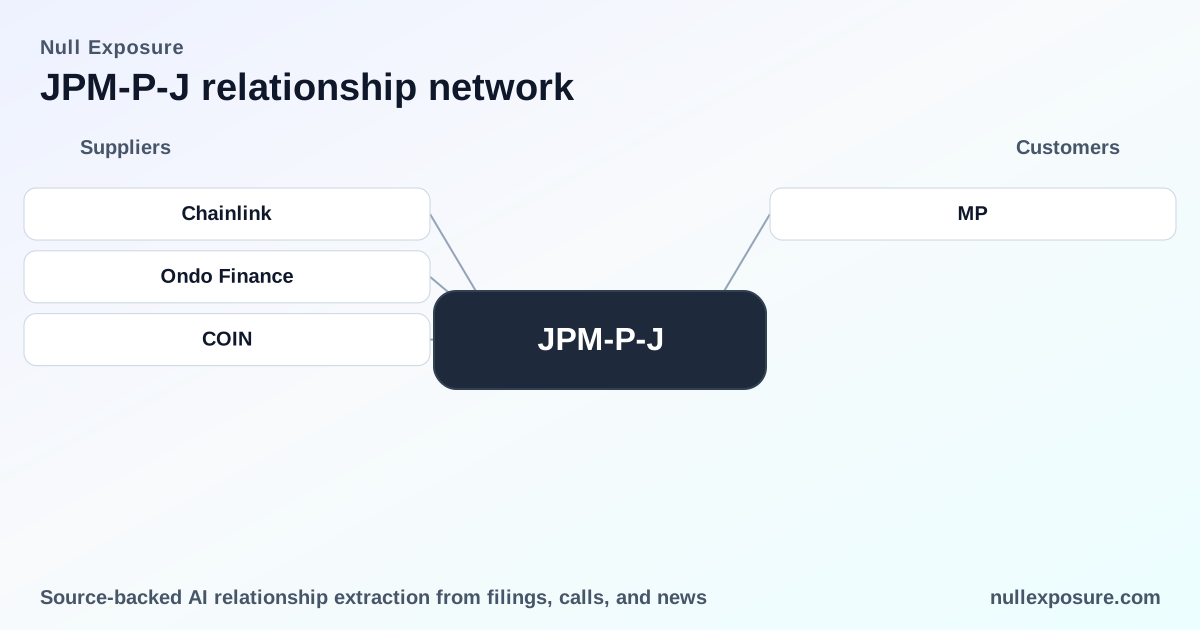
Below are the supplier relationships identified in public reporting and news for FY2025. Each relationship is summarized in plain English with source context.
Chainlink
JPMorgan used Chainlink as the communication protocol to trigger blockchain-based payments, enabling off-chain data to inform transactions on its private ledger. According to Fortune’s coverage of May 2025, Chainlink’s oracles were relied upon to let JPMorgan’s blockchain process outside information for payment events. (Fortune, May 2025)
Ondo Finance
JPMorgan’s blockchain division, Kinexys, executed a transfer between two accounts on a private blockchain to settle the purchase of tokenized treasuries on Ondo Finance’s public ledger, demonstrating cross-ledger settlement mechanics. Fortune reported this activity in May 2025 as part of JPMorgan’s work integrating private and public ledger settlement flows. (Fortune, May 2025)
Coinbase
JPMorgan expanded client-facing crypto capabilities through partnership activity that includes work with Coinbase, reflecting a broader push into crypto custody and trading services for institutional clients. Cointelegraph reported in FY2025 that strategic ties with Coinbase form a key component of JPMorgan’s more expansive approach to crypto and blockchain that year. (Cointelegraph, FY2025)
What these relationships tell investors about JPMorgan’s operating posture
- Contracting posture: JPMorgan is pursuing a partnership-first approach for blockchain services — leveraging third-party specialists rather than building every capability internally. This indicates a deliberate, modular contracting strategy that accelerates client product rollout while preserving core balance-sheet control.
- Concentration and criticality: The bank’s engagements with specialized providers increase criticality for those partners because they underpin specific service rails (e.g., oracle feeds, tokenized asset settlement, crypto custody/trading channels). When a supplier supports a unique capability that JPMorgan does not replicate, operational concentration rises.
- Maturity and cadence: Relationships described in FY2025 reflect a transition from experimentation to conditional production uses — private blockchain settlement integrated with public-ledger counterparties and client-facing exchange ties. That progression signals increasing maturity of supplier integrations.
- Company-level constraints signal: The supplier-scope record contains no explicit constraints entries. The absence of recorded contractual constraints in the dataset is itself a company-level signal: it indicates no public, supplier-specific restriction surfaced in the reviewed results, which investors should interpret alongside external regulatory and operational disclosures.
For a deeper look at supplier exposures across providers and to track new relationship signals, visit https://nullexposure.com/.
Risk vectors investors must price
These supplier relationships introduce several material considerations that affect preferred claimholders:
- Operational dependency risk: When JPMorgan routes settlement or payment logic through third-party blockchain protocols, any supplier outage or integration defect can delay revenue realization and stress treasury operations.
- Concentration risk: A small number of specialized partners can be single points of failure for new services, raising the importance of vendor redundancy and contractual SLAs.
- Regulatory and compliance risk: Partnerships in crypto and tokenization increase regulatory scrutiny — legal or supervisory actions against a supplier or the underlying technology could constrain product deployment or force costly remediation.
- Strategic execution risk: Using external providers speeds deployment but can limit JPMorgan’s control over future product economics and roadmap, potentially shifting margins or competitive advantage.
How investors should incorporate this into JPM-P-J analysis
- Revisit preferred dividend coverage assumptions with an overlay for revenue and fee sensitivity tied to payments, custody, and tokenization services.
- Monitor supplier concentration metrics and public SLA/contract disclosures in subsequent filings or news — the marginal impact of a vendor issue is higher where the bank has outsourced a non-redundant capability.
- Track regulatory developments around tokenized securities and oracle services globally, as enforcement or rule changes will affect the profitability and risk calculus of these supplier-integrated products.
If you want ongoing supplier-monitoring and supplier-exposure intelligence for preferred-security investors, explore our coverage and methodology at https://nullexposure.com/.
Bottom line and actionable steps for operators and investors
JPMorgan’s FY2025 supplier footprint in blockchain shows a clear strategic choice: partner to scale new capabilities while keeping core balance-sheet roles internal. That delivers faster product rollout and client access, but it also concentrates operational and regulatory risk on a set of specialized suppliers whose health and governance matter for earnings stability.
Recommended actions:
- For investors: stress-test cash flow models for supplier disruption and adjust yield-hunt assumptions to reflect execution and regulatory risk.
- For operators and risk teams: ensure vendor SLAs, redundancy planning, and compliance controls are documented and stress-tested for each critical blockchain supplier.
For continuous updates on supplier relationships and to benchmark vendor criticality across financial institutions, visit https://nullexposure.com/.