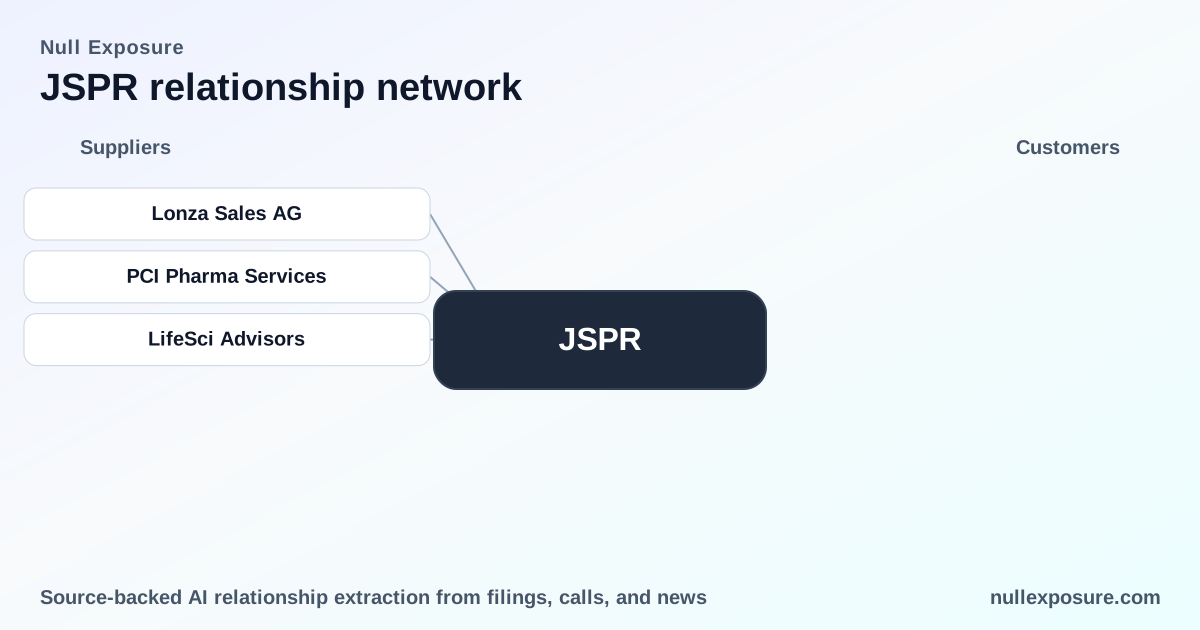
Jasper Therapeutics (JSPR) — Supplier Relationships, Operational Constraints, and Investor Takeaways
Jasper Therapeutics is a clinical-stage biopharmaceutical company that advances briquilimab through outsourced development, manufacturing and commercialization support; the company’s economic model depends on progressing clinical programs to regulatory approval and then monetizing through product sales, partnerships or licensing while relying on third-party providers for manufacturing, packaging and investor communications. Revenue realization is contingent on successful clinical advancement and uninterrupted supplier performance, so counterparty strength and contract terms are direct drivers of value realization for investors.
Explore more supplier intelligence and tracking at https://nullexposure.com/ to monitor counterparty changes and contractual risk.
What the supplier footprint says about how Jasper operates
Jasper does not operate owned manufacturing capacity and runs a predominantly outsourced operating model. The company has long-term development and manufacturing agreements with at least one major CMO, uses specialized service providers for labeling/packaging and external investor relations firms for public communications. That structure implies a contracting posture favoring formal, long-dated CMO relationships, high concentration in manufacturing, and a reliance on external service maturity rather than in-house scale.
Key company-level signals drawn from public disclosures:
- Concentration and criticality: Jasper discloses reliance on a single manufacturer for clinical supply, which elevates operational risk if that supplier suffers compliance, capacity or quality issues. This is a company-level materiality signal that investors must treat as a primary operational risk.
- Contracting posture: Jasper executes long-term development and manufacturing agreements where feasible, indicating preference for committed capacity and formal quality testing arrangements.
- Service orientation and maturity: The business model is service-heavy—CROs, CMOs, and specialized providers perform clinical, manufacturing and packaging functions—reflecting a mature outsourcing approach but limited owned manufacturing capability.
- Spend profile: Public filings show a mix of advisory-level spend (hundreds of thousands of dollars) and mid-single-digit millions on critical IT/service infrastructure, indicating selective high-value supplier engagements alongside smaller professional relationships.
Lonza Sales AG — the manufacturing backbone
According to Jasper’s FY2024 10‑K, the company entered into development and manufacturing agreements with Lonza in November 2019 specifically for the manufacturing of briquilimab and for product quality testing. Lonza functions as a third‑party manufacturer (CMO) handling key production and quality activities. (Source: Jasper Therapeutics FY2024 10‑K filing.)
Takeaway: Lonza is a long‑term, active CMO partner responsible for material production and quality testing, making it a strategic counterparty for the program.
PCI Pharma Services — packaging, labeling and logistics
Jasper’s FY2024 10‑K states that labeling, packaging and storage of finished drug product are provided by PCI Pharma Services in San Diego, California. PCI acts as the distribution/packaging service that supports finished‑product readiness for clinical or eventual commercial distribution. (Source: Jasper Therapeutics FY2024 10‑K filing.)
Takeaway: Packaging and storage are outsourced to a specialized provider, reducing Jasper’s operational footprint but adding dependency on a separate logistics partner for product integrity and supply chain continuity.
LifeSci Advisors — investor communications and IR support
A Globenewswire press release dated January 8, 2026 lists LifeSci Advisors as an investor contact for Jasper’s briquilimab study update, indicating the use of an external investor relations or communications firm to manage media and investor outreach. (Source: Globenewswire press release, January 8, 2026.)
Takeaway: External IR support is in use for public communications, which is standard for clinical-stage companies and important for market messaging and investor relations execution.
Explore supplier risk dashboards and contract monitoring at https://nullexposure.com/ to maintain continuous visibility into these counterparties.
How these relationships translate into investor risk and value drivers
- Single‑source manufacturing is a core enterprise risk. The company’s disclosure that it relies on a single manufacturer for clinical supply elevates the probability that any disruption—regulatory non‑compliance, capacity constraints, or quality issues—will delay development timelines and defer revenue prospects. This is a structural risk that investors must price into valuation and scenario models.
- Long-term CMO contracts signal both stability and lock‑in. Long‑dated agreements with Lonza secure capacity and quality oversight, which supports program continuity, but they also create negotiation and flexibility constraints if the company needs to pivot suppliers for scale or cost reasons.
- Service diversification is limited to specialized functions. PCI Pharma Services and other CRO/CMO arrangements cover packaging and clinical trial support, leaving Jasper dependent on third parties for mission‑critical execution rather than internal redundancy.
- Spend concentration shows targeted outsourcing investment. Public filings reference advisory payments in the low hundreds of thousands and IT service payments in the low millions, which indicates selective allocation of external spend rather than broad outsourcing at scale.
Practical steps investors and operators should watch
- Monitor regulatory inspections and quality reports for Lonza and PCI. Any FDA or EMA biotech manufacturing notices will have outsized impact on timelines and valuation.
- Assess contract terms for supply guarantees and capacity reservations. Long‑term agreements are beneficial only if they include explicit capacity, change‑of‑control, and contingency clauses.
- Insist on dual‑sourcing or validated tech transfer timelines for commercial readiness. Transition plans and second‑source validation reduce the single‑supplier shock risk.
- Track communications cadence and IR engagement. Effective public messaging via firms such as LifeSci Advisors influences investor sentiment during key data releases.
For targeted supplier due diligence and continuous monitoring solutions, visit https://nullexposure.com/ and review supplier dossiers and contract signals.
Bottom line for investors
Jasper’s supplier footprint is conventional for a clinical‑stage biotech: outsourced manufacturing to a named global CMO (Lonza), specialized packaging and storage to PCI Pharma Services, and external IR support. The principal investment consideration is the operational concentration around a single manufacturer, which creates a binary outcome pathway—on‑time manufacturing and regulatory compliance unlock value; supplier disruption delays or derails monetization. Investors should underwrite scenarios for both capacity continuity and supplier failure, negotiate covenant protections in any financing that references supply continuity, and demand transparent supplier KPIs from management.
Maintain active monitoring of these counterparties and contract terms; secure supply‑chain intelligence at https://nullexposure.com/ to convert supplier visibility into better investment decisions.