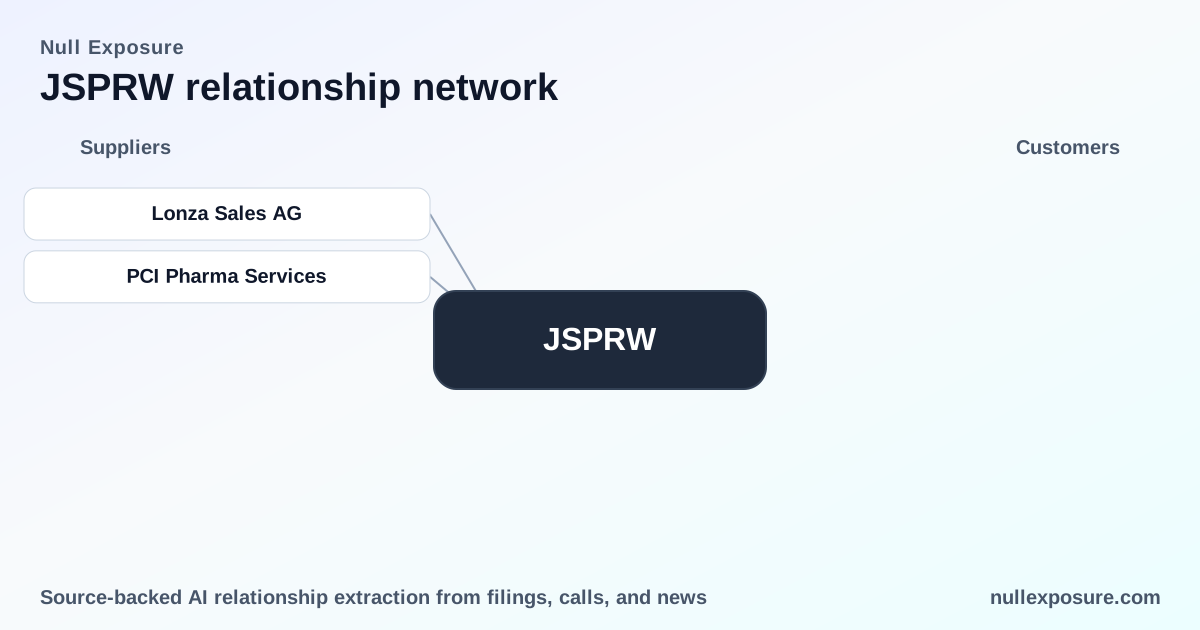
JSPRW supplier relationships: Lonza and PCI Pharma Services — where the supply chain concentrates risk and value
Thesis — JSPRW operates as an asset‑light clinical‑stage biotechnology company that develops briquilimab and outsources nearly all manufacturing, packaging and infrastructure functions to third parties. The firm monetizes through drug development and eventual product commercialization or licensing, while its economics and execution hinge on a small set of external suppliers and licensed intellectual property. For an investor or operator, the key decision is whether the outsourced model and supplier concentration are compensated by clinical progress and enforceable licensing terms. Learn more about supplier intelligence and diligence at https://nullexposure.com/.
Asset‑light, license‑dependent business model — what investors need to know
JSPRW’s filings make the operating model explicit: the company depends on third‑party patents and licensed know‑how for its product development, and it does not own manufacturing facilities. Those characteristics create a contracting posture that is: license‑centric, highly outsourced, and concentrated.
- Contracting posture and IP dependence: The company states it is dependent on patents, know‑how and proprietary technology licensed from third parties for the development and commercialization of briquilimab, establishing licensing as a core contractual modality for product viability (FY2024 Form 10‑K).
- Concentration and criticality: The company confirms reliance on a single manufacturer for clinical supply; loss or regulatory failure by that manufacturer is defined as a critical business risk in the 2024 10‑K.
- Service orientation and maturity: Multiple vendor roles are active — from clinical CROs to IT and packaging — indicating an operating profile that is service‑provider reliant rather than capital‑intensive. Spend notes show modest but non‑negligible vendor fees consistent with a small‑company outsourcing model (FY2024).
These signals point to a company where operational continuity, supplier qualification and licensing rights are principal drivers of near‑term value.
The supplier list and what each relationship implies for execution
Lonza Sales AG — single‑source manufacturer for briquilimab
Lonza is engaged under development and manufacturing agreements for briquilimab and product quality testing; the 10‑K identifies Lonza as a third‑party manufacturer and a single‑source supplier for clinical materials. This makes Lonza a critical execution node: any manufacturing disruption or cGMP non‑compliance at Lonza would directly imperil clinical supply and timing. (According to the company's FY2024 Form 10‑K filing.)
PCI Pharma Services — labeling, packaging and storage in San Diego
PCI Pharma Services provides labelling, packaging and storage of finished drug product at its San Diego facility, supporting the company’s clinical and finished‑product operations. This relationship supports commercial readiness and supply chain handling but is peripheral to active drug substance manufacture. (According to the company's FY2024 Form 10‑K filing.)
What the constraints tell us about operational risk and governance
The 10‑K and related disclosures surface several company‑level constraints that shape supplier strategy and risk management:
- Licensing dominates product dependency. The company explicitly states dependence on licensed patents and know‑how for briquilimab development and commercialization, making contractual IP protections and license longevity critical to valuation (FY2024 10‑K).
- Founders and individual contractors are material to operations. The company disclosed consulting agreements with two founders (one a Board member) who received founders’ common stock and assigned patents; advisory compensation is immaterial in absolute dollar terms but relevant for governance and IP assignment questions (FY2024 10‑K).
- Supplier roles skew to service providers and CMOs. Multiple excerpts identify use of CROs, contract laboratories, IT service providers and CMOs for trials, infrastructure and manufacturing — a mature outsourcing posture but one that concentrates operational exposure in suppliers rather than in-house capacity (FY2024 10‑K).
- Spending signals consistent with a small, outsourced operator. The company recorded $0.3 million for founders’ advisory services and paid $1.4 million to an IT service provider in FY2024, indicating vendor spend bands in the low‑to‑mid‑single‑digit millions, consistent with clinical‑stage expense patterns (FY2024 10‑K).
- Concentration is declared critical. Management discloses reliance on a single manufacturer and flags the inability to find alternatives on commercially reasonable terms as a critical risk, underscoring the need for contingency planning and supplier qualification strategies (FY2024 10‑K).
For deeper supplier due diligence and tracking tools, visit https://nullexposure.com/.
Operational and investment implications — prioritize resilience and enforceable rights
Investors and operators should convert these disclosures into monitoring and mitigation actions:
- Supply diversification or contingency sourcing. Given the single‑source designation for clinical supply, underwriting should assume transition risk and cost to requalify an alternative CMO. Contract terms with Lonza should be reviewed for exclusivity, capacity commitments and penalties.
- Quality and regulatory oversight. Because manufacturing is outsourced, investors must emphasize supplier audits, quality metrics and regulatory history as part of clinical timeline risk assessment.
- IP and founder governance scrutiny. Licensing dependencies and founder consulting arrangements create governance vectors; confirm that IP assignments, license scopes and board independence do not create downstream restrictions on commercialization.
- Cost and scaling signals. Current vendor spend (e.g., $0.3M advisory; $1.4M IT) suggests limited scale today; model incremental manufacturing and packaging costs robustly for a commercial scenario.
Key takeaways: Lonza is the operational fulcrum for briquilimab; PCI Pharma Services handles downstream packaging and storage; licensing and founder agreements are material corporate constraints. These are the primary vectors where execution risk and value realization intersect.
Final read — how to monitor next
Monitor the following forward‑looking events to translate disclosures into valuation changes: Lonza capacity and inspection history, any amendments to manufacturing agreements, supplier audits or warning letters, changes to license terms, and any new supplier additions that reduce single‑source exposure. Operators should push for contractual provisions that protect supply continuity; investors should demand transparency on supplier KPIs and contingency plans.
For comparative supplier intelligence and bundled monitoring services tailored to investor diligence, see https://nullexposure.com/.
Action items: prioritize a supplier risk checklist for Lonza, validate PCI Pharma Services’ fulfillment KPIs, and confirm licensing exit covenants and assignment mechanics in the event of a corporate transaction — these are the levers that convert clinical progress into monetizable outcomes.