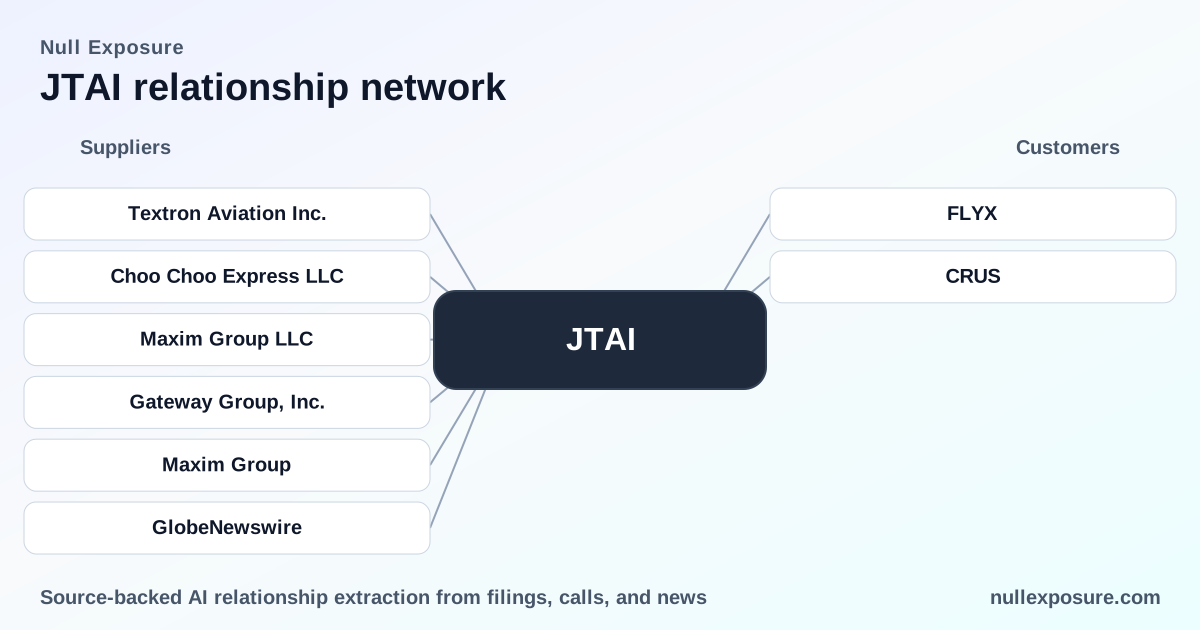
Jet.AI (JTAI) supplier map: aircraft, capital markets and one infrastructure JV that changes the risk profile
Jet.AI operates as a hybrid asset-and-services provider: it builds and operates high-performance GPU infrastructure and AI cloud services while retaining aviation assets and financing mechanisms to support corporate liquidity and growth. Revenue will depend on selling AI compute capacity and related hosting services, while capital needs are met through short-term equity distribution agreements and selective asset purchases; suppliers therefore sit at the intersection of capital markets, hardware procurement and infrastructure development. For a deeper look at how supplier relationships shape exposure and execution risk, visit https://nullexposure.com/.
Who Jet.AI is doing business with — the practical supplier list investors need
Below are the relationships surfaced in disclosure and press coverage; each is summarized in plain English with the cited source.
-
Textron Aviation Inc.
Jet.AI executed an aircraft purchase agreement on October 31, 2024 for three Cessna Citation CJ4 aircraft, making Textron a manufacturer and capital-equipment supplier for the company’s aviation operations. According to Jet.AI’s FY2024 10‑K filing, the aircraft purchase is a recorded contractual commitment. (FY2024 10‑K) -
Choo Choo Express LLC (CCE)
Jet.AI announced a planned joint venture with CCE to develop a 50‑megawatt data center campus in Moapa, Nevada, positioning CCE as a local infrastructure development and construction partner for the company’s hyperscale ambitions. This JV was disclosed in a December 23, 2025 press release distributed by GlobeNewswire and picked up by multiple outlets. (GlobeNewswire press release, 23 Dec 2025; Finviz/Business Insider coverage, Dec 2025) -
Maxim Group LLC / Maxim Group
Maxim is the advisor and execution partner for equity distribution: Jet.AI engaged Maxim as exclusive financial advisor and entered an ATM equity distribution arrangement, which the company later reported as “exhausted” after completing an offering that sold roughly 4.34 million shares for about $3.54 million in gross proceeds, with Maxim earning a 3% commission. Maxim functions as Jet.AI’s capital markets intermediary. (8‑K and related news coverage, March 2026; Marketscreener/TradingView/TS2 reporting) -
Gateway Group, Inc.
Gateway Group is listed as Jet.AI’s investor relations contact in multiple filings and press notices and appears in communications tied to the company’s merger and financing disclosures. Gateway Group provides IR and communications services supporting investor-facing disclosures. (Investor relations listings in GlobeNewswire and Business Insider press copies, FY2025–FY2026) -
GlobeNewswire (distribution channel)
GlobeNewswire is the press distribution service used for Jet.AI’s December 2025 JV announcement and other releases; some aggregators note that downstream summaries are AI‑assisted. GlobeNewswire is a distribution partner influencing market visibility rather than a supplier to operations. (GlobeNewswire press release, Dec 2025; QuiverQuant summary, Jan 2026)
What the supplier picture implies about Jet.AI’s operating model and constraints
Jet.AI’s supplier mix reveals a complex operating posture: asset-heavy commitments (aircraft purchases and multi‑megawatt data center builds) are paired with recurring reliance on capital markets and financial advisors for liquidity. That combination drives several observable characteristics:
-
Contracting posture — hybrid: The company balances long‑lived asset contracts (aircraft purchases and multi‑year leases referenced elsewhere in filings) with short‑term financing arrangements, including bridge loans and ATM equity programs. This creates simultaneous execution risk (capex projects) and refinancing risk (ongoing dependence on equity markets).
-
Concentration and criticality — narrow but strategic: A small set of counterparties are strategically critical. Textron supplies aircraft; Choo Choo Express is the local development partner for a large data‑center expansion; Maxim controls the distribution channel for incremental equity. Losing or delaying any one counterpart could materially affect operations or liquidity.
-
Maturity — early and execution‑dependent: The active relationships documented are at early stages — planned JV announcements, recently completed or exhausted ATM placements, and newly executed aircraft purchases — making value realization highly dependent on near‑term execution and permitting/ construction timelines.
-
Spend profile — mid‑range operational spend with concentrated capital outlays: Public excerpts show operational spend increases in the $1M–$10M band for fleet management and related costs, while capex commitments (aircraft purchase, 50MW campus) reflect larger episodic capital requirements. This indicates predictable operating supplier spend but lumpy capital supplier exposures.
These company-level signals come from filings and disclosure excerpts rather than generalized inference; they reflect the mix of long‑term leases for aircraft and short‑term financing arrangements recorded in Jet.AI’s public filings and press. Investors should treat these as structural business model drivers that influence liquidity and execution risk.
For actionable supplier stress testing and counterparty diligence, see https://nullexposure.com/ for tailored supplier intelligence.
Key investment implications and risk factors
-
Execution and timing risk dominate near‑term equity returns. The Moapa 50MW campus is capital intensive and permits‑dependent; delays would defer revenue while consumption of cash or equity dilution continues. (JV announcements, Dec 2025)
-
Financing dependence increases dilution sensitivity. The exhausted ATM and completed share sale illustrate that Jet.AI uses equity distribution agreements as a primary liquidity channel; investors should monitor future ATM availability and commission structures. (8‑K filings and news, March 2026)
-
Concentration in a few strategic suppliers raises operational vulnerability. Aircraft procurement with Textron and construction partnership with CCE make a small number of suppliers critical to both non‑core (aviation) and core (data center) capabilities. (FY2024 10‑K; GlobeNewswire press release)
-
Communications and market access are centralized. Gateway Group and GlobeNewswire control investor outreach and visibility—useful for understanding the narrative but also a vector for market perception risk. (Investor relations listings, Dec 2025–Jan 2026)
What investors should do next
- Review the Moapa JV term sheet and permitting timeline; prioritize milestones tied to capex spend and developer guarantees.
- Monitor Maxim’s role and any future equity distribution agreements for dilution and commission exposure, and track ATM capacity before planning position sizing.
- Conduct counterparty diligence on CCE (construction track record) and Textron delivery schedules to stress‑test operational timelines.
For supplier-level reporting, timely alerts and counterparty risk scoring that matter to investors, visit https://nullexposure.com/.
In sum, Jet.AI’s supplier landscape is small, strategic and execution‑intensive: aircraft purchases and a major data‑center JV broaden the company’s asset base, but the firm’s short‑term financing posture and reliance on a handful of advisors and developers concentrate both operational and capital markets risk. Investors should prioritize milestone‑driven monitoring and partner due diligence to separate contractual headline risk from realizable value.