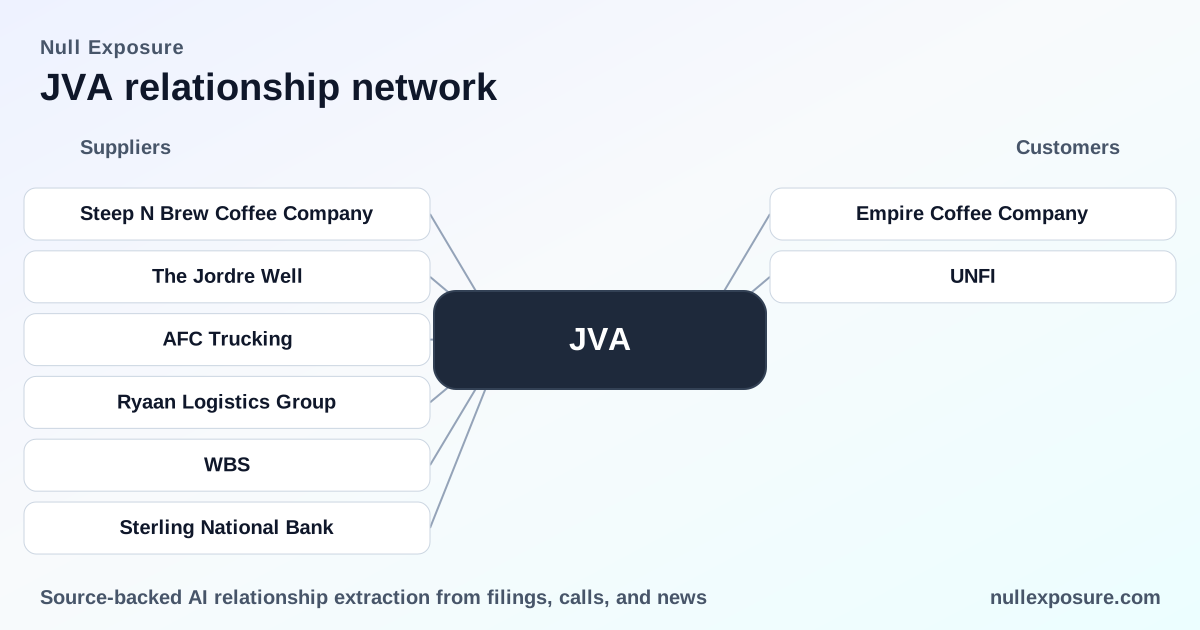
Coffee Holding Co. (JVA): Supplier relationships and what they tell investors about operational risk and upside
Coffee Holding Co., Inc. (NASDAQ: JVA) manufactures, roasts, packs, markets and distributes roasted and blended coffees and also operates a green-coffee trading business and specialty roaster joint ventures. The company monetizes through branded and private-label coffee sales, wholesale distribution, and transactional green-bean trading; profit generation depends on margin capture in roasting and recurring throughput in distribution, with working capital and logistic execution as critical operational levers. For investors, the question is whether a lightweight contracting posture and geographically diverse sourcing support margin stability as revenue scales. Learn more at https://nullexposure.com/.
Why supplier relationships matter for Coffee Holding’s cash flow profile
Coffee companies generate operating leverage only if supply continuity, transport reliability, and flexible procurement combine with stable roasting margins. Coffee Holding’s public filings and press coverage show a mix of transactional purchases and targeted acquisitions that expand specialty capabilities. Spot purchasing and purchase-order sourcing lower contract rigidity but raise exposure to price swings and logistics disruptions. Given JVA’s modest market cap and thin margins, interruptions or elongated receivables payable cycles can compress EBITDA quickly.
Quick financial context for framing supplier risk
Coffee Holding reports roughly $96.3 million in trailing revenue, market capitalization about $18.1 million, and EV/EBITDA near 7x on trailing results — signposts of a small, margin-sensitive operator with modest enterprise value relative to cash flow. Trailing operating margin is roughly 2.8% and profit margin around 1.5%, which emphasizes that supplier and financing dynamics materially affect bottom-line outcomes.
The complete supplier and counterparty map you need to know
Below are the supplier and service relationships surfaced in recent company disclosures and trade reporting. Each entry contains a concise, plain-English summary and the public source.
-
Steep N Brew Coffee Company — Coffee Holding acquired substantially all assets of Steep N Brew through its specialty joint venture Generations Coffee Company LLC, extending JVA’s specialty product footprint in Ohio and adding customer and production capacity. According to Comunicaffe’s 2018 coverage of the transaction, the acquisition was executed through the Generations joint venture (FY2018 / Comunicaffe).
-
The Jordre Well — Coffee Holding invested in a CBD beverage partner to develop and commercialize CBD-infused products tailored to the company’s existing brands, signaling a product innovation route beyond core roasted-bean lines. Daily Coffee News reported on the stake and collaboration in 2020, noting The Jordre Well’s role in CBD product development (FY2020 / Daily Coffee News).
-
AFC Trucking — AFC Trucking is the Florida-based carrier named in a 2025 lawsuit discussion after a shipment scheduled through brokered logistics did not arrive; the interaction highlights execution risk in the company’s outbound freight chain. Daily Coffee News’ January 2025 report on Coffee Holding’s suit references AFC Trucking as the intended carrier in the disrupted shipment (FY2025 / Daily Coffee News).
-
Ryaan Logistics Group — Ryaan, a Prosper, Texas-based freight broker, was the contracted broker to coordinate the shipment at issue in the 2025 complaint, indicating that Coffee Holding uses third-party brokers for freight coordination rather than only in-house logistics. The broker-deal relationship and subsequent legal action were described in a January 2025 Daily Coffee News article (FY2025 / Daily Coffee News).
-
Webster Bank (WBS) — Webster Bank is a lender under an extended credit agreement Coffee Holding cited as addressing going-concern questions, demonstrating the importance of bank financing to short-term liquidity and working capital funding. Comunicaffe reported on the extension of the credit agreement in 2024, which management said helped address going-concern considerations (FY2024 / Comunicaffe).
-
Sterling National Bank — Coffee Holding entered into an Amended and Restated Loan and Security Agreement with Sterling National Bank, which was later acquired by Webster Financial Corp.; this history underscores the evolution of JVA’s secured credit position and the interlink between its lending counterparties. TradingView’s reporting of the company’s SEC 10‑K cites the amended loan agreement and Sterling’s later acquisition (FY2026 / TradingView / SEC 10‑K reference).
What constraints tell us about procurement posture and supply risk
Coffee Holding’s own disclosures signal a transactional, spot-focused procurement model: the company states it does not maintain formal, material long-term supplier agreements and typically purchases under individual purchase orders. That contracting posture reduces fixed commitments but increases exposure to commodity volatility and spot-premium costs. The company also reports that dealers supplying green coffee are located primarily in the United States, while beans are sourced from producing regions including Colombia, Mexico, Kenya, Indonesia, Brazil and Uganda — a clear indication of geographic sourcing diversification across LATAM, EMEA and APAC origins but reliant on U.S.-based dealers for supply flows.
Operational implications:
- Contracting posture: Predominantly spot and purchase-order based, which supports flexibility but increases price and volume execution risk.
- Concentration and criticality: Dealer network is U.S.-centric for procurement execution, but underlying origin exposure is global, so logistics and port disruptions in origin or U.S. dealer consolidation could be critical.
- Maturity: Given occasional acquisitions and a joint-venture route into specialty, the company is small but opportunistic, relying on bolt-ons and partnerships to add capability rather than long-term integrated supply contracts.
For investors, those constraints imply that near-term margin volatility will track commodity moves and freight reliability more than long-term contracting protections.
Operational risk highlighted by recent events and what to watch next
Recent litigation over a missing shipment and the use of brokers underline execution risk in the transport layer; bank covenant adjustments and credit extensions show financing is an active concern for liquidity management. Key investor monitoring points: freight claim frequency and resolution, renewal or amendment of credit facilities, and any move from spot buying to more hedged or contracted sourcing for green coffee.
If you want a consolidated vendor and counterparty view for due diligence or portfolio monitoring, visit https://nullexposure.com/ to explore supplier intelligence and relationship mapping.
Bottom line and investor action items
Coffee Holding is a small-cap roaster-trader that grows through specialty acquisitions and partnerships while operating a largely transactional procurement model and relying on third-party logistics and short-term bank financing. That combination delivers agility but leaves margins and liquidity sensitive to single-point logistics failures and commodity swings. For investors, upside arrives from specialty growth and improved logistics discipline; downside concentrates around execution failures or a tightening credit backdrop.
For a deeper supplier-risk assessment and continuous monitoring to inform position sizing, check the company profile and relationship feeds at https://nullexposure.com/. Explore the supplier map before you allocate capital.