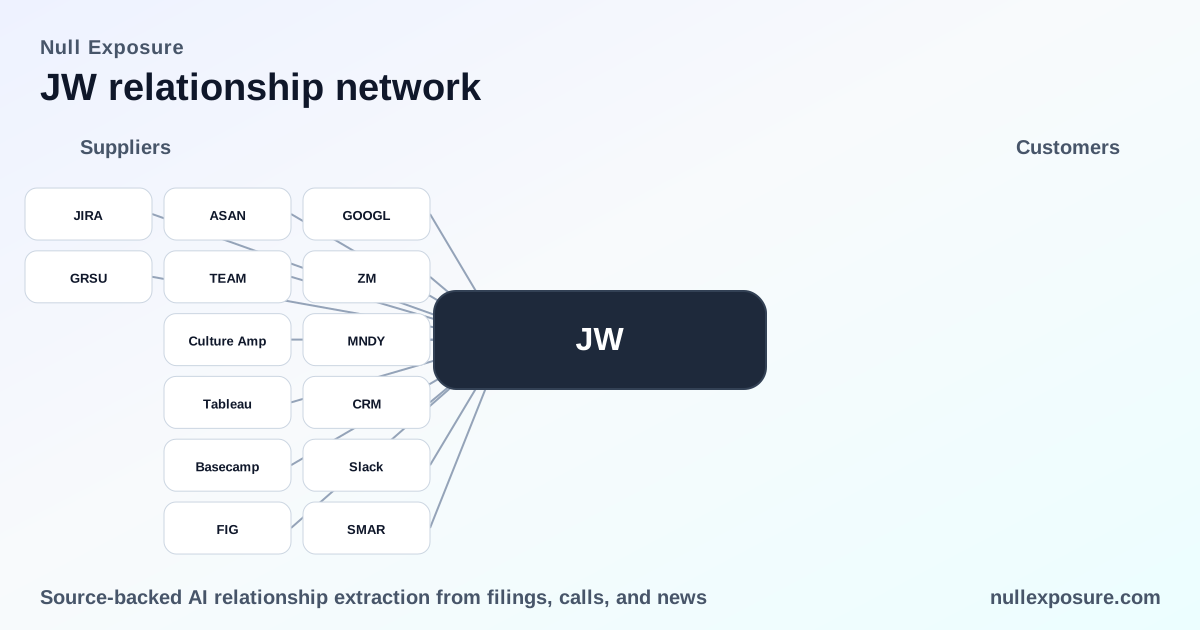
JW supplier map: what investors need to know about Justworks’ SaaS ecosystem
JW (Justworks) runs a subscription-based HR and payroll platform for small and mid-sized employers and monetizes through recurring SaaS fees and ancillary employer services (payroll processing, benefits administration and compliance support). The company’s supplier list is concentrated in productivity, collaboration and HR-adjacent tools that support product development, analytics and go-to-market activities — not core customer-facing infrastructure — which shapes both operational risk and capital allocation choices.
For a quick company-level intelligence feed, visit https://nullexposure.com/ to see how supplier relationships map to financial and operational risk.
Why the vendor roster matters for investors
JW’s supplier mix reveals a standardized SaaS operating posture: multiple off-the-shelf collaboration and project management providers, combined with analytics and design vendors. That profile implies low proprietary infrastructure cost, faster product iteration, and a controllable subscription expense base — but also elevated third-party dependency on widely used SaaS platforms that create integration, security, and continuity risk vectors.
- Consolidation risk is low because JW uses many point solutions rather than a single dominant vendor, but operational coupling is high since these tools touch product, analytics and hiring pipelines.
- Cost predictability is high for licenses and subscriptions, while service termination or access changes (vendors changing terms or features) present the principal vendor risk.
Explore an annotated supplier intelligence view at https://nullexposure.com/ to compare JW’s profile against peer HR-platforms.
Supplier roster and what each relationship signals
Below are all supplier relationships identified in the sourced company profile. Each entry is a concise, plain-English summary with the original source noted.
-
Google (GOOGL) — The company uses Google Analytics for traffic and usage analytics and Google Drive for project documentation and collaboration, indicating reliance on Google’s productivity and analytics stack for development and product telemetry. Source: Built In profile of Justworks (FY2025) — https://builtin.com/company/justworks (first seen 2026-03-10).
-
Zoom (ZM) — Zoom is used as a core collaboration and meeting tool, signifying standard remote-work communications infrastructure across teams. Source: Built In profile of Justworks (FY2025) — https://builtin.com/company/justworks (first seen 2026-03-10).
-
Monday.com (MNDY) — Monday.com is cited for project management workflows, reflecting a preference for visually oriented task-management platforms in product and operations planning. Source: Built In profile of Justworks (FY2025) — https://builtin.com/company/justworks (first seen 2026-03-10).
-
Salesforce (CRM) — Salesforce is used as the CRM, confirming a conventional choice for sales pipeline management and customer data centralization. Source: Built In profile of Justworks (FY2025) — https://builtin.com/company/justworks (first seen 2026-03-10).
-
Slack — Slack supports real-time team collaboration and cross-functional coordination, indicating integrated communications tied into engineering and support workflows. Source: Built In profile of Justworks (FY2025) — https://builtin.com/company/justworks (first seen 2026-03-10).
-
Smartsheet (SMAR) — Smartsheet is employed for project and work-management tasks, used alongside other task platforms to manage cross-team deliverables. Source: Built In profile of Justworks (FY2025) — https://builtin.com/company/justworks (first seen 2026-03-10).
-
Asana (ASAN) — Asana is present in the toolset for project tracking and sprint planning, reinforcing a multi-platform approach to task management. Source: Built In profile of Justworks (FY2025) — https://builtin.com/company/justworks (first seen 2026-03-10).
-
Trello (TEAM) — Trello usage indicates lightweight board-based planning is part of the development and operations mix, likely for smaller projects or cross-functional coordination. Source: Built In profile of Justworks (FY2025) — https://builtin.com/company/justworks (first seen 2026-03-10).
-
Culture Amp — Culture Amp is used for employee engagement and performance feedback, signaling investment in people analytics and HR processes that support retention. Source: Built In profile of Justworks (FY2025) — https://builtin.com/company/justworks (first seen 2026-03-10).
-
Tableau — Tableau is referenced for analytics and visualization, indicating a BI layer for executive reporting and product/marketing analytics. Source: Built In profile of Justworks (FY2025) — https://builtin.com/company/justworks (first seen 2026-03-10).
-
Basecamp — Basecamp appears among project-management choices, suggesting experimentation with different collaboration paradigms across teams. Source: Built In profile of Justworks (FY2025) — https://builtin.com/company/justworks (first seen 2026-03-10).
-
Figma (FIG) — Figma is used for product and design work, confirming modern, cloud-based UX workflows feeding the product pipeline. Source: Built In profile of Justworks (FY2025) — https://builtin.com/company/justworks (first seen 2026-03-10).
-
JIRA — JIRA is employed for engineering issue tracking and sprint management, indicating conventional software development tooling at scale. Source: Built In profile of Justworks (FY2025) — https://builtin.com/company/justworks (first seen 2026-03-10).
-
Greenhouse (GRSU) — Greenhouse is used for recruitment and applicant tracking, evidencing structured hiring processes and an investment in talent acquisition infrastructure. Source: Built In profile of Justworks (FY2025) — https://builtin.com/company/justworks (first seen 2026-03-10).
Constraints and broader operating-model signals
No explicit contractual supplier constraints were identified in the available profile. Treat that absence as a company-level signal:
- Contracting posture: flexible — absence of disclosed long-term exclusivity implies license-based engagements rather than capital-intensive vendor lock-in.
- Concentration: diversified — the vendor base spreads across competing project-management and collaboration tools rather than concentrating spend with a single provider.
- Criticality: operational enablers — most suppliers support internal productivity, product development, analytics and hiring rather than being core revenue-driving platforms.
- Maturity: modern SaaS stack — choices like Figma, Tableau, and Slack suggest up-to-date tooling that supports rapid product iteration and remote collaboration.
These signals indicate a predictable OpEx profile for investors, balanced by a need for disciplined vendor governance to manage integration and data security.
(If you want a side-by-side risk comparison versus peers, see https://nullexposure.com/ for modelled supplier exposures.)
Investment implications — what to watch next
- Operational continuity is the primary third-party risk. Because JW standardizes on many external SaaS providers, vendor outages or policy changes can disrupt development and analytics workflows quickly. Investors should monitor incident history and contractual SLAs where disclosed.
- Integration and data governance matter. Multiple overlapping project-management tools increase integration complexity and potential data fragmentation that could raise product-development costs.
- Cost tail is manageable but persistent. License and subscription fees are predictable, supporting margin stability if headcount growth is disciplined.
- Talent systems are modernized. Use of Culture Amp and Greenhouse supports retention and scalable hiring — an operational strength for a labor-heavy SaaS business.
Final read and action items
For investors evaluating JW, the supplier landscape signals a low-capex, high-OpEx operating model built on modern SaaS tools that accelerate product development but require active vendor and data governance. Focus diligence on vendor SLAs, security posture, and how JW rationalizes overlapping collaboration platforms to control cost and complexity.
To compare JW’s supplier profile with industry peers and drill into supplier-driven operational risk, go to https://nullexposure.com/.
If you need a customized supplier-risk briefing for portfolio monitoring, start at https://nullexposure.com/ for tailored coverage and alerts.