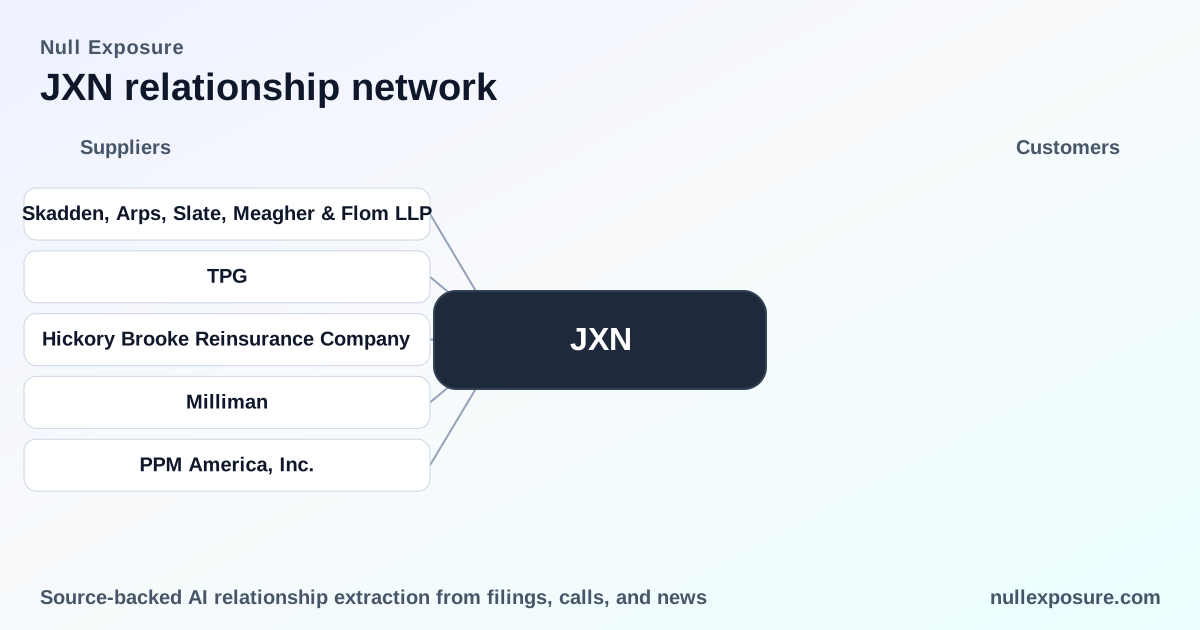
Jackson Financial (JXN): supplier relationships you need to price into risk and opportunity
Jackson Financial operates as a U.S. life-insurance and asset-management platform that monetizes through annuity and life insurance premiums, investment spread income in the general account, and third‑party asset management revenue. The firm pairs in-house investment management (PPM America) with external partners to scale product innovation and balance-sheet distribution; strategic capital and management agreements further align asset growth with shareholder value. For investors and operators, the supplier landscape is a lens into Jackson’s distribution capacity, capital flexibility, and execution risk.
Discover a concise mapping of these supplier ties and what they imply for return and resilience: https://nullexposure.com/
Why these supplier ties matter to investors
Jackson’s recent moves show a deliberate shift toward outsourced asset scale and captive risk capacity. External managers and advisers expand product and credit capabilities without immediate permanent balance-sheet deployment, while legal and actuarial advisers reduce transaction frictions for complex structuring. These relationships are both commercial growth levers and operational dependencies—they accelerate annuity sales and broaden asset classes, but concentrate counterparty exposure around a small set of critical partners.
Explore further relationship-level insights here: https://nullexposure.com/
The relationship roster—what each supplier does and why that matters
TPG Inc.
TPG entered a headline strategic partnership with Jackson in early 2026, including a $500 million common equity investment and a ten‑year renewable investment management agreement under which TPG will manage a minimum commitment of $12 billion of AUM, with incentives targeted at $20 billion. This positions TPG as a long‑term external manager supplying investment‑grade asset‑based finance and direct lending capabilities to complement PPM America and accelerate Jackson’s spread-based annuity growth (press coverage and company announcements, January–March 2026).
Source: multiple press reports and company announcements (BusinessWire/FinancialContent, Insurance News Net, The Globe and Mail, January–March 2026).
PPM America, Inc.
PPM America remains Jackson’s core internal asset manager, continuing to manage the majority of the general account while retaining investment oversight jointly with Jackson; the TPG arrangement is structured to complement, not replace, PPM’s role. PPM’s continued stewardship preserves institutional continuity in portfolio construction and regulatory reporting (company release coverage, March 2026).
Source: Jackson/press release coverage (Yahoo Finance, March 2026).
Hickory Brooke Reinsurance Company
Jackson and TPG used part of the capital infusion to capitalize Hickory Brooke Reinsurance Company, a Michigan‑based captive reinsurer seeded with TPG’s investment and $150 million of Jackson cash to support sales growth of fixed and fixed‑index annuity products. This creates onshore reinsurance capacity, enabling product expansion while managing statutory capital and pricing dynamics (industry reporting, March 2026).
Source: InsuranceBusinessMag and related March 2026 coverage.
Milliman
Milliman served as Jackson’s actuarial advisor in establishing Hickory Brooke Re, providing actuarial structuring and reserve modeling for the captive arrangement. That advisory role is central to ensuring the reinsurance vehicle is properly capitalized and actuarially validated for the intended annuity flows (press release coverage, March 2026).
Source: Company press material reported on Yahoo Finance (March 2026).
Skadden, Arps, Slate, Meagher & Flom LLP
Skadden acted as legal counsel to Jackson in the strategic transaction with TPG and the associated corporate and regulatory workstreams. Legal advisory by a major global firm reduces execution risk on complex long‑term management agreements and capital transactions (press release and news coverage, January–March 2026).
Source: Company press releases and BusinessWire/FinancialContent reports (January–March 2026).
What the supplier map tells you about Jackson’s operating model
- Contracting posture: mix of long‑term strategic relationships and short‑term liquidity arrangements. The TPG management agreement is a multiyear, renewable arrangement central to execution; alongside that, the company maintains revolving and short‑term facilities to manage liquidity. These combined exposures indicate deliberate layering of durable external capacity plus tactical funding lines.
- Concentration and criticality: concentrated at the top. A small number of partners (TPG and PPM) are responsible for the lion’s share of incremental asset capabilities; legal and actuarial advisers are critical for transaction execution but not ongoing asset management.
- Maturity and stage: active, large‑scale commitments. The TPG arrangement and captive reinsurance were executed in FY2026 and are described as active and material; other relationships are ongoing service arrangements typical of a large life insurer.
- Spend profile: high absolute and programmatic commitments. Evidence shows commitments and facilities in the hundreds of millions to billions (revolving credit capacity, minimum AUM commitments from TPG), indicating enterprise‑level spend bands and reliance on large‑ticket partners.
- Role diversity: service provider and buyer behaviors coexist. Jackson acts as a buyer of legal, actuarial and specialized management services while simultaneously outsourcing asset management functions to external providers—reflecting a hybridization of in‑house and third‑party execution.
Key investment implications
- Growth via third‑party scale: The TPG partnership materially increases Jackson’s access to private credit and asset‑based finance, directly supporting annuity spread improvements and product innovation—a positive for revenue leverage.
- Execution and counterparty concentration risk: Concentration of new asset commitments with TPG and reliance on PPM for the remainder of the general account create vendor‑specific execution risk; legal and actuarial advisers reduce but do not eliminate that risk.
- Capital and liquidity flexibility: The use of a captive reinsurer and a mix of long‑term and short‑term credit facilities shows active balance‑sheet engineering to support growth while preserving statutory capital ratios.
If you are evaluating counterparty exposure or supplier risk in life insurers, this Jackson map is the first stop—refresh your underwriting and scenario stress tests for concentrated manager risk and captive reinsurance funding.
Learn more about assessing supplier concentration and counterparty risk at https://nullexposure.com/
Final takeaway and next steps
Jackson’s FY2026 supplier moves are strategic, material, and directional: external capital and management scale with TPG, supported by in‑house PPM oversight and specialist advisors for legal and actuarial execution. Investors should price both the upside from accelerated annuity growth and the asymmetric operational risk from concentrated counterparties.
For a deeper supplier risk assessment and monitoring playbook, visit https://nullexposure.com/ and connect the relationship signals to portfolio scenarios.