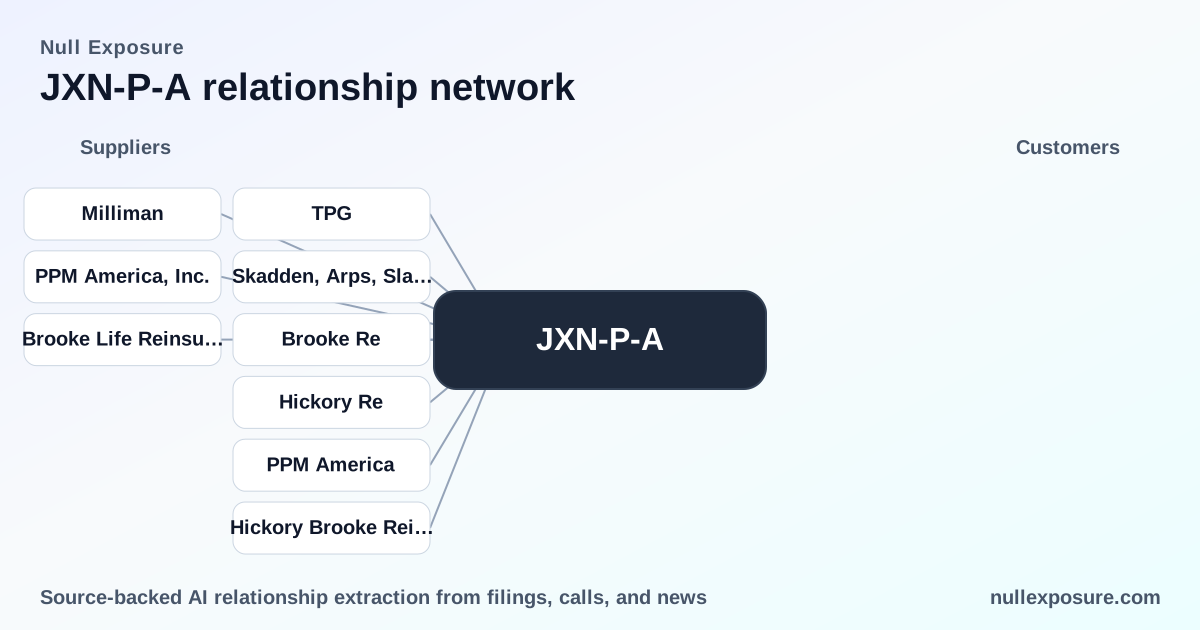
Jackson Financial (JXN-P-A): supplier relationships that reshape its asset and reinsurance strategy
Jackson Financial operates and monetizes by packaging life insurance and annuity liabilities while capturing spread and fee income from its general account; the company increasingly leverages third‑party capital and external managers to bolster yield, de‑risk liabilities through captive reinsurance, and expand access to private credit and asset‑based finance. Recent supplier moves reframe Jackson from a pure insurer into an asset‑management partner for alternatives players and professional services firms, with direct implications for capital allocation and earnings mix. For a deeper supplier map and ongoing coverage, visit https://nullexposure.com/.
How the new arrangement changes the operating playbook
Jackson’s commercial model historically centers on underwriting annuities and managing a large general account to earn spread. The recent partnership activity shows a pivot: external managers bring scale and product capabilities (private credit, direct lending, asset‑based finance) while captive reinsurers and actuarial advisors enable capital efficiency and hedging flexibility. This combination creates diversified earnings channels — management fees and investment margins — but also concentrates execution risk around large mandate relationships and newly capitalized reinsurance vehicles.
- Business model drivers: monetization shifts from pure underwriting to fee capture and co‑investment economics; external capital can lower regulatory capital needs and accelerate product growth.
- Primary risk vectors: counterparty concentration, governance of captive reinsurers, and successful integration of external asset managers into the general account.
Explore how these dynamics affect supplier concentration and counterparty risk at https://nullexposure.com/.
Company-level operating signals and constraints investors should read as a single story
Treat these as firm-wide signals rather than discrete vendor stats. Jackson’s recent supplier posture shows a preference for long‑dated, renewable commercial arrangements, indicating a contracting posture that seeks stability and runway for asset‑heavy strategies. The presence of minimum AUM commitments and multi‑year mandates points to concentration risk — a small number of large external managers could materially influence investment performance and capital flows. The creation and capitalization of captive reinsurers signals criticality: reinsurance vehicles are now central to Jackson’s capital and product strategy rather than peripheral hedging tools. Finally, the firm is operating in a transitional maturity phase — legacy in‑house asset management (PPM) still controls most of the general account while new partnerships scale alternative capabilities.
The full supplier map — what every named relationship provides
Below are plain‑English summaries for each relationship referenced in public reporting, with concise source notes.
-
TPG Inc.
Jackson entered a long‑term, non‑exclusive investment management partnership under which TPG will manage a minimum $12 billion of AUM with incentives toward $20 billion, and TPG made an equity investment tied to the arrangement; this is positioned to broaden Jackson’s private credit and asset‑based finance exposure (TPG press release and multiple news reports, March 2026).
Source: TPG announcement and contemporaneous coverage (TPG.com; news reports March 2026). -
PPM America / PPM America, Inc.
PPM remains the incumbent manager for most of Jackson’s general account and will share oversight with incoming partners while continuing to source higher‑yielding assets such as residential mortgages and structured securities that support spread‑based products (company earnings commentary and reporting, Q4 2025 / FY2026).
Source: Jackson earnings and commentary (company transcripts and The Globe and Mail coverage, early 2026). -
Skadden, Arps, Slate, Meagher & Flom LLP
Skadden served as legal advisor to Jackson on the strategic partnership and related transactions, reflecting the use of top‑tier transactional counsel for structuring and regulatory work (transaction press releases).
Source: Transaction press releases and legal advisory notes (TPG release; CapitalBrief, March 2026). -
Brooke Re (Brooke Life Reinsurance Company / Brooke Re)
Jackson completed a reinsurance transaction with Brooke Life Re that optimized hedging and stabilized capital generation; Brooke Re functions as a captive vehicle reinsuring variable annuity guarantees and is now integrated into Jackson’s capital strategy (company disclosures and industry reporting).
Source: Reinsurance and earnings coverage (InsuranceNewsNet; TradingView summaries, 2026). -
Hickory Re (Hickory Brooke Reinsurance Company)
Jackson launched Hickory Re as a Michigan‑based captive reinsurer focused on fixed and fixed‑indexed annuity reinsurance, with TPG’s investment used to assist initial capitalization; questions about cash flow distribution and holding‑company transfers were raised by analysts during earnings calls (reinsurance press coverage and earnings Q&A).
Source: Reinsurance News and analyst Q&A coverage (ReinsuranceNews, TradingView, 2026). -
Milliman
Milliman acted as an actuarial advisor in the establishment of the new captive reinsurance entity, providing technical validation and reserve/capital modelling support for the reinsurance structures.
Source: Reinsurance News report on captive formation and advisor roles (ReinsuranceNews, 2026). -
Brooke Re (analyst discussion reference)
Analysts sought additional disclosure on minimum capital and governance at Brooke Re during Jackson’s earnings call, indicating investor scrutiny of captive structures and capital allocation policies.
Source: Analyst Q&A excerpts from earnings transcripts (TradingView / Benzinga, Q4 2025).
What investors and operators should watch next
- Execution of minimum AUM targets. The economics assume material inflows to external managers; failure to scale to target AUM shifts revenue and margin expectations.
- Governance of captive reinsurers. Capital policy, transfer pricing and the ability to repatriate cash to the parent are central to realizing projected benefits.
- Integration between PPM and external managers. Operational alignment and portfolio governance determine whether new sources of yield translate to durable spread income.
Key risks summarized:
- Concentration of asset management with a few large partners.
- Complexity in captive reinsurance governance and capital flows.
- Execution and disclosure gaps around long‑dated management mandates.
If you want more structured supplier intelligence and continuous monitoring on Jackson’s counterparties, start here: https://nullexposure.com/.
Bottom line — what this means for valuation and counterparty due diligence
Jackson is deliberately reshaping its supplier and capital architecture to accelerate annuity sales and diversify investment sources. That strategy enhances upside through fee capture and private credit exposure but substitutes execution and concentration risk for traditional underwriter stability. Investors and operators should prioritize monitoring AUM ramp metrics, captive capital policy, and legal/actuarial governance as leading indicators of whether this supplier slate converts into sustainable, diversified earnings.
For ongoing alerts and analyst briefs on Jackson supplier dynamics, visit https://nullexposure.com/ for coverage and subscription options.