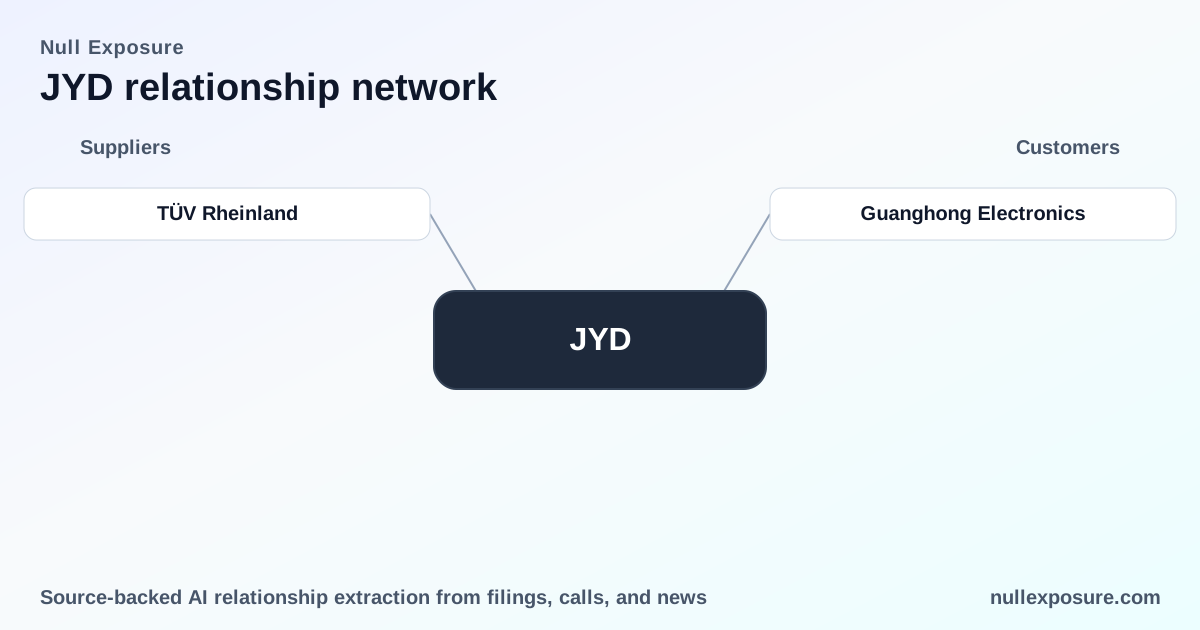
Jayud Global Logistics (JYD): Supplier relationship briefing — TÜV Rheinland and what it means for operators and investors
Jayud Global Logistics is a China-headquartered integrated freight and logistics operator that monetizes by providing cross-border supply-chain services, freight forwarding, and value-added logistics solutions to importers and exporters. Revenue derives from service fees on shipments and ancillary logistics services, while capital structure and market valuation reflect a small public float and concentrated insider ownership. For investors evaluating supplier and certification relationships, the recent TÜV Rheinland engagement is a clear operational signal about quality systems and market positioning. Explore more company relationship data at https://nullexposure.com/.
How Jayud runs the business and where money comes from
Jayud operates as a B2B logistics intermediary: it coordinates cross-border transport, customs brokerage, warehousing, and related services and invoices customers per-move and via service contracts. The company reported Revenue (TTM) of $575.3 million with negative net profitability (EPS -6.09; Profit Margin -5.19%) and a small market capitalization in the single-digit millions, indicating a business that generates material top-line volume but is under margin pressure and capital-constrained. Insider control is high (64% insider ownership) and institutional ownership is negligible, which shapes negotiating posture and strategic flexibility.
Why a TÜV Rheinland certification matters for a logistics supplier
TÜV Rheinland is a widely recognized third-party certifier for quality and management systems. A formal certification from TÜV Rheinland signals that Jayud’s operational controls, production capacity and quality management were assessed against international standards, which supports contract wins with multinational customers and reduces onboarding friction for regulated shipments. News coverage in March 2026 noted the certification as part of vendor diligence narratives published alongside other corporate developments (see the relationship entries below for the exact sources).
Read deeper supplier relationship signals and historical mentions at https://nullexposure.com/.
What the record shows — every recorded relationship entry
- TÜV Rheinland — A March 10, 2026 news piece documented that TÜV Rheinland performed a thorough onsite assessment covering operational aspects, production capacity, and quality management, concluding in certification that helps Jayud compete internationally; the article was published on Intellectia and discussed the certification alongside related company news (https://intellectia.ai/news/stock/jayud-global-logistics-faces-class-action-lawsuit-over-investor-misleading-claims).
- TÜV Rheinland — A separate Intellectia article from the same day reiterated that TÜV Rheinland’s onsite assessment validated Jayud’s processes and capacity, framing the certification as a competitive asset in international markets (https://intellectia.ai/news/stock/jayud-global-logistics-faces-securities-class-action-with-deadline-on-january-19-2026).
- TÜV Rheinland — A further Intellectia item also recorded the same certification text, indicating multiple news mentions in March 2026 for the certification in the context of broader corporate reporting and litigation coverage (https://intellectia.ai/news/stock/jayud-global-logistics-faces-securities-fraud-class-action-filed-in-ny-court).
Each of the three items repeats the same operational excerpt and dates in FY2026; taken together they show consistent media reporting of TÜV Rheinland’s onsite certification activity.
What this supplier relationship changes for operators and commercial counterparties
- Contracting posture: Certification strengthens Jayud’s position in competitive RFPs with multinational shippers that require third-party verification of quality management and capacity. Certified processes reduce buyer due diligence friction and can accelerate onboarding timelines.
- Commercial criticality: For global customers, certification is a gating item; TÜV Rheinland certification increases Jayud’s relevance to customers with strict compliance standards, potentially enabling higher-margin or longer-duration contracts.
- Operational maturity: Certification is a positive maturity signal—it indicates documented processes and capacity—but does not alone resolve profitability challenges shown in the company’s financials (negative EPS and EBITDA losses).
- Concentration and negotiating leverage: With high insider ownership and very low institutional participation, Jayud’s strategic decisions and supplier choices will be driven by controlling shareholders, which influences contract terms and the pace of structural investments.
Risk profile and what investors should watch next
- Execution risk remains material. Certification supports market access but does not remove operational or margin pressure: Jayud’s Operating Margin (TTM ~0.83%) and negative EBITDA confirm that secular and scale economics are not yet stabilised.
- Information flow and media context matter. The March 2026 articles that document the TÜV Rheinland assessment were published in the context of broader corporate news cycles; investors should read the full articles for litigation context and confirm whether certification was a routine recertification or a first-time audit (see cited links above).
- Counterparty concentration risk is ambiguous. The relationship entries show a third-party certifier engagement rather than a strategic commercial customer; certification reduces some demand-side risk but does not substitute for diversified, sticky revenue streams.
If you are assessing operational counterparties or vintage supplier-risk models, check Jayud’s vendor and certification history on the platform: https://nullexposure.com/.
Practical next steps for investors and operators
- Verify the scope and validity dates of the TÜV Rheinland certificate with Jayud’s filings or investor relations to distinguish short-term PR from durable operational improvement. Ask for the scope of the assessment (sites covered, standards applied) and renewal cadence.
- Map certification outcomes to contract portfolios: if multinational customers require certified partners, quantify the near-term pipeline exposure that certification unlocks.
- Factor ownership and liquidity constraints into any counterparty credit work—insider control and low public float create a governance and capital-raising dynamic that affects supplier payment terms and investment in capacity.
For a centralized view of supplier signals, certifications, and relationship timelines, visit https://nullexposure.com/ and search the supplier node for JYD.
Bottom line
TÜV Rheinland’s onsite assessment and certification is a meaningful operational endorsement for Jayud that reduces some onboarding and compliance friction with international customers. However, certification alone does not address the company’s profitability shortfall or concentrated ownership structure. Investors and operators should treat the certification as a positive quality signal while continuing to evaluate revenue quality, margin trajectory, and governance before increasing exposure.