Jiuzi Holdings (JZXN): distribution-first EV retail with headline partnerships — what investors should know
Jiuzi Holdings operates and monetizes as a retail and franchise dealer of new energy vehicles and related parts under the Jiuzi brand in China, generating revenue through vehicle and parts sales across its franchise and company-owned stores. The company’s cash flow profile is driven by unit sales and aftermarket parts margins while capital intensity and profitability remain pressured by operating losses and negative EBITDA. Investors should treat the business as a retail-distribution play with high operational leverage and headline-driven reputational risk.
Explore supplier and counterparty signals in full at https://nullexposure.com/
What the business model looks like in practice
Jiuzi is a traditional automotive dealer built around franchise networks and retail footprints, not an OEM. That contracting posture implies the company’s commercial leverage is with vehicle suppliers, franchise partners and retail customers rather than upstream manufacturing. The public profile shows large operating losses and low valuation multiples that reflect execution and scale risk: reported RevenueTTM 2,882,700 alongside EBITDA -9,957,149, a Price/Book ~0.107, and elevated volatility (Beta 1.586). These figures indicate a business still burning capital and reliant on top-line growth to absorb fixed retail costs.
Key commercial characteristics to track as an operator or counterparty:
- High operating leverage — retail stores and franchise support create fixed-cost exposure if same‑store sales decline.
- Distribution-criticality — revenue depends on inventory flow and retail footfall; supplier interruptions or franchise disputes would be immediately material.
- Early‑stage profitability — negative margins and diluted EPS indicate maturity is incomplete; capital and liquidity management are priority items for counterparties.
Supplier and market relationships you need on your radar
This section covers every relationship surfaced in the available results and what each means for supplier or partner evaluation.
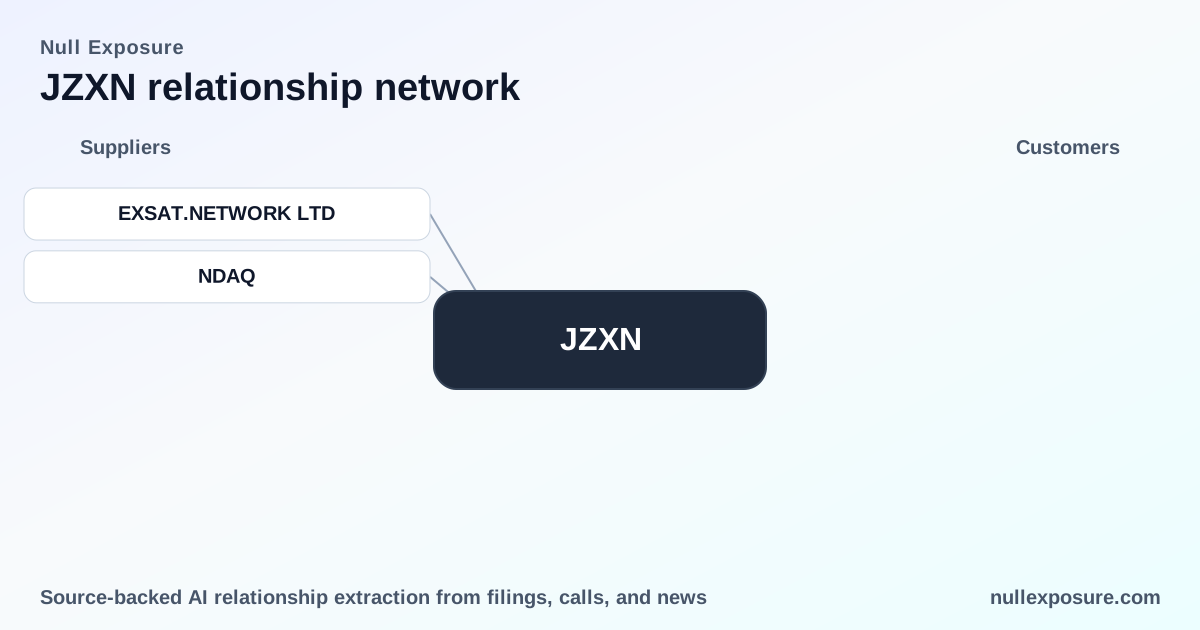
EXSAT.NETWORK LTD
Jiuzi signed a cooperation agreement with EXSAT.NETWORK LTD, the core ecosystem organization of the EOS cryptocurrency project, positioning the company to explore blockchain-related collaboration or ecosystem integration. According to a Futunn news post announcing the agreement (March 2026), the cooperation is formalized as a strategic relationship tied to the EOS ecosystem.
Nasdaq Capital Market
Jiuzi is listed on the Nasdaq Capital Market and has recently regained minimum bid price compliance, a governance signal that directly affects market access and listing status. A Globe and Mail press release noted the company’s standing on the Nasdaq Capital Market (March 2026), which influences liquidity, investor base composition, and regulatory oversight.
Operating model signals and supplier constraints
There are no explicit supplier constraints disclosed in the supplied constraint records, which itself is an informative company-level signal: Jiuzi has not publicized contractual supplier limitations, exclusive supply dependencies, or supplier concentration constraints in the referenced materials. Use that absence as a prompt to investigate directly when underwriting exposure.
From the company profile and reported metrics, derive the following operating signals:
- Contracting posture: retail/franchise operator — agreements are likely with multiple franchised dealers and OEM distribution channels rather than single-source manufacturing supply.
- Concentration signal: institutional ownership is modest (~13.74%), insiders are minimal (~0.094%), suggesting narrow analyst coverage and potential for volatility around news events.
- Maturity and criticality: persistent negative EBITDA and very low price-to-book imply the business is in an expansion or recovery phase, making supplier and counterparty continuity critical for near-term survival.
- Liquidity and market access: Nasdaq listing compliance reduces delisting risk and preserves access to U.S. capital markets, which is material for financing inventory and retail working capital.
Where the main risks and opportunities sit
Investors and operators should focus on a handful of directional drivers:
- Inventory and supplier continuity: as a retail franchise network, any disruption to vehicle supply or parts provisioning would quickly depress revenue and margins. Monitor OEM and logistics relationships tightly.
- Execution risk in retail rollout: scaling stores or franchises increases fixed costs; breakeven is sensitive to same-store sales trends.
- Reputational and strategic partnerships: the EXSAT cooperation introduces non-traditional adjacency risk (crypto/blockchain public relations and execution complexity) and potential opportunity if used for loyalty, payments, or digital services.
- Capital and liquidity pressure: negative EBITDA and thin institutional support mean capital raises, covenant monitoring, or equity dilution are credible near-term events.
Practical actions for investors and counterparties:
- Request detailed supplier concentration schedules and franchise economics to assess single‑counterparty exposure.
- Monitor cash flow statements and working capital trends each quarter; follow liquidity events around inventory financing.
- Track execution milestones tied to any new strategic partnerships (e.g., the EXSAT agreement) and regulatory filings that disclose commercial terms.
If you want deeper counterparty profiles and real-time supplier signals, start your diligence at https://nullexposure.com/
Investment implications and recommended next steps
For investors, Jiuzi is a speculative retail play in the new energy vehicle channel: upside depends on retail execution and the conversion of headline partnerships into monetizable products or services, while downside is participation in a cash-burning retail network. For operators and suppliers, contractual protections (payment terms, inventory consignment, termination rights) should be prioritized given Jiuzi’s negative operating cash flow.
Recommended immediate steps:
- Obtain contract-level detail on franchise agreements and key supplier terms.
- Demand transparency on the EXSAT cooperation’s commercial objectives and financial commitments.
- Maintain position sizing discipline given liquidity and earnings volatility.
Learn how to convert supplier signals into actionable counterparty risk controls at https://nullexposure.com/
Bottom line
Jiuzi is a franchise-driven EV dealer with headline partnerships and public-market compliance that reduce some governance risk but continue to operate with negative profitability. The EXSAT collaboration is a non-traditional relationship worth monitoring for execution risk and potential strategic upside, while Nasdaq compliance preserves liquidity channels. Investors and suppliers must prioritize contract terms, working capital surveillance, and concrete milestones tied to any strategic partnership before increasing exposure.