Kala Pharmaceuticals (KALA): supplier relationships, operational constraints, and what investors should know
Kala Pharmaceuticals develops and commercializes ophthalmic therapies built on a proprietary nanoparticle mucus‑penetrating particle (MPP) platform. The company monetizes primarily through product development and eventual drug commercialization while relying on external capital markets and third‑party manufacturing and distribution partners to fund and deliver its clinical and commercial programs. Investment and counterparty managers should treat Kala as a development‑stage biopharma with outsourced production, concentrated supply risk, and active financing flows.
Learn more about supplier intelligence and counterparty exposure at https://nullexposure.com/.
How Kala runs the business and where the supply risk lives
Kala does not own manufacturing capacity. The company contracts third parties for manufacture, packaging, sterilization, storage and distribution for its lead program KPI‑012 and other product candidates. Corporate disclosures state Kala “does not own or operate, and currently have no plans to establish, any manufacturing facilities,” and that it sources drug substance and finished product on a purchase‑order basis rather than under long‑term committed supply contracts. This establishes a clear operating posture: outsourced manufacturing with short‑term contracting and logistics dependence.
- Contracting posture: evidence shows Kala relies on short‑term purchase orders for KPI‑012 (confidence 0.75). That creates flexibility for cost control but increases execution risk during scale‑up or supply disruptions.
- Concentration and criticality: Kala lacks redundant supply for its bulk drug substance and stores its master and working cell banks in two locations, leaving the program critically exposed if both locations are compromised (materiality labeled critical, confidence 0.65).
- Geographic footprint for operations: clinical activity is concentrated in the United States with expanding sites in Latin America (NA confidence 0.90; LATAM confidence 0.80), which has implications for regulatory coordination and logistic complexity.
- Roles and suppliers: third parties function as manufacturers, distributors and a range of service providers (confidence 0.80 across those dimensions), from CROs conducting trials to professional services like audit and compensation consulting.
These operating traits translate into two investment realities: operational exposure to third‑party performance and sensitivity to financing cycles, since Kala has historically relied on equity raises and debt restructurings to sustain development.
Supplier and capital‑market counterparties you should track
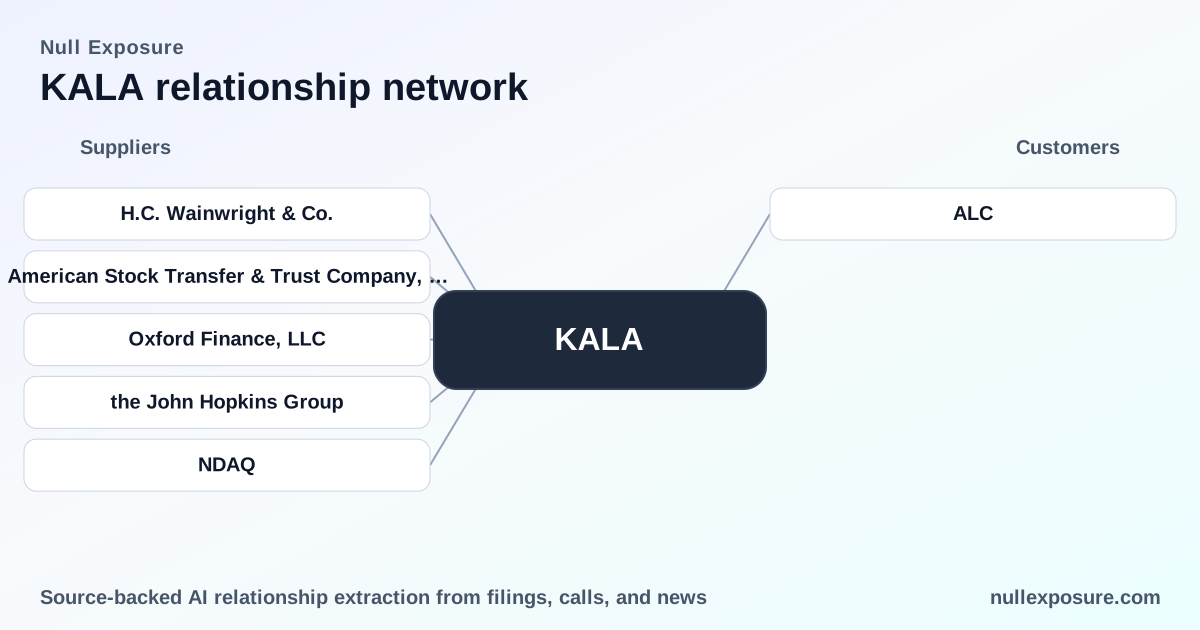
Below are every supplier/partner relationship surfaced in recent disclosures and filings, with concise descriptions and sources.
H.C. Wainwright & Co.
Kala engaged H.C. Wainwright & Co. as the exclusive placement agent for a registered direct offering priced at the market that raised roughly $10 million during FY2025. This was disclosed in company press materials and distribution notices in December 2025. (See GlobeNewswire and SahmCapital coverage, December 2025.)
Oxford Finance, LLC
Kala announced settlement of approximately $10.6 million of debt with Oxford Finance as part of its FY2025 capital actions, indicating a deleveraging step tied to financing and operational realignment. (See GlobeNewswire release, Sep 29 and Dec 5, 2025, and related press summaries.)
American Stock Transfer & Trust Company, LLC
For investor and shareholder services related to the company’s reverse stock split and stockholder inquiries, Kala points shareholders to American Stock Transfer & Trust Company, indicating AST continues to serve as the company’s transfer agent. (See Yahoo Finance report on the reverse stock split, October 2022.)
Nasdaq Global Select Market
Kala’s common stock is listed and traded on the Nasdaq Global Select Market under the symbol KALA, and has been subject to corporate actions such as a split‑adjusted trading announcement associated with the October 2022 reverse split. (See Yahoo Finance coverage, October 2022.)
the John Hopkins Group
Kala holds an exclusive worldwide license to nanoparticle technology originating from Johns Hopkins researchers, which underpins the company’s MPP platform and early scientific value proposition. This licensing history dates back to pre‑IPO technology transfers reported in industry coverage. (See Nanalyze feature on pre‑IPO nano drug delivery, July 2017.)
Mid‑report note — take action if you manage counterparty risk
If you are actively underwriting supplier exposure or evaluating partner credit, prioritize monitoring of Kala’s procurement cadence, debt settlements, and any announcements about additional supply agreements. Subscribe for actionable supplier intelligence at https://nullexposure.com/.
What the constraints mean for investors and operators
The constraint signals in Kala’s disclosures are company‑level operational warnings rather than attribution to any single vendor:
- Short‑term contracts for supply mean Kala can pivot suppliers but also faces elevated fill‑rate and lead‑time risk when converting clinical supply to commercial volumes.
- Critical single‑source exposure for bulk drug substance increases the value of any new supplier or redundancy added; a failure to diversify supply would impose material operational risk on commercialization timelines.
- Geographic concentration in U.S. clinical sites with expansion into Latin America creates a two‑jurisdiction operational footprint that requires dual regulatory and logistic playbooks.
- Wide use of third‑party service providers (CROs, auditors, compensation consultants) reflects a mature externalized operating model; performance of these vendors directly affects trial timelines and governance signals.
Key risk takeaway: Outsourcing lowers fixed cost but concentrates operational execution risk with third parties and with the company’s supply chain architecture.
Financial and strategic implications for counterparties
Kala’s public financial snapshot is consistent with a development‑stage biopharma: a market capitalization of roughly $243 million, negative EBITDA and EPS, and zero reported revenue over the trailing twelve months, signaling reliance on financing and partnerships to fund R&D. Analyst consensus target pricing is low (around $1.50), and the share register shows a very large outstanding share count paired with a small reported float—dynamics that increase dilution sensitivity when the company accesses equity capital.
For counterparties, this profile implies:
- Price and payment terms should reflect cash‑flow constraints and the likelihood of near‑term financing activity.
- Contract terms that include supply contingency, milestone payments, and clear termination/force majeure language are prudent.
- Monitoring of loan settlements and placement agent activity provides advance signal of balance‑sheet stress or recapitalization events.
Learn more about structuring supplier agreements with high‑risk biopharma counterparties at https://nullexposure.com/.
Bottom line and next steps
Kala’s value engine is science‑driven but execution‑dependent: the MPP platform is the intellectual asset while manufacturing, distribution and financing relationships determine delivery. Investors and supplier managers should treat Kala as a high‑execution‑risk counterparty that requires active monitoring of supply redundancy, capital raises, and third‑party performance. For counterparties exposed to KPI‑012 or similar programs, incorporate redundancy clauses, short delivery lead‑time penalties, and financing triggers into agreements.
For ongoing supplier diligence and counterparty monitoring workflows, visit https://nullexposure.com/ for tailored insights and alerts.