KalVista Pharmaceuticals (KALV): Supplier relationships and what they mean for investors
KalVista Pharmaceuticals operates as a clinical-stage developer of small-molecule protease inhibitors and monetizes by advancing lead candidates toward commercialization and through commercial partnerships and regional distribution deals for its oral hereditary angioedema (HAE) therapy, EKTERLY (sebetralstat). The company outsources manufacturing, clinical operations, and distribution, capturing value through licensing, regulatory approvals, and product sales once commercialized. With a market capitalization near $850m and still negative EBITDA, the immediate investor thesis is grounded on commercialization progress and execution of third-party partnerships to convert R&D value into revenue. Learn more about the supplier analysis framework at https://nullexposure.com/.
How KalVista actually runs its supply and commercialization model
KalVista runs a classic asset-light commercialization model common to late-stage biotech: core discovery and regulatory strategy are retained in-house while manufacturing, clinical operations, and distribution are outsourced. Company disclosures confirm that KalVista contracts third parties to manufacture EKTERLY and other candidates for preclinical, clinical, and expected commercial supply, and plans to rely on CROs, investigators, and consultants for trials. KalVista also states it does not believe it is substantially dependent on any single third party and plans to maintain multiple manufacturers and stock levels to support activities.
These statements translate into four company-level operating signals:
- Contracting posture: Mostly outsourced—manufacturers, CROs, and third-party distributors are central to delivery and commercialization.
- Concentration: Company-level guidance presents supplier concentration as intentionally low; KalVista signals multiple manufacturers and inventory buffers to reduce single-counterparty risk.
- Criticality: Suppliers are functionally critical for regulatory and commercial execution, but the firm treats each relationship as operationally important but individually immaterial.
- Maturity and scale: KalVista is transitioning from clinical to commercial posture; supplier relationships will shift from trial support to scalable commercial manufacturing and regulated distribution.
These company-level constraints are explicit in KalVista filings and disclosures and should be read as the baseline for evaluating any named relationship.
What the recorded supplier relationships are — the full list
KalVista’s publicly surfaced supplier and partner footprint in the reviewed results is compact but strategically relevant. Below is every relationship captured in the available data, with a concise plain-English summary and source reference.
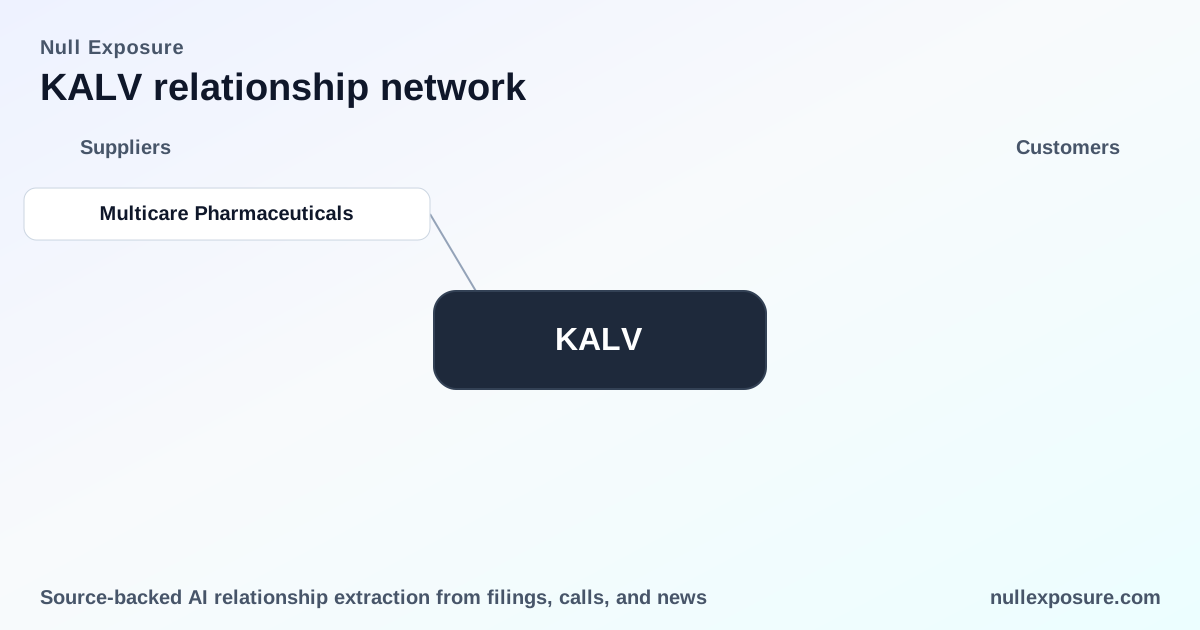
Multicare Pharmaceuticals — Latin America distributor
Multicare will manage regulatory registration, importation, and distribution of KalVista’s oral HAE therapy in Brazil, Argentina, Colombia, and Mexico under an agreement announced January 14; this establishes a regional commercialization partner to accelerate market access across the four largest Latin American markets. A news report from MexicoBusiness News covered the deal on March 10, 2026 (MexicoBusiness News, Mar 2026).
What investors should take from the Multicare arrangement
The Multicare agreement is a commercialization acceleration play: KalVista secures a partner with local regulatory and distribution capabilities in four sizable markets rather than building a direct infrastructure there. That implies faster time-to-market and lower upfront capital requirements, while the company retains upside through product sales or milestone economics. The deal is consistent with KalVista’s stated reliance on third-party distributors and its strategy to avoid high concentration risk by using multiple outsourced partners.
Risk, value drivers, and execution checklist
KalVista’s supplier approach creates a clear set of investment implications:
- Value drivers are regulatory approvals and partner execution. The Latin America partnership expands addressable markets for EKTERLY and, if successful, will translate into early commercial revenue in those territories. KalVista’s RevenueTTM (~$1.43m) and negative EBITDA (~$201.8m) highlight that commercial flows are nascent; partner-led launches are the near-term path to revenue ramp.
- Execution risk is operational rather than technological. The company’s stated intent to use multiple manufacturers mitigates single-source manufacturing risk, but successful launches still depend on timely regulatory filings, importation logistics, and distributor execution.
- Concentration risk is low per disclosures, but complexity rises. Working with multiple vendors and regional distributors reduces counterparty concentration but increases program management demands and compliance overhead.
- Commercial margin and pricing risk. Distributor agreements often compress realized margin early in a market entry; investors should watch deal economics and whether KalVista retains favorable pricing or large channel discounts.
A mid-cycle assessment should focus on clinical/regulatory milestones and supplier performance indicators. For ongoing supplier monitoring and portfolio impact analysis visit https://nullexposure.com/.
Signals to watch next (practical milestones)
- Regulatory filings and approvals in Brazil, Mexico, Argentina, and Colombia tied to Multicare’s registration activity.
- Manufacturing confirmations that multiple suppliers are qualified for commercial supply and any inventory build plan ahead of launch.
- Commercial metrics from initial launches (prescriptions, shipments, pricing) where available through corporate reports or partner disclosures.
- Amendments or expansions to distribution agreements signaling stronger economics or deeper commitment.
Bottom line and investor actions
KalVista’s operating model is outsourced and partnership-driven, with supplier relationships treated as operationally necessary but individually immaterial—this lowers single-vendor concentration risk while shifting the execution burden to procurement and partner management. The Multicare distribution deal materially advances KalVista’s go-to-market efforts in Latin America and is consistent with the firm’s stated supplier strategy. Monitor regulatory milestones and early commercial performance to validate the path from partnership announcement to revenue recognition.
For a systematic supplier risk and exposure review tailored to your portfolio, see the full analytic offering at https://nullexposure.com/. To subscribe for alerts on partner execution and regulatory milestones, visit https://nullexposure.com/ and set real-time monitoring across KalVista’s relationships.