Kairos Pharma (KAPA) — supplier relationships, operating posture, and what investors should watch
Kairos Pharma is a clinical-stage oncology company that operates as a virtual R&D organization: it acquires or licenses drug assets, outsources research and manufacturing, and intends to monetize through clinical progress, licensing deals, and eventual product commercialization or royalty streams. The company runs lean corporate operations while depending on third-party manufacturers, clinical sites and advisers to advance its pipeline — a model that compresses fixed costs but concentrates operational risk in a small number of external providers. For a compact due-diligence brief and supplier intelligence, visit https://nullexposure.com/.
The business model in one line
Kairos runs a capital-efficient, asset-driven biotech model: acquire curated oncology assets, advance them through outsourced clinical and manufacturing channels, and extract value via clinical milestones, licensing or commercial launches. This structure makes supplier contracts and contingency manufacturing plans central to valuation and operational continuity.
How Kairos runs day-to-day — a virtual R&D company with outsourced delivery
Kairos conducts core activities through partners: CROs run trials, CMOs produce clinical material, academic medical centers host trials, and boutique advisers support investor relations and licensing. This contracting posture lowers fixed overhead but creates critical single-point dependencies where supplier failure would delay programs and de-risking milestones. The company’s public filings and press releases consistently show this operating stance, and recent asset acquisitions expand the number of external relationships that must be managed tightly.
- Key operational signal: the company states it will rely on CMOs for both clinical and commercial manufacturing, and has stated plans to identify a U.S. manufacturing site for contingency supply (FY2024 filing and related disclosures).
- For a supplier-focused risk assessment and procurement playbook, see https://nullexposure.com/.
Who Kairos works with — relationship-by-relationship review
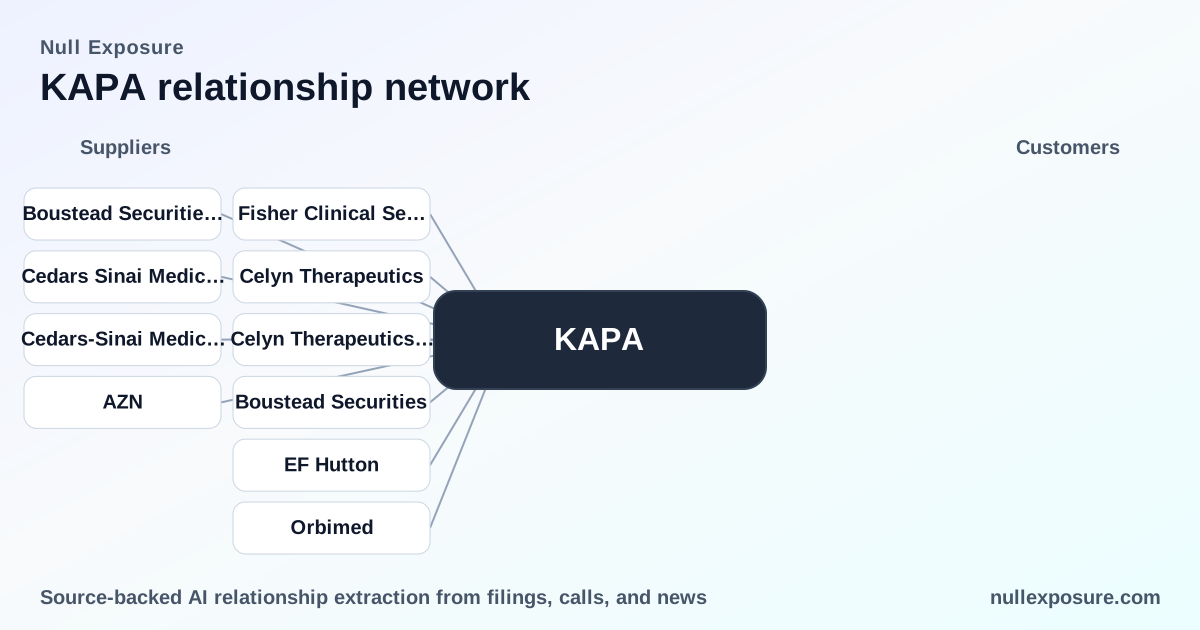
Below I cover every counterparty listed in the public relationship results and provide the straight facts investors and procurement teams need to verify.
Fisher Clinical Services
Kairos names Fisher Clinical Services as a provider used for drug supply and drug product manufacture for its current product candidate. This is stated directly in Kairos’s FY2024 10‑K filing (filed 2024).
Source: Kairos FY2024 10‑K filing (company disclosure, FY2024).
Celyn Therapeutics / Celyn Therapeutics, Inc.
In March 2026 Kairos announced a term sheet and binding strategic asset acquisition from Celyn Therapeutics for two clinical oncology assets, including CL‑273; multiple press releases and market reports indicate the transaction includes upfront considerations, equity participation and milestone/royalty structures. Market coverage and company releases in March 2026 describe Celyn as backed by OrbiMed and Torrey Pines Investment.
Source: Company press release and March 2026 news reports (Marketscreener / PharmiWeb / STT Info / Mugglehead, March 2026).
Boustead Securities (and Boustead Securities, LLC)
Boustead Securities is reported to have acted as lead manager on Kairos’s IPO, and Boustead appears in underwriter lock-up provisions in prospectus-related filings; a March 2026 market filing references Boustead in lock-up arrangements.
Source: Renaissance Capital IPO coverage and lock-up disclosure (Renaissance Capital, MarketScreener, FY2024–FY2025).
EF Hutton
EF Hutton participated alongside Boustead as an underwriter/placement agent on Kairos’s financing transactions noted in public IPO coverage.
Source: Renaissance Capital IPO coverage (FY2024).
OrbiMed (Orbimed)
OrbiMed is cited in public announcements as a backer of Celyn Therapeutics, the counterparty to the CL‑273 acquisition; press reports in March 2026 link OrbiMed to the Celyn financing and transaction backing.
Source: MarketScreener / STT Info press releases (March 2026).
Cedars‑Sinai Medical Center
Cedars‑Sinai is the clinical site sponsor for at least one of Kairos’s Phase 1 trials (KROS‑201), and the company has announced trials and patent activity tied to Cedars‑Sinai in PR material from FY2022 and referenced again in 2026 coverage about trial set-ups. Cedars‑Sinai functions as a critical clinical partner for patient enrollment and protocol execution.
Source: PR Newswire company announcements and subsequent press (FY2022; referenced FY2026).
AstraZeneca (AZN)
Public disclosures reference a planned Phase 1 trial that pairs Kairos assets with AstraZeneca’s Tagrisso for lung cancer — a development-stage clinical plan noted in FY2022 materials. This indicates prior or planned clinical strategy alignment with a large pharmaceutical partner.
Source: PR Newswire / Kairos disclosures (FY2022).
PreCheck Health Services, Inc.
Kairos has executed a bioassay services agreement with PreCheck to provide biomarker screening services to support patient identification for ongoing ENV105 trials, as disclosed in its corporate filings. That contract is operationally relevant for enrollment and companion diagnostic workflows.
Source: Kairos FY2024 disclosures (contract excerpt, FY2024).
Cross Current Capital LLC (and Alan Masley)
Kairos engaged Cross Current Capital and an individual advisor under a consulting agreement to provide financial and business consulting, including investor relations and capital markets introductions — a vendor relationship addressing corporate growth and capital strategy.
Source: Kairos FY2024 disclosures (contract excerpt, FY2024).
Belair Capital Advisors Inc. (BCA)
Kairos entered a strategic advisory agreement with Belair Capital Advisors to receive corporate strategy, market positioning and business development services for a one‑year term, covered in the company’s FY2024 filings.
Source: Kairos FY2024 disclosures (strategic advisory agreement, FY2024).
CEO.CA Technologies Ltd.
Kairos contracted CEO.CA for internet-based financial information and communications services under a one-year engagement disclosed in September 2024, reflecting an outsourced investor information channel.
Source: Kairos FY2024 disclosures (CEO.CA agreement, FY2024).
What the constraints tell investors — contracting posture and risk profile
The public constraints and filing excerpts create a clear company-level signal:
- Contracting posture: Kairos operates a virtual model that relies heavily on third-party CMOs and CROs for manufacturing and trials; the company explicitly plans to use cGMP‑compliant vendors for clinical and expected commercial supply (company filing language).
- Criticality and concentration: The company’s filings treat CMOs as mission‑critical; the disclosures state that dependence on CMOs can impair development and commercialization if disrupted, signaling high operational concentration risk.
- Geographic posture: Kairos has publicly flagged plans to identify and contract a U.S. manufacturing site for contingency manufacturing, indicating a geographic preference or requirement for U.S.-based production capacity.
- Maturity and spend: Contracts are active and operational (ongoing clinical activity is outsourced), and the company reports small vendor advances on the balance sheet (advances of $3,115 as of Dec‑31, 2024), while constraint tagging places vendor spend in a $1M–$10M band — read as a company-level signal that supplier spend will scale materially as clinical programs progress.
Operational risks and value drivers — what matters to investors and operators
- Primary risk: Manufacturing and supply interruption at a CMO would directly delay clinical milestones and valuation catalysts. This is a core commercial risk given the company’s explicit reliance on CMOs.
- Value driver: The Celyn asset acquisition (CL‑273 and a second oncology asset) expands the pipeline and creates near-term clinical milestones that can re‑price the company if trials advance.
- Mitigant: Establishing a U.S. contingency manufacturing site and negotiating robust supply agreements with quality and capacity guarantees will materially reduce execution risk.
For supplier diligence playbooks and competitive supplier intelligence services, visit https://nullexposure.com/.
Tactical steps for investors and procurement teams
- Validate written CMO capacity and contingency plans, including change‑of‑control, quality, and supply continuity clauses.
- Confirm commercial rights and milestone obligations in the Celyn transaction to understand potential outflows (equity stakes, milestone payments, royalties).
- Verify clinical site capabilities at Cedars‑Sinai and any co‑development clauses with large partners (e.g., AstraZeneca references) that could affect program strategy and partner economics.
Bottom line
Kairos’s model is efficient but supplier‑dependent: the company reduces internal fixed cost by outsourcing manufacturing, clinical execution and commercial services, but that creates concentrated operational risk around a small set of service providers and recent asset partners. Investors should prioritize contract-level diligence on CMOs, service providers and the Celyn acquisition terms because those relationships directly determine the timing and realization of value.
If you want a focused supplier-risk scorecard for KAPA or tailored procurement playbooks built from public filings and market coverage, start here: https://nullexposure.com/.