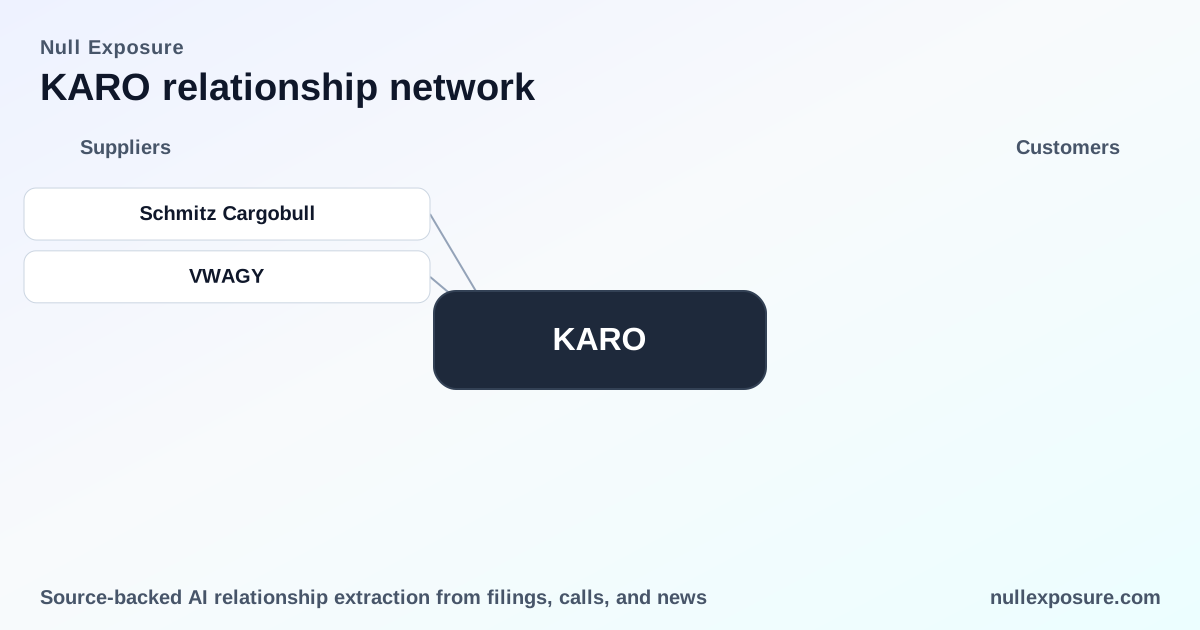
Karooooo (KARO): Supplier Relationships, Strategic Stakes, and Operational Signals
Karooooo operates a global vehicle fleet management software platform and monetizes through recurring SaaS subscriptions, telematics integrations delivered via its Cartrack subsidiary, and value-added services tied to real-time vehicle data. Enterprise integrations with vehicle and trailer OEMs convert hardware-dependent customers into software and connectivity revenue streams, delivering high gross margins and predictable recurring cash flow for investors. For a quick view of supplier risk and relationship mapping, start here: https://nullexposure.com/.
What the business model looks like in practice
Karooooo is a software-first operator whose economics are driven by scale in connected fleets. Public financials through the latest quarter (2025-11-30) show Revenue TTM of $5.25B, Gross Profit of $3.63B, and Operating Margin of 26.2%, validating a high-margin, subscription-like footprint. High insider ownership (79.0%) and modest institutional ownership (16.8%) are governance signals that influence strategic continuity and deal execution. Karooooo’s contracting posture favors integration partnerships with OEMs and telematics providers, converting once-off hardware sales into ongoing service revenue and data monetization.
Supplier relationships that matter to revenue and operations
Below I cover the supplier and partner relationships surfaced in public reporting and news — each summarized succinctly with source attribution.
Schmitz Cargobull — trailer telematics integration
Karooooo’s Cartrack subsidiary integrated Schmitz Cargobull’s TrailerConnect® telematics data into its fleet management platform, enabling transport operators to gain trailer visibility without installing new hardware. This integration reduces barriers to adoption for fleets and accelerates recurring connectivity revenue. (Reported by Simply Wall St, March 10, 2026: https://simplywall.st/stocks/us/software/nasdaq-karo/karooooo/news/how-cartracks-schmitz-cargobull-telematics-integration-will)
Volkswagen — OEM partnership referenced in earnings call
Karooooo confirmed a partnership with Volkswagen during its Q3 FY2026 earnings call discussion, signaling deeper OEM-level integration opportunities for vehicle data services and fleet solutions. OEM partnerships such as this drive enterprise customer access and scale adoption across manufacturer ecosystems. (Earnings call transcript referenced by InsiderMonkey, November 2026 remarks; reported March 10, 2026: https://www.insidermonkey.com/blog/karooooo-ltd-nasdaqkaro-q3-2026-earnings-call-transcript-1679561/)
What these relationships imply about contracts, criticality, and maturity
- Contracting posture: Partnerships with OEMs and major trailer manufacturers indicate long-term, integration-focused contracts rather than one-off hardware deals. Integrations that transmit native OEM telematics data into Cartrack reduce the need for third-party devices and lock customers into Karooooo’s platform.
- Criticality to customers: Real-time trailer and vehicle visibility is operationally critical for fleet operators; these integrations are therefore strategic assets that translate into stickier customer relationships and higher lifetime value.
- Maturity and scale: The mix of OEM partners and the company’s strong margin profile signal a mature commercialization model where software and connectivity are primary revenue drivers rather than device sales.
- Concentration and governance signal: High insider ownership suggests centralized decision-making and long-term strategy continuity; institutional ownership is limited, implying less pressure for short-term changes from public investors.
No explicit supplier constraints were listed in the provided relationship dataset, which presents a company-level signal that public reporting in this tranche did not capture vendor-specific contractual limitations.
For deeper supplier-risk intelligence, see https://nullexposure.com/.
Risks exposed by the supplier map
- Integration dependency: Business performance depends on continued access to OEM telematics streams and the maintenance of integration agreements; losing an OEM connection would harm product capability and potential revenue.
- Limited public constraints: The absence of disclosed constraints in the available relationship data reduces transparency for third-party risk assessment; investors must seek contract-level detail in due diligence.
- Governance concentration: With insiders controlling a large share, strategic decisions (including partnership prioritization and pricing) will reflect entrenched leadership preference; this supports long-term execution but reduces countervailing shareholder influence.
Investor takeaways and practical checklist
- Positive: Karooooo’s OEM and trailer integrations convert capital-intensive fleet customers into recurring revenue, supporting the company’s robust margins and growth profile. The Schmitz and Volkswagen relationships are direct evidence of this go-to-market strategy.
- Watch: Request contract tenors, data access terms, and exclusivity clauses for OEM integrations to quantify supplier lock-in and single-counterparty risk.
- Actionable steps for operators and investors:
- Confirm the technical and commercial scope of OEM integrations (data fields delivered, update cadence, termination clauses).
- Validate revenue attribution from OEM-integrated customers versus legacy hardware customers.
- Monitor OEM rollouts and regulatory changes affecting vehicle telematics data access.
Before committing capital or operational reliance, review contract summaries and integration SLAs; for supplier-risk dashboards and ongoing monitoring, visit https://nullexposure.com/.
Final assessment
Karooooo’s supplier relationships with Schmitz Cargobull and Volkswagen are strategically aligned with a SaaS-centric, recurring revenue model that scales through embedded OEM data. These partnerships materially increase customer stickiness and reduce hardware friction, supporting the company’s high operating margins and revenue per share metrics. Investors and operators should prioritize access to contract-level details and technical scope to quantify dependency and downside exposure. For a focused supplier-risk evaluation and ongoing monitoring, explore https://nullexposure.com/.