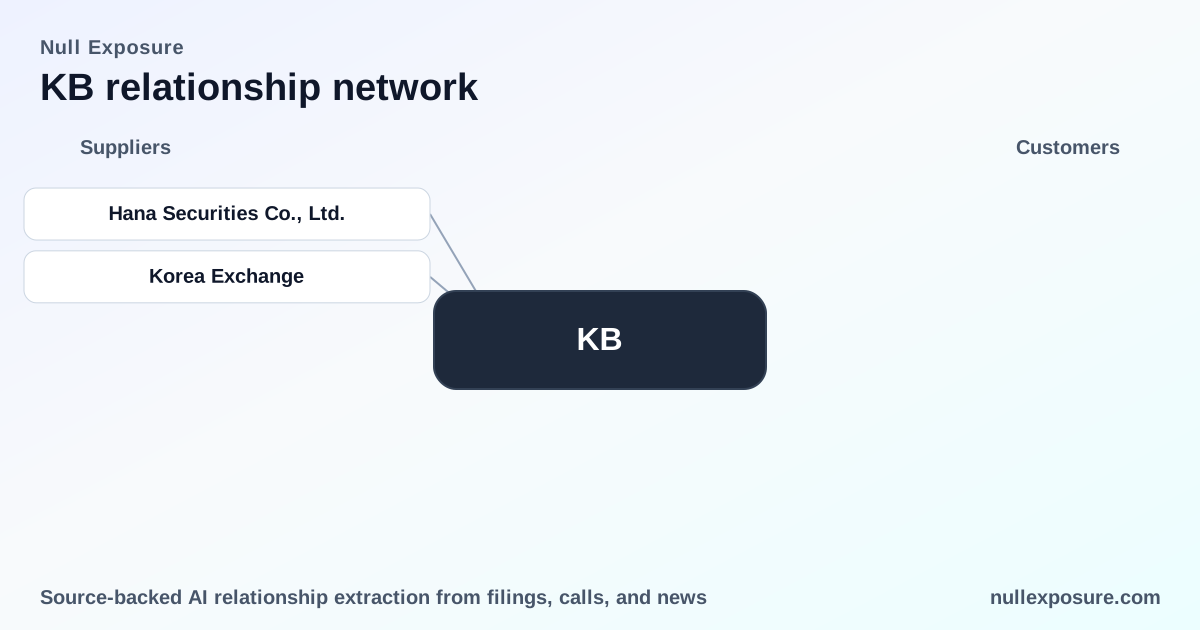
KB Financial Group: supplier relationships that matter for capital actions
KB Financial Group is a diversified South Korean banking franchise that monetizes through traditional banking spreads, fee income, and capital markets activities across retail, corporate and investment channels. For investors and operators, the supplier map for KB in this dataset is narrowly focused on capital markets counterparties tied to share repurchase execution and trust arrangements — not on core banking vendors — which makes these relationships strategically important for governance and shareholder-return execution but limited in operational scope. Explore more supplier intelligence at https://nullexposure.com/.
Why these supplier relationships are material to investors
KB’s supplier interactions in the record are linked directly to share buyback mechanics rather than ongoing technology or loan operations. That concentration means a small set of counterparties can influence timing, legal control and market execution of capital-return programs. For an equity investor, the practical implication is that governance of buybacks and the choice of execution partners affect share count, liquidity and investor perceptions — all of which feed into valuation.
Visit https://nullexposure.com/ for deeper supplier profiles and contextual signals.
Hana Securities: trustee relationship concluded
KB entered a trust agreement with Hana Securities Co., Ltd. on July 24, 2025 for the acquisition of treasury shares; KB announced on January 9, 2026 that the trust agreement terminated following the scheduled expiration of its term. This was a discrete trustee role tied to a defined buyback program rather than an ongoing vendor-supplier arrangement. Source: The Globe and Mail press release citing KB’s announcement dated January 9, 2026 (link).
Korea Exchange: buyback execution venue
KB launched a KRW 600 billion share buyback to be executed on the Korea Exchange between February 6 and April 20, 2026, indicating the Exchange served as the primary market venue for program execution. The Korea Exchange relationship is transactional and market-facing, critical for pacing and public visibility of the repurchase program. Source: The Globe and Mail press release reporting the buyback details (February–April 2026 execution window).
What these relationships tell us about KB’s operating model
The supplier data in this snapshot supports several firm-level signals about KB’s contracting posture and supplier profile:
- Contracting posture — tactical and program-specific. Supplier engagements recorded are event-driven (trust agreement for treasury shares; market execution on the exchange), not long-term platform contracts. That indicates KB uses specialized counterparties on an as-needed basis for capital actions rather than centralized long-duration supplier contracts for this function.
- Concentration — low breadth, high focus. Only two counterparties appear in the current supplier set, reflecting low supplier breadth but relatively high importance of each counterparty for buyback outcomes.
- Criticality — strategic for shareholder returns, not core operations. These relationships are critical to capital return execution and investor optics but do not reflect dependencies for deposit-taking, lending systems, or core IT.
- Maturity — established capital markets plumbing. The relationships reflect standard, mature market practices: trustee arrangements for share acquisition and execution on the national exchange.
No explicit supplier-level constraints were recorded in the available signals; at the company level this absence is itself information: KB’s public supplier footprint in this extract is limited to capital markets counterparties rather than an extensive outsourced vendor ecosystem.
Investment implications and operational risk
KB’s buyback program mechanics create a few clear investor considerations:
- Timing and execution risk: Execution windows on the exchange and the presence (or termination) of trust agreements can accelerate or decelerate buybacks, affecting share count and liquidity. The termination of the Hana Securities trust following its scheduled term is a procedural signal — investors should track whether subsequent trust arrangements are put in place or whether execution shifts entirely to open market trading.
- Governance and disclosure: Reliance on discrete counterparties for buybacks elevates the importance of transparent disclosures around program rules, counterparties and timelines. KB’s public notices, as relayed in the press releases, indicate standard disclosure but investors should watch for recurring patterns or changes in counterparties across cycles.
- Market perception: Announced repurchases executed on the Korea Exchange present visible signals to the market and can influence short-term sentiment and valuation multiples. KB’s continued use of a KRW 600 billion program demonstrates active capital allocation to shareholder returns.
Key takeaway: these supplier relationships are important levers for capital allocation outcomes but are not structural dependencies for KB’s banking operations.
Quick, actionable checklist for investors and operators
- Confirm whether future buyback programs reuse the same trustee or move to a different mechanism, and monitor associated filing dates and termination notices.
- Track execution cadence on the Korea Exchange filings and trade reports during announced windows to verify completion rates.
- Evaluate governance disclosures around repurchases to assess counterparty selection process and potential conflicts of interest.
Full relationship coverage (concise summaries with sources)
Hana Securities Co., Ltd. — KB terminated a trust agreement originally signed on July 24, 2025 for the acquisition of treasury shares after the trust’s scheduled term ended, indicating the trustee role concluded as planned. Source: The Globe and Mail press release reporting KB’s January 9, 2026 announcement (link).
Korea Exchange — KB launched a KRW 600 billion share buyback to be executed on the Korea Exchange between February 6 and April 20, 2026, identifying the Exchange as the execution venue for the program. Source: The Globe and Mail press release describing the buyback program and execution window (link).
Closing assessment and next steps
For investors focused on the mechanics of shareholder returns, the supplier relationships recorded for KB are short, clear and governance-oriented: trustee functions and exchange execution are the relevant supplier interactions, with limited operational vendor risk in this extract. Monitor subsequent filings for new trust agreements or alternative execution methods to detect shifts in KB’s capital-return playbook.
If you want a concise supplier risk brief or ongoing monitoring for KB and its capital markets counterparties, get tailored intelligence and alerts at https://nullexposure.com/.
Explore supplier-backed investment signals and vendor transparency resources at https://nullexposure.com/ to integrate buyback counterparty risk into your investment workflow.