KB Home (KBH) — Supplier Relationships and Strategic Implications for Investors
KB Home builds and sells single‑family homes across 49 U.S. markets and monetizes through home sales, option upgrades and lot development margins, with services and financing that support unit throughput. Revenue flows are driven by unit closings and product upsell, while raw‑material and trade partner contracts directly shape gross margin volatility. For a focused supplier risk view and tracking of strategic partnerships, visit Null Exposure.
How KB Home runs the business and where suppliers fit in
KB Home operates as a production homebuilder with a capital‑efficient model that outsources much of construction to trade contractors and sources building materials from third parties. The company reported $6.24 billion in trailing revenue and $1.22 billion in gross profit, supporting an operating margin in the mid‑single digits; those margins depend on procurement discipline, fixed‑price trade contracts and options to buyers. KB Home’s market capitalization of roughly $3.52 billion and a trailing P/E near 8.8x reflect a business that is cash generative but sensitive to input costs and sales cadence.
Key financial anchors for supplier assessment:
- Revenue TTM: $6.24B; Gross profit TTM: $1.22B; Profit margin: 6.9%.
- Trailing P/E: 8.83 and Forward P/E: 12.18, signaling market expectations for margin normalization.
- High institutional ownership (approx. 98%) creates a supplier environment where predictable cost control and transparency are valued by investors.
The new Cosentino arrangement and what it means
Cosentino has been named KB Home’s exclusive countertop provider across all 49 markets, establishing a national supply relationship that standardizes a visible product line in new homes. According to a March 10, 2026 industry report, the agreement positions Cosentino as the sole countertop brand for KB Home’s model and production homes nationwide, creating scale benefits for both parties while concentrating a key interior finish with a single supplier partner. (Floor Covering Weekly, March 10, 2026).
Implication: Exclusive national supply for a category like countertops reduces SKU complexity and improves procurement leverage for KB Home, while concentrating counterparty risk around availability, logistics and price renegotiation for that category.
Company‑level procurement signals and contracting posture
KB Home’s public disclosures provide specific signals about its supplier relationships and procurement posture that matter to investors and operator relationships:
- KB Home sources many building materials from third parties and selects products with sustainability certifications where feasible, reflecting a procurement policy that favors certified inputs for marketing and compliance benefits.
- The company typically enters fixed‑price contracts with larger trade partners and building material suppliers for specified periods, establishing a contracting posture that transfers input price risk onto suppliers during the contract term and creates incentive for supplier efficiency.
- KB Home is a lessee for corporate offices, division offices and design studios; its lease population is comprised of operating leases where KB Home is the lessee, indicating an organizational footprint that balances owned lots with leased administrative/retail facilities.
- The company disclosed nearly $1.20 billion of borrowing capacity under its credit facility as of November 30, 2025, with up to $248.4 million available for letters of credit, signaling meaningful financial flexibility to fund procurement and letters of credit that support supplier requirements.
These are company‑level signals: they describe KB Home’s procurement and capital posture broadly and do not attribute behavior to any single supplier unless the disclosure names that supplier.
Relationship inventory — every supplier tie recorded
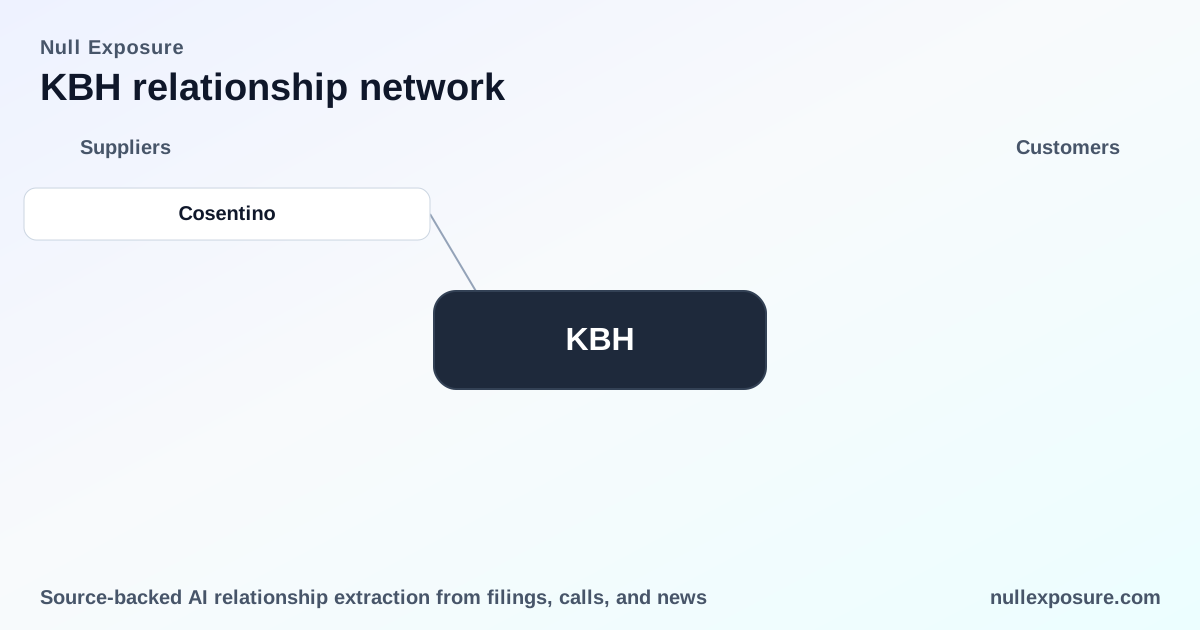
Cosentino — A national exclusive countertop supplier for KB Home’s 49 markets; the partnership centralizes countertop sourcing and establishes Cosentino as the sole provider for that category across KB Home’s footprint (Floor Covering Weekly, March 10, 2026).
(There are no additional supplier relationships recorded in the public results provided.)
What this means for supplier strategy, concentration and investor risk
- Concentration and criticality: Consolidating countertops under Cosentino reduces procurement complexity and increases purchasing scale, which strengthens KB Home’s unit economics for finishes but increases criticality on a single supplier for a high‑visibility interior item.
- Contracting leverage: Fixed‑price supplier contracts favor KB Home’s margin predictability in rising cost environments, transferring cost escalation risk to suppliers for the contract term and enhancing short‑term margin stability.
- Maturity and vendor selection: The emphasis on sustainability‑certified products and national exclusive deals suggests KB Home is moving toward standardized, mature vendor relationships rather than fragmented local sourcing.
- Operational resilience: Substantial available credit and the use of letters of credit support KB Home’s ability to fund inventory and secure supplier performance, reducing short‑term counterparty credit risk for trade partners.
If you manage supplier exposure or evaluate vendor opportunities with KB Home, prioritize operational redundancy for concentrated categories, capacity guarantees in contracts, and logistics reliability to match KB Home’s national scale. For a deeper supplier‑risk playbook and continuous monitoring, visit Null Exposure.
Actionable takeaways for investors and operators
- Positive: Standardizing countertops with Cosentino drives procurement efficiency and better predictability for finish margins across KB Home’s 49 markets. This is a margin‑supportive move for the company.
- Watchlist: The exclusivity structure increases counterparty concentration risk; investors should monitor service levels, pricing clauses and contingency sourcing plans.
- Negotiation posture: KB Home’s reliance on fixed‑price contracts and strong liquidity indicates leverage in multi‑year supplier negotiations but also sets up sharp margin impacts if product quality or supply interruption occurs.
For targeted intelligence on supplier contracts, exclusivity clauses and trade partner concentration that impact builder margins, explore detailed supplier profiles at Null Exposure.
Final recommendation
KB Home’s supplier strategy is converging toward fewer, larger national partners with fixed‑price terms and sustainability preferences, which benefits margin predictability but raises concentration risk in visible categories like countertops. Investors should incorporate supplier concentration and contract structures into valuation stress tests; operators and potential suppliers should structure capacity and contingency in any exclusive relationship with KB Home.
For ongoing tracking of KB Home supplier risk and to evaluate counterparties across the homebuilding ecosystem, visit Null Exposure.