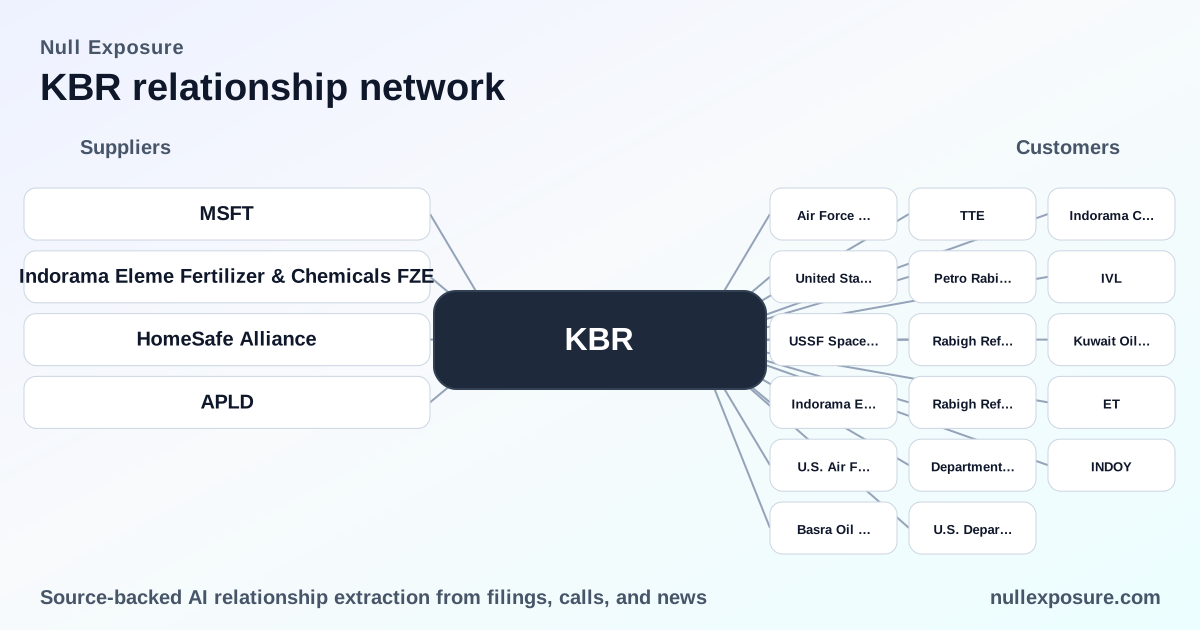
KBR Inc.: Supplier relationships that shape project economics and delivery risk
Thesis — KBR monetizes engineering, construction and technology by selling end-to-end project delivery and recurring services to government and commercial clients: fixed‑price and cost‑plus EPC contracts, long‑duration supply agreements, and recurring software and performance services tied to operating plants. Revenue derives from project execution margins and from higher‑margin technology and service contracts that scale when deployed across licensed assets and contractor portfolios. Investors should evaluate KBR’s supplier and partner footprint because it directly affects execution risk, margin capture, and the optionality of recurring revenue streams. For a faster read and ongoing monitoring, visit https://nullexposure.com/.
How KBR’s business model converts projects into cash flow
KBR operates as a hybrid contractor and technology licensor. The firm wins large engineering and construction contracts that generate material near‑term revenue (Revenue TTM: $7.786B) and then layers higher‑margin recurring income through technology offerings and long‑term supply arrangements (EBITDA: $685M; Operating margin ~7.6%). The company is currently pursuing digitalization of project controls and productized performance services that increase visibility into project economics and enable faster commercial decisions. High ROE (30.7%) signals effective capital deployment when projects run to plan, but execution and supplier continuity are key levers for preserving margins.
KBR’s capital structure and valuation metrics (Market cap ~$4.64B; Trailing P/E ~10.5; EV/EBITDA ~7.5) reflect a business with meaningful cash generation but elevated execution sensitivity typical of the engineering & construction sector. This sensitivity makes supplier and partner relationships both strategic value drivers and concentrated risk points.
For ongoing company and counterparty research, see https://nullexposure.com/.
Supplier and partner relationships investors should track
Microsoft — digital controls for project delivery
KBR is rolling out Microsoft Dynamics across its STS portfolio to digitalize ERP and project controls, enabling near‑real‑time commercial decisions and tighter project execution. This is positioned as an operational lever to improve project margins and responsiveness. Source: KBR Q4 2025 earnings call transcript referenced in an InsiderMonkey summary (published March 10, 2026).
Indorama Eleme Fertilizer & Chemicals FZE — long‑dated catalyst supply
KBR was awarded a 10‑year catalyst supply contract by Indorama Eleme Fertilizer & Chemicals FZE, representing a multi‑year, product‑tied revenue stream that complements project work with recurring supply income. Long‑term contracts like this create predictable revenue lanes but also commit KBR to supply and performance obligations. Source: GlobeNewswire release announcing the contract (February 19, 2026).
HomeSafe Alliance — partnership and program execution visibility
KBR publicly described the HomeSafe partnership as “strong” and “excellent” during its Q1 public remarks, underlining the strategic importance of program partnerships to KBR’s service delivery and future pipeline. This relationship is presented as a program where execution credibility and sustained performance are central to long‑term value capture. Source: coverage of KBR comments reported by OpenPR, referencing the company’s May 6, 2025 Q1 remarks.
Applied (APLD) — INSITE 3.0 and physics‑based AI for plant performance
KBR launched INSITE 3.0 through a new venture with Applied, using physics‑based AI to enhance operational performance at licensed ammonia plants and similar assets, creating software‑driven recurring revenue and differentiated service offerings for plant operators. This partnership represents KBR’s push to convert engineering know‑how into scalable software and performance contracts. Source: KBR Q4 2025 earnings call transcript summarized by InsiderMonkey (published March 10, 2026).
What the constraints tell investors about KBR’s operating posture
The company‑level constraints in public disclosures provide clarity on how KBR sources inputs and manages third‑party relationships, producing actionable risk signals:
- Global sourcing is intrinsic to the model. KBR obtains equipment and materials from a variety of global suppliers, which supports geographic project diversity but increases exposure to supply‑chain shocks, trade controls, and freight dynamics. This is a company‑level signal on procurement footprint and global supplier dependence.
- KBR operates as both integrator and reliant buyer of manufacturer inputs. The company acknowledges dependence on third‑party subcontractors, suppliers, and equipment manufacturers. That dual posture amplifies execution risk: KBR is the prime integrator for clients but often depends on external manufacturers for critical components.
- Third‑party risk management is institutionalized. The firm maintains a third‑party risk program to assess cyber and vendor risks, indicating maturity in governance but also the need for continuous oversight as digital offerings expand.
Together these constraints indicate a contracting posture that is portfolio‑diverse but execution‑sensitive, with supplier criticality concentrated around specialized equipment and software integrations.
Investment implications and a practical checklist
KBR’s supplier and partner map feeds directly into valuation and risk monitoring. Key implications:
- Recurring revenue growth vector: Partnerships with Applied (INSITE) and long‑dated supply deals like Indorama convert one‑time project wins into predictable cash flow, increasing the business’s multiple over time.
- Execution and supply risk: Global sourcing and reliance on manufacturers create single‑vendor or geopolitical vulnerabilities that can compress margins if not managed.
- Digitalization as margin lever: Microsoft Dynamics deployment improves visibility into project economics and can reduce commercial leakage on large contracts.
- Reputation and program risk: Public assurances about partnerships such as HomeSafe underscore the link between program execution and future contract awards.
Use this checklist to evaluate ongoing risk:
- Track new long‑term supply agreements and their revenue recognition profiles.
- Monitor rollout progress and integration milestones for digital controls (Microsoft Dynamics) and INSITE 3.0.
- Watch supplier concentration in critical equipment categories and geographic exposure to trade restrictions.
- Verify third‑party risk program maturity and cyber risk coverage as software and licensor revenues grow.
For a deeper supplier‑level risk assessment and continuous monitoring, consult https://nullexposure.com/.
Bottom line: supplier relationships are strategic growth engines and execution levers
KBR’s growth is balanced between large EPC projects and the systematic monetization of technology and supply contracts. Supplier and partner relationships such as Microsoft, Applied, Indorama, and HomeSafe are not peripheral — they directly influence margin capture, revenue durability, and execution risk. Investors should treat these relationships as primary inputs to scenario models and risk frameworks rather than ancillary disclosures.
To continue monitoring KBR’s supplier landscape and materially relevant counterparty developments, visit https://nullexposure.com/ for updated coverage and research tools.