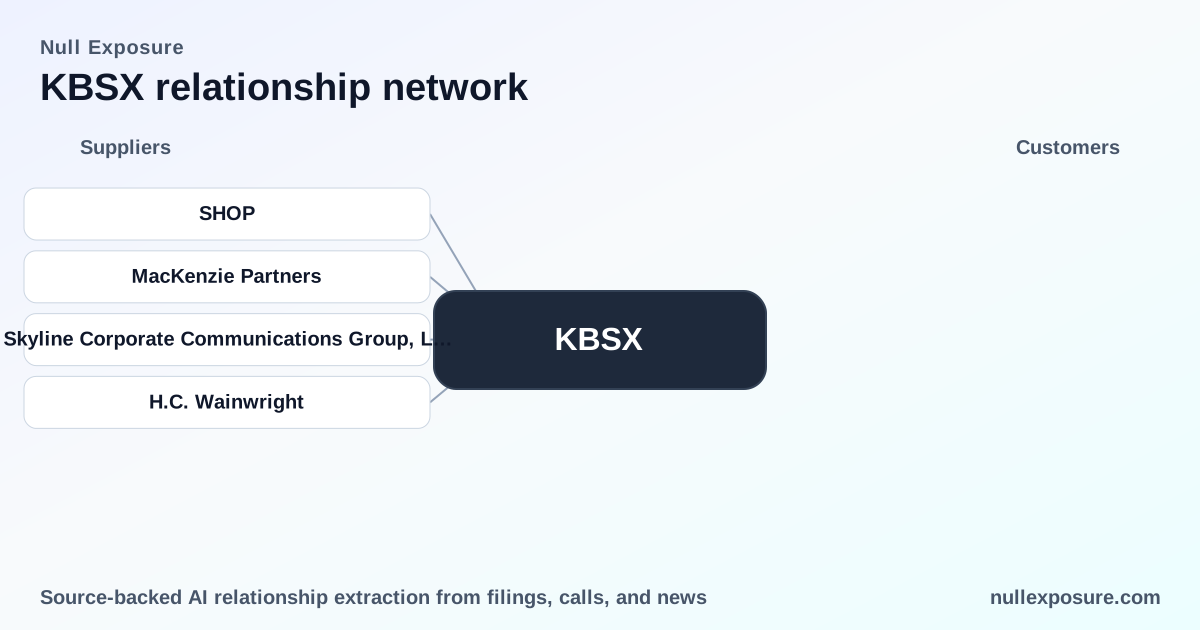
FST Corp. (KBSX) — supplier map and what it means for investors
FST Corp. manufactures and markets steel and graphite golf shafts and sells related golf products and services; it monetizes through product sales, fulfillment-driven e‑commerce channels, and direct-to-consumer distribution supported by outsourced marketing, investor relations, and corporate services. Management is actively building scalable e‑commerce and fulfillment capabilities while relying on a small set of third‑party service providers for commerce, communications and governance support. For a quick look at supply-side exposure and vendor concentration, visit https://nullexposure.com/.
Business investors and operators should read this as a supplier‑centric lens: the suppliers listed are not raw‑material vendors but service and platform partners that affect distribution, investor access, and corporate communications.
Why the supplier list matters for an investor in a small cap manufacturer
FST is a compact, founder/insider‑controlled business (46.4% insider ownership) with modest market capitalization and negative operating profits; vendor choices therefore have outsize operational and signaling effects. Key operating model characteristics:
- Contracting posture: predominantly service‑oriented, with SaaS and retained communications/legal vendors rather than vertically integrated manufacturing suppliers. This reduces capital intensity but increases dependence on external providers for revenue growth execution.
- Concentration: a small number of repeated communications and investor‑relations partners indicates concentration in IR/PR spend, which is efficient for message control but increases single‑vendor dependency risk.
- Criticality: e‑commerce platform and fulfillment operations are operationally critical to sales; a disruption to those services would quickly hit revenue realization.
- Maturity and scale: small‑cap profile with positive topline growth but negative EBITDA and EPS signals a company in scaling mode investing in distribution and investor visibility.
For more context on how supplier relationships map to risk and opportunity, see https://nullexposure.com/.
Supplier relationships you should know (with sources)
Shopify (Shopify Plus)
FST announced the rollout of Shopify Plus to scale e‑commerce operations, automate workflows and support market expansion—an explicit move to professionalize and scale online sales. According to a Yahoo Finance release (March 10, 2026), FST has initiated the Shopify Plus rollout to support larger‑account and automated commerce use cases: https://finance.yahoo.com/news/fst-corp-joins-shopify-plus-120000864.html.
Takeaway: Shopify Plus is a strategic sales channel that is operationally material to online revenue capture.
MacKenzie Partners
MacKenzie Partners is engaged as FST’s proxy solicitor to handle shareholder voting and AGM logistics; contact details for proxy assistance were provided in the shareholder meeting notice. FST’s AGM notice (Dec 1, 2025) directs shareholders to MacKenzie Partners for voting support: https://markets.financialcontent.com/sweetwaterreporter/article/newsfile-2025-12-1-fst-corp-to-hold-annual-general-meeting-of-shareholders-december-8-at-1000-am-eastern.
Takeaway: Outsourced proxy services indicate a professionalized governance process and reliance on third parties for shareholder engagement.
Skyline Corporate Communications Group, LLC
Skyline is repeatedly listed as FST’s investor relations and press distribution partner across multiple press releases (earnings, fulfillment expansion, event presentations and AGM materials). Examples include a GlobeNewswire release on July 9, 2025, and other filings announcing revenue growth and IR contact details: https://www.globenewswire.com/news-release/2025/07/09/3112552/0/en/FST-Corp-Announces-Expansion-of-Fulfillment-Center-in-Garden-Grove-California.html and related releases in 2025–2026.
Takeaway: Skyline is FST’s primary communications vendor; this is a concentrated relationship that drives investor perception and message control.
H.C. Wainwright
FST participated in the 27th Annual H.C. Wainwright Global Investment Conference (September 2025), using the conference platform to present growth progress to institutional and retail investors: see the investor conference notice (Sept 2025): https://markets.financialcontent.com/whittierdailynews/article/gnwcq-2025-9-5-fst-corp-to-present-at-the-27th-annual-hc-wainwright-global-investment-conference.
Takeaway: Participation in recognized investor conferences supports discovery among institutional investors but has not yet translated into significant institutional ownership (5.38%).
What these supplier relationships imply for operations and risk
FST’s external supplier slate is dominated by commerce enablement (Shopify Plus), communications/IR (Skyline), proxy solicitation (MacKenzie) and investor outreach (H.C. Wainwright). Those choices map into three operational realities:
- Revenue delivery depends on platform and fulfillment execution. The Shopify Plus rollout and the stated fulfillment center expansion in Garden Grove put external commerce and logistics vendors at the center of near‑term revenue scaling.
- Investor visibility is centralized through a small set of firms. Heavy reliance on Skyline and repeat press releases indicates a deliberate communications program; this concentrates messaging power but raises vendor‑specific counterparty risk if the relationship weakens.
- Governance and shareholder mechanics are outsourced. Using an experienced proxy solicitor reduces execution risk around meetings and voting but also signals that management prefers external handling of shareholder administration.
Mid‑cycle monitoring should prioritize merchant performance metrics (online conversion and fulfillment throughput), PR cadence, and the Amazon/Shopify channel performance data that management presents in future releases. For practical monitoring and supplier exposure tools, visit https://nullexposure.com/.
Financial and market context investors need to keep front of mind
FST is a small‑cap company (Market Cap ~$58.4M) with trailing revenue of $47.97M and **gross profit of ‑14.8%), reflecting continued investment in growth and distributions. Key balance‑sheet and market signals:$20.63M (approx. 43% gross margin)**, but the company reports negative EBITDA (‑$1.47M) and a negative profit margin (
- Scale: revenue growth is visible (quarterly revenue growth YOY: +30.4%), indicating demand traction.
- Profitability: operating margin is negative (~‑6.98%) with diluted EPS at ‑$0.16, so profitability improvement remains a priority.
- Ownership profile: high insider ownership (46.4%) and minimal institutional ownership (5.38%) indicate founder control and limited institutional validation to date.
These financials frame supplier risk: with a lean capitalization base, FST’s ability to absorb vendor cost shocks or sudden platform migration costs is limited.
What investors and operators should watch next
- Shopify Plus rollout KPIs: monitor conversion rate, average order value and cart abandonment after platform migration—these are direct drivers of top‑line leverage.
- Fulfillment scaling: measure fulfillment cost per order and delivery lead times after the Garden Grove expansion announcements.
- Communications cadence: track IR output from Skyline and activity at investor conferences to understand market engagement.
- Governance signals: proxy activity handled by MacKenzie Partners is a proxy for shareholder relations; watch for voting outcomes on equity plans and board items.
For deeper supplier exposure analysis and ongoing monitoring resources, check https://nullexposure.com/.
Conclusion: FST is a small but growing specialty‑manufacturing issuer that has deliberately outsourced commerce, communications and governance to a tight group of professional providers. That structure accelerates scalability but concentrates operational risk in a few external partners—investors should press management for platform KPIs and fulfillment economics to validate the path to positive operating leverage.