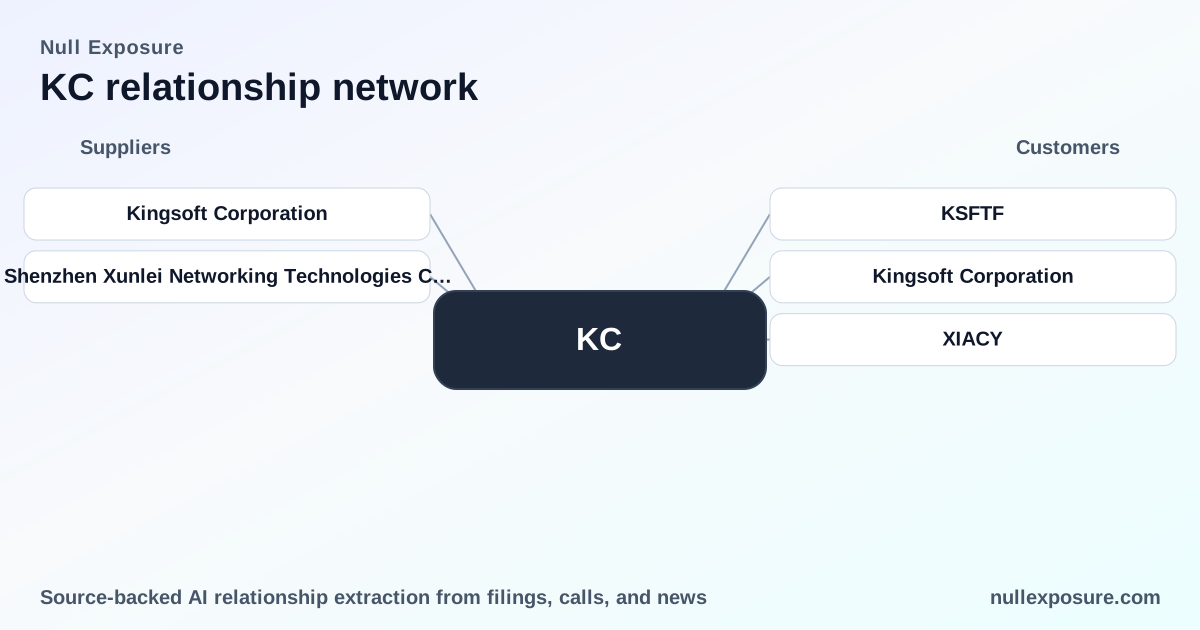
Kingsoft Cloud (KC): Related-party ties and what they signal for investors
Kingsoft Cloud is a Chinese cloud-services operator that monetizes through infrastructure and application cloud offerings, industry-focused solutions, and ancillary services such as property and lease arrangements tied to its operating footprint. The company generates scale through enterprise and consumer cloud contracts, and its financial profile shows meaningful revenue scale (Revenue TTM ≈ 9.03B) alongside negative EPS and operating margins that reflect growth and investment. For investors and ops teams assessing supplier and partner risk, the corporate links between Kingsoft Cloud and related entities—particularly major shareholder Kingsoft Corporation and a recent strategic purchase from Shenzhen Xunlei—are central to operational concentration and cash flow governance. Visit NullExposure for deeper supplier network reports and ongoing monitoring.
How Kingsoft Cloud makes money and what drives supply relationships
Kingsoft Cloud sells cloud compute, storage, and software services to businesses in China and monetizes via recurring contracts, usage-based billing, and enterprise deployments. Revenue growth is the primary driver, while property & lease arrangements and intra-group service contracts are material levers that affect cost structure and capital allocation. The company’s market capitalization and profitability profile show a business still investing through losses at the net-income level (negative diluted EPS), but with strong gross profit scale.
Operationally, this structure produces a few durable signals investors should treat as company-level characteristics:
- Contracting posture: The company uses framework agreements and annual caps for related-party property and service transactions, indicating formalized but ongoing reliance on affiliated vendors.
- Concentration: Significant shareholder overlap and affiliate transactions concentrate contractual exposure and create governance vectors around pricing and access to property/operations.
- Criticality: Property services and leased facilities are operationally critical for data center footprint and service delivery; related-party provision of these services heightens critical-path risk.
- Maturity: The increasing annual caps through 2026–2027 indicate a decision to formalize and extend these arrangements over the near term, reflecting an operational model that expects continued affiliated support.
Kingsoft Corporation: shareholder landlord and related-party counterparty
Kingsoft Corporation, which holds roughly 32.94% of Kingsoft Cloud, was the subject of a late-February 2026 SEC filing in which Kingsoft Cloud raised the annual caps on related-party property services and lease transactions for 2026 and 2027 under their framework agreement. This is a direct example of the company formalizing expanded economic exposure to a major shareholder through property and lease contracts. According to coverage of that SEC filing reported by Simply Wall St in March 2026, the change increases the operational envelope for these intra-group transactions and cements Kingsoft Corporation’s ongoing supplier role.
Source context: Coverage of the SEC filing and related-party cap increases was reported by Simply Wall St (first seen March 10, 2026), citing the company disclosure filed in late February 2026.
Shenzhen Xunlei → Wuhan Kingsoft Cloud: a targeted equity transfer into a VIE
A separate transaction reported in early March 2026 shows Shenzhen Xunlei transferring 20% of Shenzhen Onething’s equity to Wuhan Kingsoft Cloud, identified as a variable interest entity (VIE) of Kingsoft Cloud, for a cash consideration of RMB 50 million (inclusive of tax). This is an example of Kingsoft Cloud extending its operational reach through a VIE acquisition rather than a straight equity purchase, aligning a small, targeted asset under its operational umbrella. GlobeNewswire reported the definitive agreements on March 3, 2026.
Source context: GlobeNewswire press release, March 3, 2026, describing the Shenzhen Xunlei disposition and the Wuhan Kingsoft Cloud Equity Transfer Transaction.
Why these relationships matter: operational and investor implications
The two relationships above combine to produce a clear risk-reward profile for investors and operators:
- Governance and related-party exposure. The raised annual caps with Kingsoft Corporation increase the dollar value of services and leases that flow through an affiliated counterparty, creating direct governance and transfer-pricing considerations for minority investors.
- Operational concentration on affiliated infrastructure. Property services and lease dependence imply that core data-center or office operations may be closely tied to shareholder-affiliated providers—a critical operational dependency during service disruptions or strategic disputes.
- Selective asset aggregation via VIEs. The Shenzhen Xunlei transaction channels a minority interest into a VIE structure, signaling a preference for control and operational influence without a conventional equity consolidation—this is a maturity and structuring signal about how Kingsoft Cloud will expand selectively.
- Capital outlays and near-term commitments. Raising caps for 2026–2027 suggests planned or anticipated increases in affiliated spend; that has implications for free cash flow and capital allocation in the near term.
Key takeaway: These relationships are not peripheral—they are integrated into operating arrangements and capital planning, and they materially affect risk concentration and governance.
For operational teams, that means focusing diligence on service-level robustness and contingency planning for affiliated suppliers. For investors, it demands closer scrutiny of related-party terms, pricing transparency, and the board-level controls that govern these transactions. If you want an ongoing watch on these supplier relationships and governance signals, explore NullExposure for tailored alerts and supplier analytics.
Short list of practical risks and mitigants
- Increased related-party spending creates pricing and conflict-of-interest risk; mitigant: require board-level disclosure, independent valuations, and external benchmarks.
- Affiliated provisioning of property services raises single-point-of-failure risk for data-center footprint; mitigant: diversify real estate and service providers where feasible, and require contractual SLAs.
- Use of VIEs to acquire operating assets introduces regulatory and consolidation complexity; mitigant: review structural legal opinion and cash flow remittance mechanics.
Final read: what investors and operators should do next
Kingsoft Cloud’s recent disclosures and transactions are a clear signal that affiliated relationships are an active channel for both cost and expansion, not a passive background fact. For investors evaluating KC supplier relationships, prioritize governance transparency, the dollar magnitude of related-party caps, and operational contingency for affiliated property services. For operators and procurement teams, insist on SLAs and fallback providers where these related parties sit on the critical path.
For continued monitoring and supplier-focused intelligence, visit NullExposure to subscribe to relationship tracking and governance alerts. The interplay of shareholder-aligned suppliers and VIE structuring will continue to define the company’s capital allocation and operational risk profile—treat these as central inputs into any investment or supplier-risk model.