Kyndryl (KD) — supplier footprint, the IBM legacy, and what operators should price in
Kyndryl sells outsourced infrastructure and modernization services to large enterprises and monetizes through long-term managed-services contracts, project-based transformation fees, and platform integrations with hyperscalers and ISV partners. Revenue derives from recurring service streams and large-scale hardware and software fulfillment tied to customer engagements, while margins depend on supplier terms, legacy vendor transitions, and the speed of hyperscaler adoption. For investors and procurement leaders, the key question is how surviving ties to IBM and the shift to hyperscalers influence cost structure, concentration risk, and contractual flexibility. Learn more about supplier intelligence and how it informs contract decisions at https://nullexposure.com/.
The headline: Kyndryl still shows a meaningful historical spend with IBM, but the relationship is evolving fast
Kyndryl’s public disclosures document a substantial historical flow of goods and services from IBM, including a multi-hundred-million-dollar hardware program and more than $1 billion of related-party cost recognition in recent prior years. Management has emphasized a deliberate pivot toward hyperscaler partnerships that is already producing material new revenue streams. According to Kyndryl’s separation disclosures and recent fiscal filings, IBM committed to deliver about $265 million of upgraded hardware as part of the separation, and Kyndryl recorded related-party cost of services of $1.4 billion for the year ended March 31, 2023. A Tikr blog post (March 10, 2026) quoted Kyndryl leadership highlighting a reduction in IBM spend from nearly $4 billion to roughly $2 billion while hyperscaler-related revenue grew toward $2 billion, up 58% year-over-year in the quarter.
Constraints and what they reveal about Kyndryl’s operating model
Kyndryl’s supplier constraints give a clear read on contracting posture, concentration, criticality, and maturity of supplier relationships.
- Contracting posture — evidence of long-term commitments tied to the separation. The company disclosed that IBM committed hardware upgrades over a two-year period as part of the separation, signaling legacy, time-bound supplier commitments embedded in the corporate split. This is explicitly attributed to IBM in company disclosures.
- Concentration — historically concentrated but declining. Multiple disclosures show very large dollar flows from a single former parent, which creates historical concentration in both spend and supplier dependence; management commentary and reported hyperscaler revenue growth indicate an active diversification strategy.
- Criticality — supplier outputs have been operationally important but contingent liabilities are limited. Kyndryl reports that obligations outstanding under certain programs were immaterial as of March 31, 2025, which reduces balance-sheet contingent risk even if the supplier relationship is operationally critical.
- Maturity and stage — legacy relationships are transitioning. Company reporting indicates related-party transactions were phased out after a separation date, and management has framed the previous supplier link as part of a controlled transition away from parent-company dependence.
These signals together imply a transitioning supplier model: legacy long-term obligations exist but are finite, material spend has historically concentrated with a single supplier, and the firm is actively migrating to new ecosystem partners.
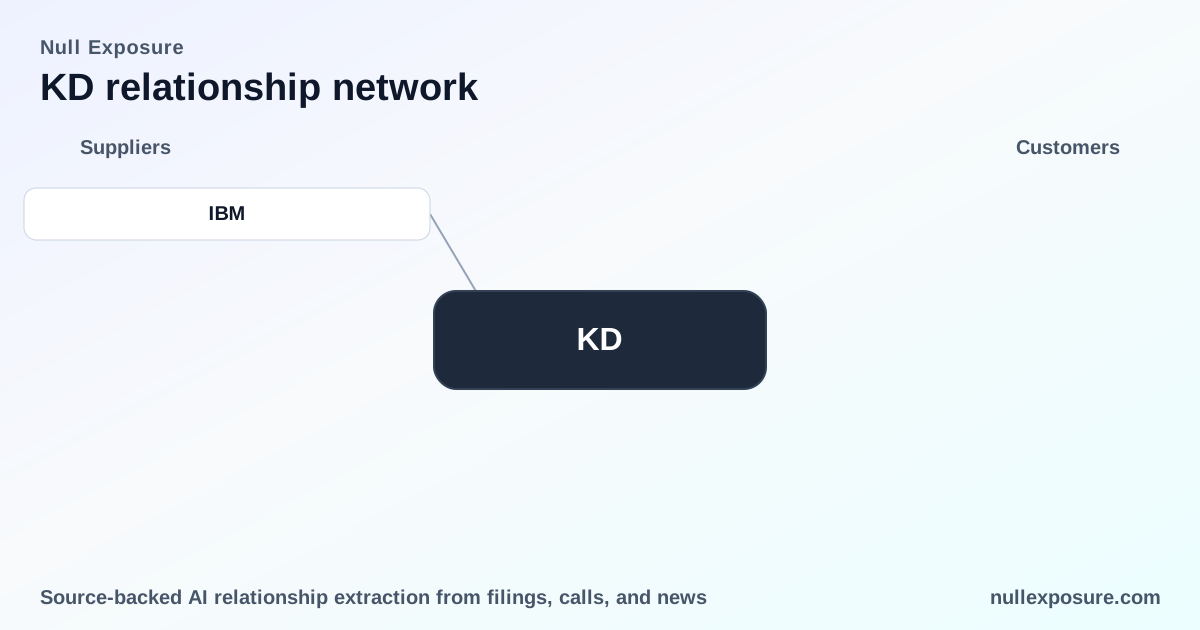
All supplier relationships in the record — the IBM connection
IBM — Kyndryl has a pronounced historical supplier relationship with IBM that included hardware commitments and large related‑party service purchases; management reports that IBM spend has materially decreased while hyperscaler revenue has grown. Source: Kyndryl separation disclosures and FY2025 filing language on related-party transactions; commentary and figures cited in a Tikr blog post (March 10, 2026) quoting management.
How to interpret the IBM-associated signals for valuation and risk
- Revenue and margin sensitivity: Historical cost-of-services recognized from related-party transactions was large (reported at $1.4 billion in FY2023), so shifts away from IBM alter both absolute revenue capture and margin composition. Investors should model lower legacy-cost tailwinds but higher variability as hyperscaler engagements scale.
- Transition risk is measurable but contained: While hardware commitments were non-trivial (about $265 million delivered in FY2024), the company reported that outstanding obligations under that program were immaterial by March 31, 2025. That implies balance-sheet exposure is limited even as operational reliance persists.
- Contract durability vs. renegotiation leverage: Long-term separation-era commitments create locked-in supply flows in the near term, but the documented decline in IBM spend gives Kyndryl negotiating leverage to reprice or replace inputs over time.
- Concentration premium is eroding: The pivot to hyperscalers reduces single-supplier concentration and creates a different service mix — higher platform-enabled revenue and potentially higher gross margins if Kyndryl captures managed services on top of hyperscaler spend.
What operators and procurement teams should do now
- Reassess legacy supplier schedules and termination windows to avoid being caught by rollover clauses that preserve old pricing. Kyndryl’s disclosures show specific separation-era hardware commitments; operators must map delivery timelines to contract terms.
- Prioritize migrating high-cost supplier inputs to hyperscaler or competitive alternatives where earnings accretion is clear and execution risk is manageable.
- Build scenario-based margin models that treat legacy IBM-related costs as a declining line item while modeling higher variability in new platform and professional-services revenue.
A good starting point for benchmarking supplier exposures and negotiating playbooks is available at https://nullexposure.com/.
Practical checklist for investors and procurement leaders
- Confirm the timetable and remaining dollar value of any separation-era supplier commitments in the latest 10‑K/10‑Q.
- Quantify the historic spend baseline with legacy suppliers (the firm reported $1.4B of related-party cost in FY2023) and model the pace of decline.
- Monitor hyperscaler revenue cadence — management reported hyperscaler revenue growing rapidly and contributing meaningfully to new bookings — and measure margin capture on those deals.
- Insist on transparency around immaterial obligations: while the company reports immaterial outstanding obligations as of March 31, 2025, verify what that means for your contract windows and liability horizon.
For a deeper look at supplier-level intelligence and contract risk scoring, visit https://nullexposure.com/.
Bottom line
Kyndryl is executing a deliberate transition away from legacy supplier concentration while retaining some short-term, separation-driven commitments. The company’s exposure to IBM has been large historically but is declining, hardware commitments were finite and largely delivered, and contingent balance-sheet risk is limited according to the firm’s disclosures. Investors should value Kyndryl on a service-recurring basis with explicit assumptions about the pace of hyperscaler adoption and the remaining legacy cost base; operators should prioritize contract remediation and migration playbooks to capture margin upside.