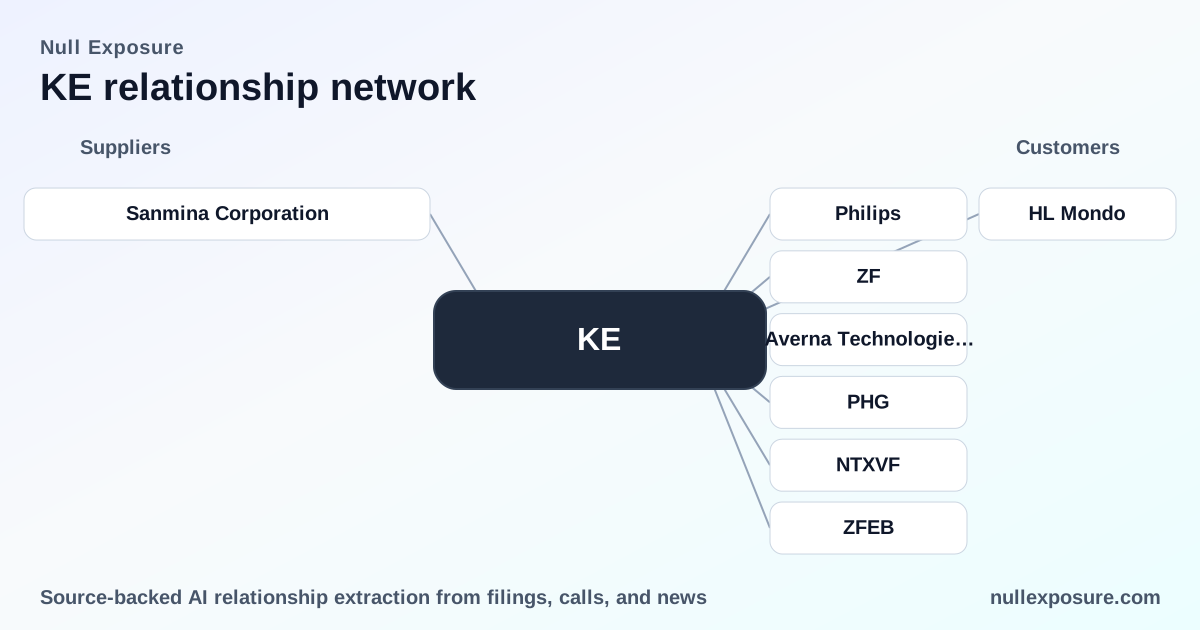
Kimball Electronics (KE): Supplier relationships, competitive posture, and what it means for investors
Kimball Electronics operates as a contract manufacturer for electronic and diversified manufacturing services across automotive, medical, industrial and public safety end markets, monetizing through program-based manufacturing contracts, design-for-manufacture services and recurring production volumes. The company converts engineering-to-production scale at customers’ program levels into steady revenue, while margins reflect program mix and capacity utilization. For a quick dive into broader supplier and market signals, visit https://nullexposure.com/.
How Kimball makes money and why supplier relationships matter
Kimball Electronics runs a classic electronics manufacturing services (EMS) business: it signs contracts with OEMs, ramps production for multi-year programs, and captures margin through scale, operational efficiency and supply-chain management. Revenue (TTM ~$1.46B) is earned from a portfolio of programs rather than transaction-by-transaction sales, and EBITDA (TTM ~$98.8M) and operating margins compress or expand with program cycles and input-cost pass-through. Institutional ownership is high (~87%), underscoring investor focus on operational consistency and supplier risk management.
The supplier ecosystem is core to profitability: program continuity depends on component availability, second-source competitiveness and the firm’s ability to maintain on-time delivery across global facilities. This article reviews the explicit relationship signals surfaced in Kimball’s public filings and draws out how those relationships inform contracting posture, concentration, criticality and maturity.
Competitive map and the relationship flagged in filings
Kimball positions itself within a competitive EMS landscape. According to Kimball Electronics’ FY2025 Form 10‑K, peer competitors listed include Benchmark Electronics, Flex Ltd., Jabil, Plexus and Sanmina Corporation. This competitive set places Kimball among established global EMS providers that compete for program wins and long-term OEM engagements (FY2025 10‑K).
Sanmina Corporation — direct competitor mention
Sanmina is explicitly named by Kimball in the FY2025 10‑K as part of the competitive set in the EMS market, indicating overlap in target customers and program types. The firm is presented as a peer, not a customer or supplier, so the relationship is competitive rather than collaborative according to the filing. (Source: Kimball Electronics, FY2025 Form 10‑K).
What the competitive mention implies for supplier and procurement exposure
A competitor mention in a 10‑K carries practical implications for supplier strategy and investor risk assessment:
- Contracting posture: Kimball operates on program-based contracts that require predictable supply chains and the ability to cost-structure multi-year engagements. Competitive pressure from peers like Sanmina drives emphasis on supplier diversity and contracting flexibility to win bids.
- Concentration signals: The 10‑K does not list specific constrained suppliers in the relationship scope; at the company level, the absence of reported supplier constraints in the relationships extract is itself a signal that Kimball’s public disclosures focus on market competition rather than single‑supplier risk in the supplier relationship section.
- Criticality of suppliers: Given the program-centric model, suppliers of critical components and subassemblies are business-critical; loss of access to key components would impact program fulfillment and margins.
- Maturity of supplier network: As an established EMS provider with global operations and diversified end markets, Kimball’s supplier network is mature and transactional, structured to support program ramp-up and production continuity.
These characteristics should guide investors evaluating supplier counterparty risk and the company’s ability to preserve margin under commodity and logistics pressure. For more supplier-focused intelligence and analysis, see https://nullexposure.com/.
Financial context that shapes supplier sensitivity
Kimball’s financial profile frames how supplier dynamics affect outcomes. Price-to-book sits near 0.97 and EV/EBITDA is roughly 7.5x, reflecting a capital-light but margin-sensitive manufacturing business. Operating margin (TTM ~5.2%) and profit margin (~1.65%) leave limited room for prolonged input-price inflation without offset from productivity gains or customer pricing. This makes supplier contracts, component sourcing and inventory management pivotal to near-term earnings stability. (Source: company financials, TTM).
Relationship-by-relationship coverage (as disclosed)
- Sanmina Corporation — Kimball names Sanmina among its EMS competitors in the FY2025 10‑K, indicating customer and program overlap that intensifies competition for contract manufacturing wins. (Source: Kimball Electronics FY2025 10‑K).
This section covers every relationship returned in the supplier-scope search results and places each relationship in the context of competitive dynamics and supplier risk assessment.
Risk implications for investors and operators
- Competitive intensity: Listing large EMS players as competitors signals continuous pressure on margins and the necessity of supply-chain resilience to protect program profitability.
- Operationally critical suppliers: Although no supplier-specific constraints are listed in the relationship-scope extract, investors should model scenarios where key components experience shortages or price shocks, given the company’s modest operating margin buffer.
- Contract lifecycle sensitivity: Program wins and losses have outsized effects on utilization and fixed-cost absorption; supplier agreements that enable flexible volume adjustments are a competitive advantage.
- Capital and scale dynamics: High institutional ownership and a modest EV/EBITDA multiple indicate investor expectations of disciplined capital deployment and steady execution rather than aggressive expansion into variable-risk geographies.
Practical takeaways for partnership and procurement decisions
- Negotiate flexibility: Supplier contracts should allow Kimball to scale volumes up and down across program life cycles while protecting against single-source disruptions.
- Prioritize second sources for critical parts: Competitive pressure from peers amplifies the importance of secure, diversified sourcing to meet OEM timing and quality expectations.
- Monitor margins closely: Small swings in component costs or logistics can materially affect reported operating results; continuous cost-to-serve analysis is essential.
For deeper supplier relationship scanning or bespoke exposure analysis, explore services at https://nullexposure.com/.
Conclusion and action points
Kimball Electronics is a established EMS operator whose profitability depends on program execution, efficient supplier contracting and the ability to compete against global peers such as Sanmina. Investors should treat supplier strategy as a core lens for valuation and risk assessment: contract flexibility, component diversification and operational discipline determine whether program revenue translates into sustainable cash flow.
If you evaluate supplier counterparty risk across industrial manufacturers, start with a company-level supplier map and competitive overlay — more on that is available at https://nullexposure.com/.