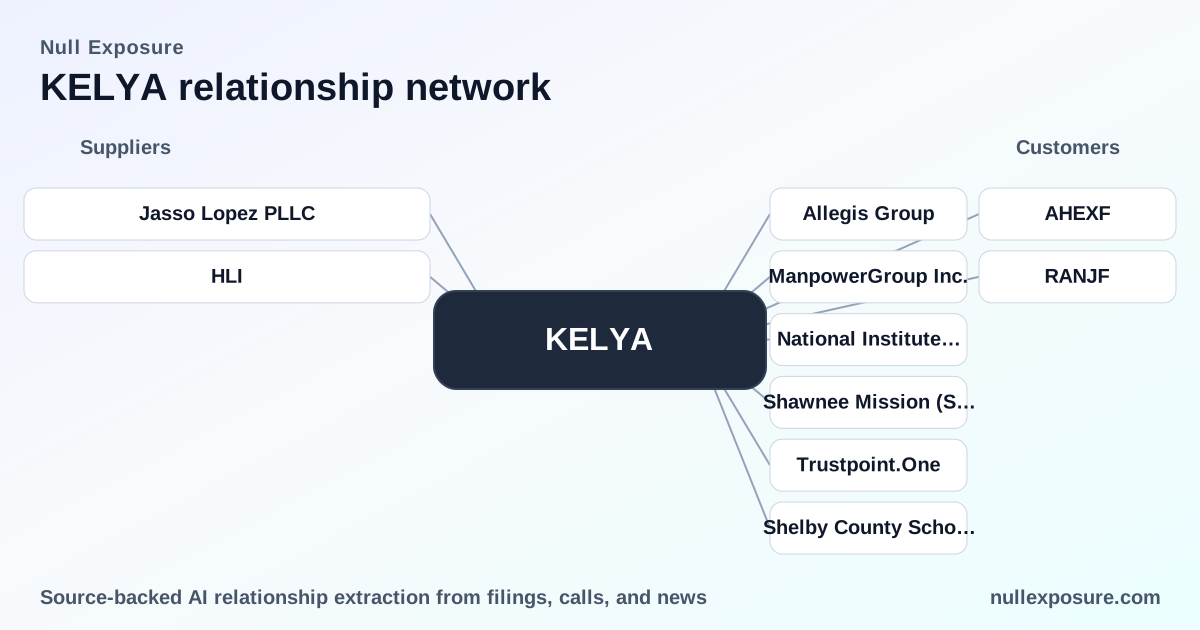
KELYA Supplier Lens: What Kelly Services’ advisor and counsel relationships reveal about deal posture and operational risk
Kelly Services operates as a global staffing and workforce-solutions firm, monetizing labor supply through temporary placements, contract staffing, and managed services agreements. Revenue is generated primarily from billable hours on temporary employees and placement fees, while cost of services is dominated by payroll-related expenses, creating a business where working-capital and counterparty execution are central to margin stability. Recent disclosures around external advisors tied to an acquisition illuminate how Kelly organizes legal and financial support for growth transactions and underscore supplier reliance that has direct implications for integration risk and transaction economics.
Explore supplier intelligence at NullExposure: https://nullexposure.com/
Why external advisors matter to an operator built on people and payroll
Kelly’s economics are simple and capital light in headline: high top-line throughput (Revenue TTM: $4.25bn) against thin operating margins (Operating Margin TTM: 0.57%) and negative bottom-line per-share results (Diluted EPS TTM: -7.24). That profile makes external suppliers—especially those supporting transactions, technology, and country-specific staffing services—operationally critical rather than peripheral. The company explicitly identifies temporary-employee wages and related payroll taxes and benefits as the primary components of cost of services, signalling that any supplier which touches payroll, compliance, or acquisition execution has outsized influence on short-term cash flow and integration outcomes.
This supplier snapshot is relevant for investors and operators evaluating KELYA because third-party advisors both shape deal outcomes and reflect management’s contracting posture: using specialized outside counsel or boutique M&A advisors implies an intent to externalize legal and transaction risk rather than building those capabilities in-house, which is normal for mid-cap staffing firms but raises questions on recurring vendor spend and concentration.
Who Kelly is working with on the recent transaction — and why it matters
Kelly disclosed external party roles tied to an announced transaction in March 2026. The public reporting identifies two named suppliers: one serving as financial advisor and one as legal counsel. Both relationships are transactional in nature but carry different risk and control implications.
Houlihan Lokey — financial adviser to Kelly
Houlihan Lokey is serving as Kelly’s financial advisor in connection with the company’s acquisition activity. This places a recognized investment banking advisor at the center of valuation, deal structuring, and sale-side negotiation support. According to HuntScanlon reporting on March 10, 2026, Houlihan Lokey was explicitly named as the financial adviser to Kelly. (HuntScanlon, 10 March 2026)
Jasso Lopez PLLC — legal counsel to Kelly
Jasso Lopez PLLC is serving as legal counsel to Kelly for the same transaction, responsible for contract negotiation, regulatory compliance and closing documentation. HuntScanlon’s March 10, 2026 coverage lists Jasso Lopez PLLC as Kelly’s legal counsel in the announced deal context. (HuntScanlon, 10 March 2026)
Both relationships were documented in the same news item covering Kelly’s M&A activity, indicating a conventional external advisory stack for acquisition execution rather than reliance on internal corporate-development resources.
What the supplier constraints tell us about Kelly’s operating model
Kelly’s public disclosures and the constraints extracted from its filings reveal two company-level signals about supplier relationships:
-
Supplier counterparties include individual-level costs tied to temporary workforce execution. The company explicitly lists temporary employee wages, payroll taxes, benefits and workers’ compensation as primary cost components—this is a direct statement that many of Kelly’s “suppliers” are actually paid labor and payroll-related service flows rather than traditional vendor contracts. That structure demands tight day-to-day operational controls and increases sensitivity to payroll-processing vendors and in-country staffing partners.
-
Kelly relies on third parties for critical operational functions. The filing notes reliance on third parties for technology infrastructure, vendor management, CRM and applicant tracking systems, plus in-country staffing services and supplier partnerships used to deliver customer services. That language signals a strategic contracting posture that outsources non-core but critical functions, translating to elevated supplier criticality even if individual counterparties are replaceable.
Taken together, these constraints imply the following operating-model characteristics for an investor assessing supplier risk:
- Contracting posture: Opportunistic outsourcing of critical systems and regional staffing; management chooses external specialization over internal scaling for certain capabilities.
- Concentration: Revenue and operations are sensitive to a broad base of small counterparty relationships (temporary workers) plus a handful of critical vendor/partner contracts for technology and regional presence.
- Criticality: Suppliers tied to payroll, compliance and transaction execution are mission-critical because they directly affect cash flow, and legal/financial advisors can materially shape deal success.
- Maturity: Use of established advisors like Houlihan Lokey signals routine corporate-development sophistication and standard deal-market behavior rather than ad hoc execution.
Investor implications — risk, governance and what to watch next
For investors and operators, the recent advisor and counsel disclosures create a short checklist for monitoring:
- Integration risk on M&A: External advisers control deal structure and closing mechanics; assess the premium paid versus expected margin uplift given Kelly’s thin operating margins and existing profitability headwinds (Profit Margin: -5.98%).
- Supplier execution and payroll continuity: The company’s cost base is dominated by payroll and benefits; any supplier interruption or vendor misconfiguration affecting payroll or benefits administration would have immediate margin and reputational consequences.
- Governance and procurement discipline: Outsourcing critical systems increases vendor-management workload—look for evidence of counterparty diversification and contractual protections in upcoming filings or proxy disclosures.
- Cost of external advisory services: Transaction-related advisory spend is non-recurring but can be meaningful relative to EBITDA (EBITDA: $97.3m) for a company of Kelly’s market cap (Market Cap: $292.5m), so deal economics should be evaluated net of advisory/legal fees.
If you want to map these supplier relationships and track change over time, NullExposure maintains an evolving record of named advisers and partner roles for mid-cap corporates. Review the Kelly supplier view on NullExposure: https://nullexposure.com/
Closing recommendation — where to focus your diligence
For investors building a thesis on KELYA, prioritize diligence in three areas: transaction economics net of advisory/legal fees; vendor controls around payroll and applicant-tracking systems; and counterparty concentration in key in-country staffing partnerships. The presence of Houlihan Lokey and Jasso Lopez PLLC confirms that Kelly is executing a conventional, advisor-led M&A playbook—this reduces headline execution uncertainty but transfers integration execution risk to management and its external counsel/advisors.
To monitor changes in Kelly’s supplier footprint and advisor slate, or to request supplier-level vendor exposure analysis for your portfolio, begin with the NullExposure supplier hub: https://nullexposure.com/
Key takeaway: Kelly’s business is intensely operational, and its supplier relationships—especially those tied to payroll, compliance, and transaction execution—are a first-order risk and value lever for investors.