Kenon Holdings (KEN) — Bank Leumi financings sharpen project execution and balance-sheet trade-offs
Kenon Holdings is an owner, developer and operator of power generation assets in Israel and internationally, monetizing through operating cash flows from power plants and returns on project-level investments. The company funds growth and buyouts in its power platform (OPC Energy / CPV Group) with a mix of equity, dividend policy and project finance; recent executions with Bank Leumi show project-level debt is a current lever for near-term capacity expansion in the U.S. market. Investors should view Kenon as a capital-intensive utility holding company with active project finance activity that directly affects free cash flow and balance-sheet optionality.
Explore deeper supplier and counterparty signals at https://nullexposure.com/.
Why the Bank Leumi transactions matter to owners and operators
Kenon is executing U.S. gas-fired project investments through OPC Energy and its majority-owned CPV Group LP. Securing external bank financing converts development commitments into financed assets and reduces immediate equity needs, but it also concentrates counterparty exposure and introduces bank covenants and servicing risk into the capital structure. Given Kenon’s sizable dividend yield (4.8 per share; 8.5% yield per latest data) and a market capitalization of roughly $4.06 billion, the company’s choice to use bank financing for the Basin Ranch project signals an explicit trade-off: accelerate asset builds while leveraging project finance rather than diluting shareholders.
- Key finance metrics: Revenue TTM $774m, EBITDA $123m, EV/EBITDA ~25.7 — valuation multiples show limited margin for execution missteps.
- Capital posture: high insider ownership (62%) and modest institutional ownership (22%) indicate an ownership base that will prioritize longer-term control and stable distributions over frequent market financing.
Learn more about supplier and counterparty exposures at https://nullexposure.com/.
Deal-by-deal relationship coverage
Below are the specific Bank Leumi relationships identified in public reports and what each means in plain English.
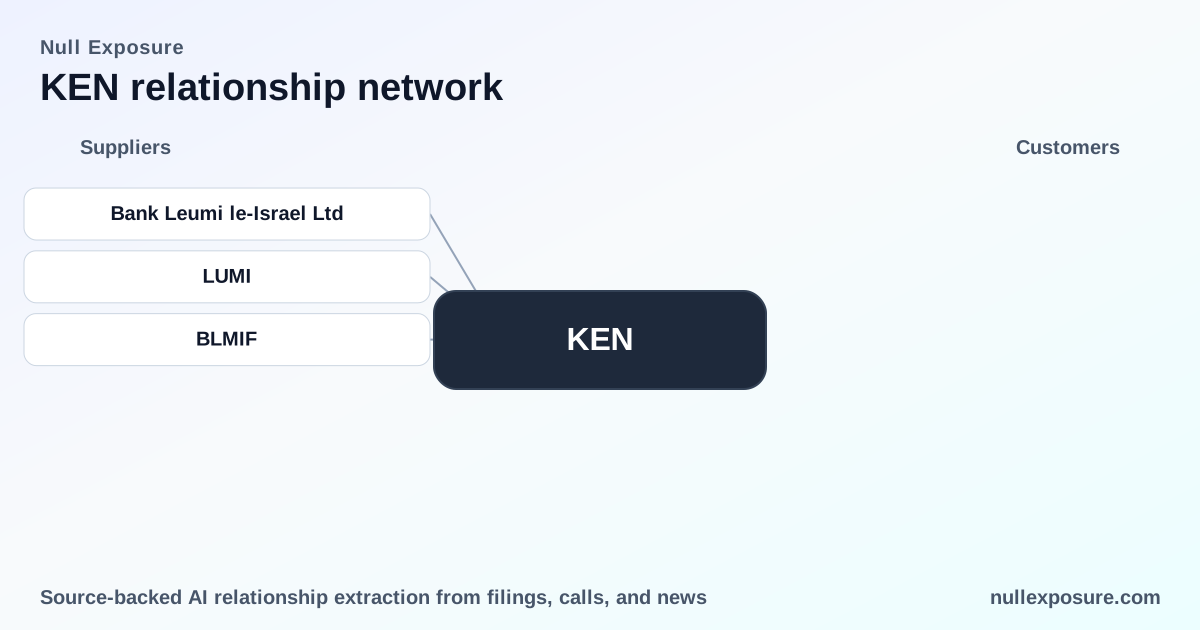
Bank Leumi le-Israel Ltd — $300 million financing for Basin Ranch (October 23, 2025)
Kenon’s OPC Energy announced a $300 million financing commitment from Bank Leumi le-Israel Ltd to fund the Basin Ranch natural gas project in Texas, converting development funding needs into structured debt for project execution. According to a company press release reported by The Globe and Mail on October 23, 2025, this financing underpins project development and reduces immediate equity drawdown for the sponsor (press release at The Globe and Mail, Oct 23, 2025: https://www.theglobeandmail.com/investing/markets/stocks/KEN/pressreleases/35656800/kenons-opc-secures-300m-financing-for-texas-gas-project/).
Bank Leumi (inferred symbol LUMI) — $130 million amendment to existing CPV financing (January 8, 2026)
Kenon reported that its OPC subsidiary’s majority-owned CPV Group LP amended the existing $300 million financing with Bank Leumi to add an additional $130 million, effectively increasing the bank’s exposure to the Basin Ranch buyout to complete the remaining 30% acquisition. The Globe and Mail reported the amendment on January 8, 2026, noting the incremental $130 million as targeted to finish the CPV buyout (Globe and Mail press release, Jan 8, 2026: https://www.theglobeandmail.com/investing/markets/stocks/KEN/pressreleases/36964495/kenons-opc-unit-secures-extra-bank-leumi-funding-for-cpvs-remaining-30-buyout-of-texas-basin-ranch/).
Bank Leumi (inferred symbol BLMIF) — same CPV financing amendment referenced with alternate identifier (January 8, 2026)
A parallel reference to the January 8, 2026 disclosure identifies Bank Leumi under a different inferred ticker, recording the same amendment that adds $130 million to the existing $300 million facility; this reflects the same counterparty relationship across different market reference systems. The Globe and Mail piece covering the CPV amendment provides this additional identifier and confirms the aggregate financing adjustments (Globe and Mail press release, Jan 8, 2026: https://www.theglobeandmail.com/investing/markets/stocks/KEN-N/pressreleases/36964495/kenons-opc-unit-secures-extra-bank-leumi-funding-for-cpvs-remaining-30-buyout-of-texas-basin-ranch/).
Operating model signals and corporate constraints
There are no explicit constraint excerpts attached to the relationship records, so the following characteristics are company-level signals derived from Kenon’s operating profile and the financing activity:
- Contracting posture: Kenon uses third‑party debt at the project level to de‑risk near‑term equity contributions and accelerate asset completion; this is consistent with an off‑balance-sheet or project‑finance approach at the subsidiary level. Expect conventional project covenants and milestone tranches to be part of borrowed facilities.
- Concentration: The public record shows Bank Leumi as a primary financier for a material U.S. project; that introduces counterparty concentration risk at the project-lending level until financing sources diversify.
- Criticality: Project-level debt relates directly to the company’s ability to complete the Basin Ranch project and to the timing of cash flows from CPV operations; these financings are critical to near‑term growth execution.
- Maturity and capital mix: Kenon sits in a capital‑intensive segment — power generation — and holds a notably high dividend yield alongside negative reported EPS, implying the company balances shareholder distributions with continued project investment. The EV/EBITDA (25.74) and Price/Sales (~5.2) indicate valuation compression if execution or financing conditions deteriorate.
Investment implications — what investors should watch
Positive read: The Bank Leumi facilities allow Kenon to complete a strategic buyout and commercialize Basin Ranch without immediate equity issuance, preserving shareholder capital and sustaining the company’s dividend policy.
Risk read: Counterparty concentration with Bank Leumi and the increased funded exposure (from $300m to $430m) raise event risk if project timelines slip, cost overruns occur, or covenant triggers are tested. Operational execution at CPV and OPC is now directly coupled with bank financing performance.
Monitor these items closely:
- Project construction milestones and any covenant waivers or amendments disclosed to investors.
- Cash flow bridge from CPV/OPC assets to Kenon’s consolidated statement; any delay risks dividend coverage.
- Disclosure of pricing, interest margins, and security packages on the Bank Leumi facilities — these determine the effective cost of the incremental $130m.
- Insider and institutional ownership dynamics given high insider stake and the reliance on external bank funding.
Bottom line and next steps for evaluators
Kenon’s recent dealings with Bank Leumi are a clear strategic choice: use bank financing to finish a material U.S. project while preserving equity and sustaining distributions. That choice reduces immediate dilution but concentrates execution risk in a single bank counterparty and links near‑term cash flows to project delivery.
If you want structured intelligence on supplier and counterparty exposure for Kenon and other suppliers, review the analysis hub at https://nullexposure.com/ for deeper relationship mapping and monitoring.
For due diligence support or a bespoke counterparty risk brief tied to Kenon’s financing relationships, visit https://nullexposure.com/ to request tailored reporting.