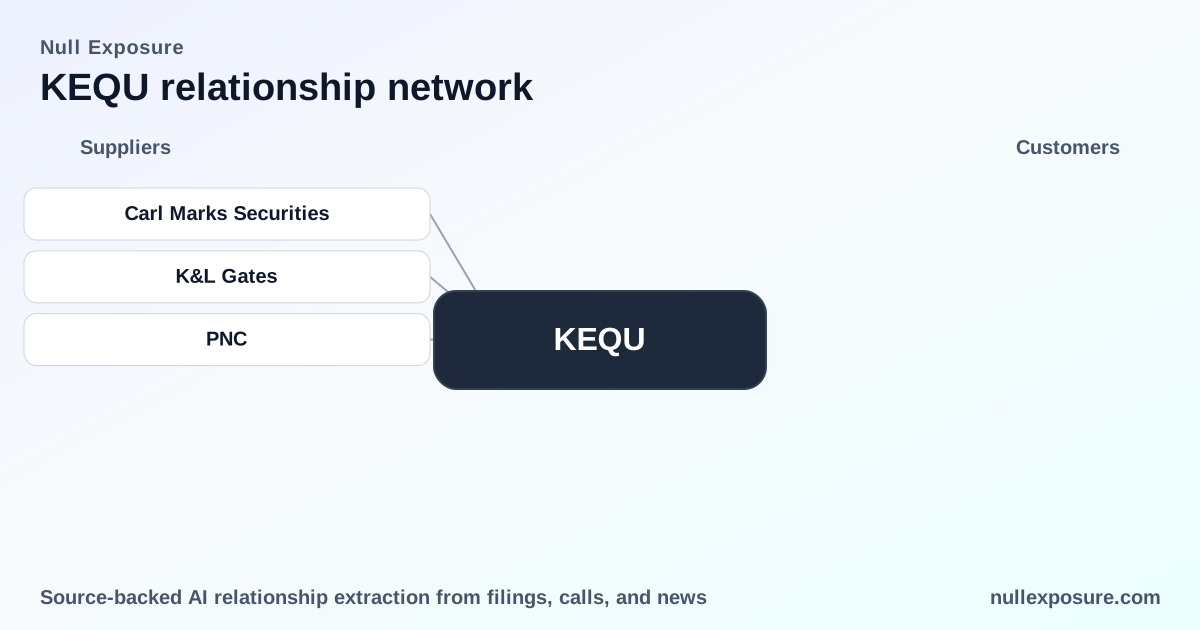
Kewaunee Scientific (KEQU) — supplier and deal counterpart map after the Nuaire acquisition
Kewaunee Scientific designs, manufactures and installs laboratory, sanitary and technical furniture and monetizes through product sales, project installations and selective acquisitions that expand its product set and market access. The company combines recurring product revenue and project-based installation work with opportunistic M&A (notably the $55 million purchase of Nuaire), financed through relationship banking and external advisers. For a focused view on supplier, advisor and financing counterparties tied to this transaction and what they imply for operational risk and strategy, visit https://nullexposure.com/.
The deal and the relationships that changed the supplier map
Kewaunee completed a material acquisition (Nuaire) that required financial, legal and banking partners. The public reporting on that transaction makes clear who executed the deal and how it was funded.
Carl Marks Securities — lead financial adviser
Carl Marks Securities acted as the lead financial adviser to Kewaunee on the Nuaire acquisition, providing deal structuring and transaction advisory services that enabled the company to execute the purchase. Business North Carolina reported this role in its March 2026 coverage of the transaction.
K&L Gates — legal counsel to Kewaunee
K&L Gates served as legal advisor to Kewaunee for the acquisition, handling the legal diligence and documentation necessary for closing. Business North Carolina’s March 2026 article identifies K&L Gates in that capacity.
PNC Bank — financing provider
PNC Bank provided the financing for the transaction, supplying the debt capital that underwrote the $55 million purchase of Nuaire. Business North Carolina reported PNC’s role in March 2026; the bank’s participation signals access to relationship lending for mid-market manufacturing M&A.
What those relationships tell investors about Kewaunee’s operating model
The advisers and bank involved in the Nuaire deal are consistent with an acquisition-led growth posture for a small-cap industrial OEM. Combine that observation with the company’s own procurement disclosure and you get a clear operational profile.
- Company disclosures state that the firm purchases "cold-rolled carbon and stainless steel, hardwood lumber and plywood, paint, chemicals, resins, hardware, plumbing and electrical fittings" from multiple suppliers and that such materials are "typically readily available." This is a direct operating signal from the company’s filings.
- From that disclosure, supplier concentration for raw materials is low and the inputs are commodity or semi-commodity items procured through standard purchasing channels; procurement is therefore transactional and predictable, reducing single-supplier dependency risk.
- Conversely, the need for an external bank and boutique adviser for the Nuaire acquisition demonstrates that capital and advisory relationships are critical to Kewaunee’s growth execution; these relationships are less fungible than raw materials and therefore represent a different class of operational dependency.
- The mix of project-based installations and manufactured product lines implies contract-oriented revenue for installation projects and repeatable product margin for manufactured furniture; procurement maturity is high for raw inputs, while deal execution capabilities rely on mature financial and legal partners.
Operational constraints investors should factor into valuation and risk
The company-level procurement disclosure produces several actionable constraints and implications for investors:
- Low supplier concentration and readily available inputs is a structural advantage that reduces short-term production disruption risk and supports stable gross margins, given normal commodity price environments.
- Contracting posture is transactional for materials but contractual for installations; supplier negotiations will focus on price and lead times, while customer contracts create project-level cash flow timing risk.
- Criticality shifts from raw-material supply to deal execution and financing when Kewaunee pursues acquisitions; banking and advisory relationships are strategic assets.
- Maturity of the supplier base is high — the inputs are standard, which simplifies integration of acquired businesses that use similar material stacks.
Strategic and risk implications for investors
Kewaunee’s recent deal activity and disclosed procurement posture create a set of trade-offs investors should monitor.
- Integration risk from M&A: The Nuaire acquisition expands product breadth but requires operational integration and cross-selling to realize synergies; success depends on Kewaunee’s execution capability and the effectiveness of the financing structure provided by PNC Bank.
- Financing dependence: Use of a relationship bank for acquisition financing means the company relies on continued access to debt markets and bank credit for inorganic growth; monitor covenant terms and leverage.
- Procurement resilience: The company’s reliance on multiple, readily available suppliers for commodity inputs is a strength that supports margin stability, but raw material price volatility still affects cost of goods sold and needs monitoring.
- Advisory and legal partners: Retaining specialist advisers (Carl Marks Securities, K&L Gates) is a sign the company practices disciplined deal execution; these relationships add execution capacity and reduce execution risk on transactions.
For deeper counterparty and supplier intelligence and to track how these relationships evolve across further transactions, go to https://nullexposure.com/.
What to watch next and the investor checklist
- Monitor quarterly filings for leverage metrics and any covenant language tied to the PNC facility. Debt servicing will determine the company’s capacity for further acquisitions.
- Track gross margin trends for signs of raw material inflation pressure; procurement flexibility is a positive, but input-price spikes will still compress margins.
- Watch integration milestones related to Nuaire: revenue cross-sell, margin convergence and any restructuring charges.
- Keep tabs on adviser and banking relationships as repeat players; continued use of the same partners signals durable access to capital and execution capability.
Conclusion — an operationally robust manufacturer with acquisitive financial partners
Kewaunee is a manufacturer with commodity-based procurement and low supplier concentration, which limits production interruption risk. The company’s recent acquisition of Nuaire, financed by PNC Bank and executed with Carl Marks Securities and K&L Gates, signals an acquisition-friendly capital posture that depends on external financial and legal relationships to drive scale. Investors should value the company’s resilient procurement profile together with the execution risk embedded in M&A and financing. For ongoing monitoring of KEQU’s counterparties and evolving supplier network, visit https://nullexposure.com/.