Kirby Corporation (KEX): Credit Relationships that Drive Liquidity and Risk Exposure
Kirby Corporation operates a fleet of domestic tank barges in the United States and monetizes its asset base by transporting liquid bulk products and providing ancillary marine services; the company funds operations and fleet investment through a combination of revolving credit, term debt and short-term lines to support letters of credit and working capital. Credit relationships are therefore a core supplier-type dependency for Kirby: they provide liquidity, enable fleet financing, and underpin counterparty credit support obligations. For a concise, business-focused view of how those relationships affect counterparties and operators, visit https://nullexposure.com/.
What investors need to know up front
Kirby’s balance between a large unsecured revolving facility and smaller bank lines creates a financing structure that is both centralized and layered. The company reported strong trailing EBITDA and a market capitalization that positions it as a sizable mid-cap industrial, but its operating margin dynamics and debt maturities define near-term refinancing and liquidity priorities. Control of short-term letters of credit and a multi-bank credit facility are material to continuing operations.
A short list of the banks that matter to KEX
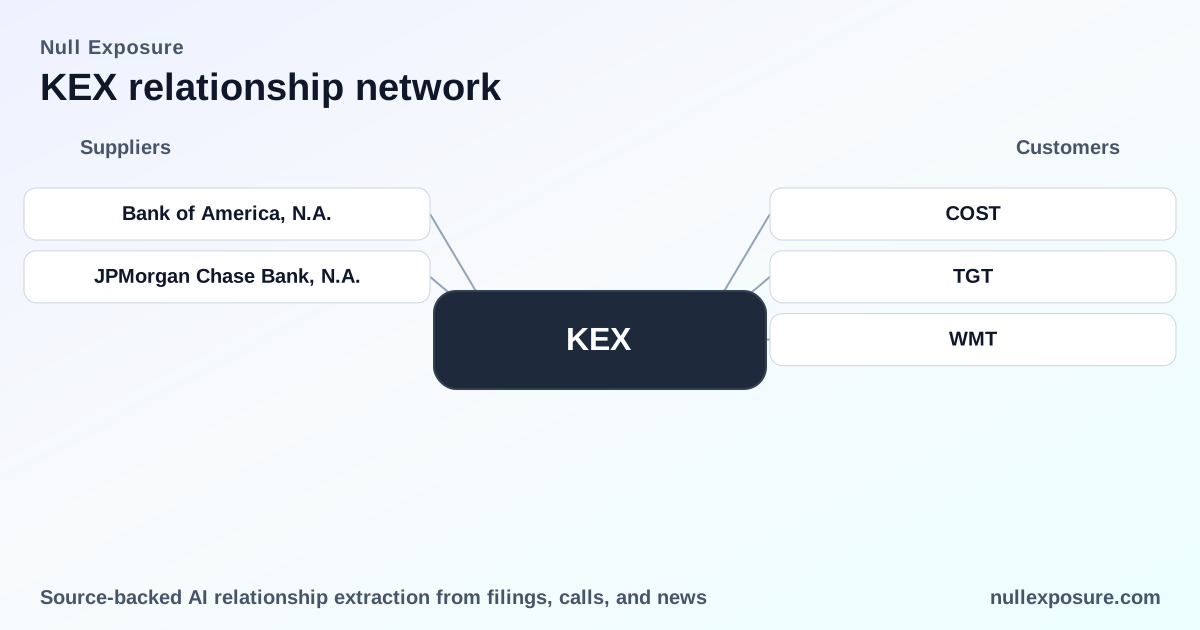
The FY2024 disclosures identify two clear banking relationships that supply essential credit capacity:
- Bank of America, N.A. provides a $15.0 million line of credit intended for short-term liquidity and letters of credit, with a maturity date of June 30, 2026. According to Kirby’s FY2024 Form 10‑K, this Credit Line is specifically structured to support immediate liquidity needs and letter-of-credit requirements.
- JPMorgan Chase Bank, N.A. acts as administrative agent on a group credit agreement (the 2027 Credit Agreement) that establishes a $500 million unsecured revolving credit facility, creating the company’s primary committed liquidity backstop per the FY2024 Form 10‑K.
Each of these relationships is documented in Kirby’s FY2024 Form 10‑K filing, which outlines facility sizes, maturities, and the administrative role played by the banks.
How these relationships translate into operational constraints
Kirby’s filings and constraint signals provide a clear sense of contract maturity and the company’s contracting posture:
- Mixed maturity profile. The company has both short-term credit capacity for letters of credit (maturing June 30, 2026) and longer-dated facilities (including a $250 million unsecured term loan maturing July 29, 2027 and a 2027 revolving credit agreement). This combination gives Kirby flexibility but concentrates several maturity events in the 2026–2027 window.
- Centralized administrative control. A syndicated facility with JPMorgan as administrative agent centralizes negotiating and covenant enforcement levers, increasing the bank group’s influence over refinancing terms and covenant waivers.
- Liquidity criticality. Short-term lines that specifically cover letters of credit are operationally critical because they enable continuing customer contracts and fuel purchases; loss or tightening of those lines would directly affect operations.
- Concentration risk with diversification of instruments. While the presence of a syndicated $500 million revolver reduces single-bank exposure, reliance on a small number of large facilities and a concentrated maturity schedule raises refinancing and rollover risk in a stressed market.
These are company-level signals drawn from the FY2024 disclosures and the contract excerpts included in the filings.
Relationship-by-relationship coverage (plain English, sourced)
Bank of America, N.A. — Kirby maintains a $15.0 million line of credit specifically for short-term liquidity and letters of credit, which matures on June 30, 2026; this facility is designed to cover immediate working capital and contingent obligations. According to Kirby’s FY2024 Form 10‑K the Credit Line exists to support short-term liquidity needs and letters of credit.
JPMorgan Chase Bank, N.A. — JPMorgan is the administrative agent for a syndicated 2027 Credit Agreement that provides Kirby with a $500 million unsecured revolving credit facility, forming the core committed liquidity backstop for the company. The FY2024 Form 10‑K discloses the 2027 Credit Agreement and JPMorgan’s role as administrative agent.
What the capital structure tells investors about supplier risk
Kirby’s financing relationships reveal several actionable themes for investors and counterparties:
- Short-term operational exposure is real. The $15 million short-term line explicitly supports letters of credit—an operationally critical instrument in marine shipping—so any disruption to short-term credit facilities would have direct contract-level effects.
- Refinancing concentration over a short horizon. Multiple material maturities converge in the 2026–2027 period (short-term line, a $250 million unsecured term loan maturing July 29, 2027, and the term of the 2027 revolver), creating a condensed refinancing calendar that underwrites sensitivity to capital markets and bank appetite.
- Bank syndicate leverage on covenant settings. With JPMorgan as administrative agent on the revolving facility, the bank group has coordinated leverage over covenants and amendments—this centralization can be efficient in stable markets and constraining in stressed conditions.
- Size and credit profile support access but not immunity. Kirby’s trailing EBITDA and market capitalization indicate solid operating scale, and an EV/EBITDA multiple under 10 suggests reasonable valuation support; however, the operational criticality of liquidity lines makes the company sensitive to covenant and liquidity stress more than some asset-light peers.
Investment implications and risk priorities
For investors and counterparties evaluating a supplier relationship with Kirby, prioritize these checks:
- Monitor covenant tests and any amendments to the JPMorgan-led credit facility, as changes will reveal lender sentiment and potential tightening of terms.
- Track the $15 million line maturity in mid-2026 because of its direct role in letters of credit and immediate operations.
- Watch the 2027 term loan and revolver maturity clustering for potential rollover risk or refinancing cost increases.
- Evaluate counterparty exposure to interruptions in credit that would affect fuel procurement and customer deliveries.
For a fuller market view and updated relationship tracking, see https://nullexposure.com/ — the homepage provides direct access to relationship analytics and reporting.
Bottom line and next steps for active investors
Kirby’s banking relationships are central to both liquidity management and operational continuity. The combination of a large syndicated revolver, a material term loan, and a small but operationally critical short-term credit line creates a concentrated maturity profile that investors must monitor closely through 2027. Active surveillance of covenant notices and amendment activity under the JPMorgan-led facility will be the most direct read on lender appetite and near-term refinancing risk.
If you are assessing counterparty risk, vendor exposure, or investment thesis sensitivity tied to liquidity, revisit the company’s FY2024 Form 10‑K and track bank communication around covenant tests and maturity management. For integrated relationship intelligence and regular updates, visit https://nullexposure.com/ and subscribe for alerts.