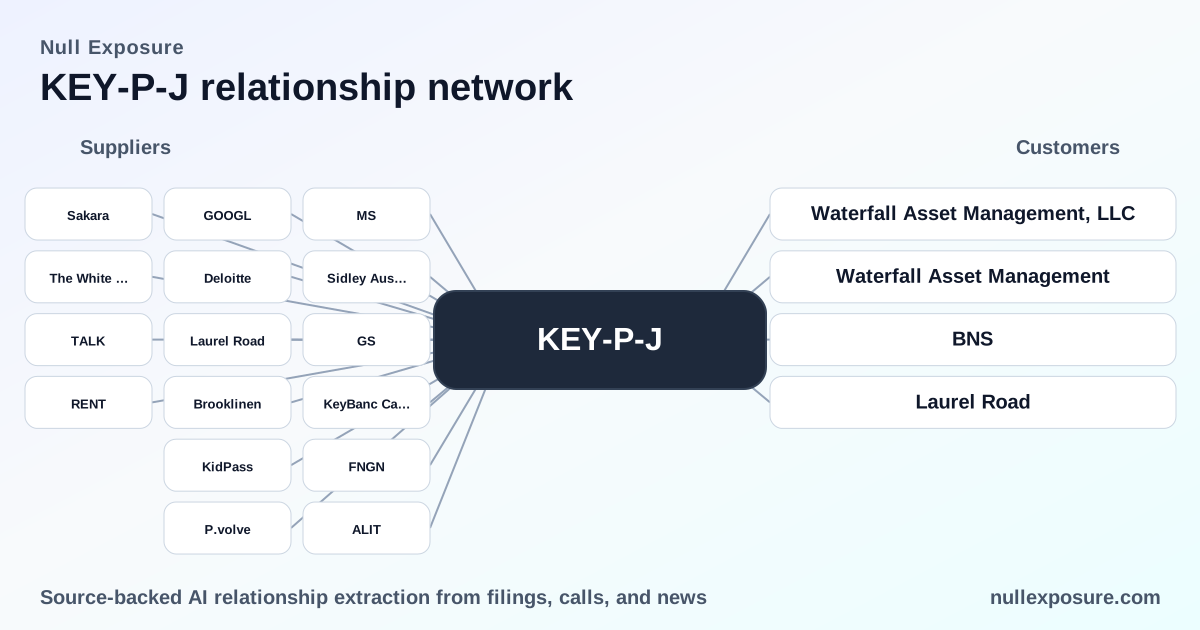
KEY-P-J (KeyCorp Depositary Shares Series F): Supplier Map and What It Means for Investors
KeyCorp’s depositary preferred (KEY‑P‑J) is a capital instrument backed by a regional banking franchise, monetized through fixed dividend claims on KeyCorp’s balance-sheet strength and capital allocation decisions. For investors assessing issuer risk beyond credit metrics, the bank’s supplier relationships offer a direct window into operational exposures: advisory banks and law firms for capital transactions, cloud and systems integrators for a major technology migration, and consumer‑facing partners that extend revenue channels for digital products.
Explore a fuller commercial risk view at https://nullexposure.com/.
Why suppliers matter for a preferred-holder thesis
Preferred stockholders have limited upside but are exposed to execution risk that affects dividend capacity and permanence of capital. Supplier choices reveal whether KeyCorp runs a centralized, tightly managed operating model or a distributed, partner-driven one, and where operational concentration could translate into execution or reputational risk.
No supplier constraints are reported in available records; as a company-level signal this implies an absence of flagged contractual limitations or public vendor disputes in the captured sources. From the relationship set we can infer several consistent operating-model characteristics:
- Contracting posture: KeyCorp engages top-tier financial and legal advisors for large capital transactions and employs boutique and digital partners for product distribution — a hybrid, risk‑managed outsourcing approach.
- Concentration: Advisory and capital markets roles are handled by large global banks; cloud and systems work is concentrated with Google Cloud and Deloitte — a small number of high‑impact vendors.
- Criticality: Technology migration to Google Cloud is operationally critical; capital actions executed with major investment banks are financially critical.
- Maturity: Relationships range from legacy advisory engagements (ASR with Goldman Sachs) to strategic digital partnerships and fintech tuck‑ins (Laurel Road), indicating both entrenched and evolving supplier footprints.
Learn how these supplier signals feed investment research at https://nullexposure.com/.
Supplier-by-supplier run-down (plain-English, source-linked)
- Morgan Stanley & Co. LLC — Morgan Stanley acted as lead structuring and financial advisor on KeyBank’s transaction selling an indirect retail auto‑loan portfolio, underscoring reliance on top-tier investment banking for balance-sheet actions (PR Newswire, FY2021: https://www.prnewswire.com/news-releases/key-sells-indirect-retail-auto-loan-portfolio-enters-into-accelerated-share-repurchase-program-301373639.html).
- Sidley Austin LLP — Sidley Austin served as legal counsel on the same transaction, reflecting use of major law firms for regulatory and transactional risk management (PR Newswire, FY2021: https://www.prnewswire.com/news-releases/key-sells-indirect-retail-auto-loan-portfolio-enters-into-accelerated-share-repurchase-program-301373639.html).
- Goldman Sachs & Co. LLC — Goldman Sachs executed an accelerated share repurchase agreement with KeyCorp to repurchase up to $585 million of common stock, signaling active capital management and use of leading dealers for buybacks (PR Newswire, FY2021: https://www.prnewswire.com/news-releases/key-sells-indirect-retail-auto-loan-portfolio-enters-into-accelerated-share-repurchase-program-301373639.html).
- KeyBanc Capital Markets — KeyBanc Capital Markets supported the transaction alongside external advisors, indicating internal capital markets capability layered with external support on large balance‑sheet moves (PR Newswire, FY2021: https://www.prnewswire.com/news-releases/key-sells-indirect-retail-auto-loan-portfolio-enters-into-accelerated-share-repurchase-program-301373639.html).
- Financial Engines — Historical retirement plan arrangements show KeyCorp contracted Financial Engines as a managed-account provider for plan participants from 2010 to 2014, an example of outsourcing investment‑advice functions (PlanSponsor coverage, FY2021: https://www.plansponsor.com/court-hands-split-decision-keycorp-excessive-fee-lawsuit/).
- Alight — From 2014 the plan used recordkeeper Alight as an intermediary that employed Financial Engines as a sub‑adviser, illustrating layered third‑party relationships within employee benefit operations (PlanSponsor coverage, FY2021: https://www.plansponsor.com/court-hands-split-decision-keycorp-excessive-fee-lawsuit/).
- Google Cloud — KeyBank announced plans to move the majority of its products and services to Google Cloud by 2025, marking a strategic, high‑priority cloud migration that materially shifts operational dependency to a hyperscaler (Retail Banker International, FY2022: https://www.retailbankerinternational.com/news/keybank-taps-google-cloud-deloitte/).
- Deloitte — Deloitte acts as KeyBank’s systems integrator for the cloud migration, providing integration and implementation services critical to the move from on‑premises data centres to Google Cloud (Retail Banker International, FY2022: https://www.retailbankerinternational.com/news/keybank-taps-google-cloud-deloitte/).
- Laurel Road — Following acquisition, Laurel Road has originated billions in loans for KeyCorp and is a strategic fintech originator channel, expanding Key’s consumer lending footprint (The Motley Fool coverage, FY2021: https://www.fool.com/investing/2021/05/20/keycorps-share-price-has-more-than-doubled-over-th/).
- Brooklinen — Brooklinen is one of the premium consumer brand partners used to populate KeyBank’s partner network for targeted digital offerings, reflecting co‑marketing and customer engagement strategies (PR Newswire, FY2021: https://www.prnewswire.com/news-releases/keybank-and-laurel-road-launch-digital-bank-for-doctors-301257891.html).
- KidPass — KidPass appears in KeyBank’s partner roster for consumer promotions, supporting product differentiation for niche customer segments (PR Newswire, FY2021: https://www.prnewswire.com/news-releases/keybank-and-laurel-road-launch-digital-bank-for-doctors-301257891.html).
- P.volve — P.volve is included among lifestyle brand partners tied to Key’s digital bank initiatives, reinforcing cross‑sell opportunities built into product launches (PR Newswire, FY2021: https://www.prnewswire.com/news-releases/keybank-and-laurel-road-launch-digital-bank-for-doctors-301257891.html).
- Sakara — Sakara is listed as a partner brand for promotional benefits within Key’s niche digital banking products, furthering rewards and member acquisition strategies (PR Newswire, FY2021: https://www.prnewswire.com/news-releases/keybank-and-laurel-road-launch-digital-bank-for-doctors-301257891.html).
- The White Coat Investor — The White Coat Investor is part of the partner network focused on medical professionals, aligned with Key’s Laurel Road‑led digital bank for doctors (PR Newswire, FY2021: https://www.prnewswire.com/news-releases/keybank-and-laurel-road-launch-digital-bank-for-doctors-301257891.html).
- Talkspace — Talkspace is named among providers offering benefits through Key’s partner network, indicating partnerships that enhance customer value propositions for wellness and mental health (PR Newswire, FY2021: https://www.prnewswire.com/news-releases/keybank-and-laurel-road-launch-digital-bank-for-doctors-301257891.html).
- Rent the Runway — Rent the Runway joins the partner list, illustrating Key’s use of lifestyle brands to strengthen digital acquisition and retention in targeted segments (PR Newswire, FY2021: https://www.prnewswire.com/news-releases/keybank-and-laurel-road-launch-digital-bank-for-doctors-301257891.html).
What these relationships mean for credit and operational risk
- Advisory and capital markets concentration with leading global banks reduces execution risk for capital transactions but raises short‑term dependency on market counterparties during buybacks and securitisations. The Goldman and Morgan Stanley engagements demonstrate sophisticated capital tool usage that can support preferred distributions through active capital management.
- The Google Cloud + Deloitte migration is the single largest operational dependency disclosed here. If migration timelines or integrations slip, customer service, transaction processing, or cost synergies could be impaired — all of which affect franchise economics.
- Third‑party marketing and fintech partners broaden distribution but dilute direct customer control. Partnerships with Laurel Road and consumer brands expand revenue channels but create reputational and operational touchpoints outside Key’s direct governance.
Act on these supplier signals — request the full exposure briefing at https://nullexposure.com/.
Investor actions and operator takeaways
- For investors: monitor progress on the Google Cloud migration timelines and any material disclosure about integration risk or outages, and track capital actions with investment bank partners that affect capital buffers supporting preferred dividends.
- For operators: institutionalize contingency plans and contract SLAs for the cloud migration, and centralize vendor governance for the partner network to preserve control over customer experience and regulatory compliance.
Final takeaway: the supplier profile paints KeyCorp as a bank that combines top‑tier capital markets and legal advisers with an aggressive digital and cloud strategy — a hybrid model that reduces some execution risk while concentrating operational criticality in a few strategic vendors.
Further supplier intelligence and issuer exposure analysis are available at https://nullexposure.com/.