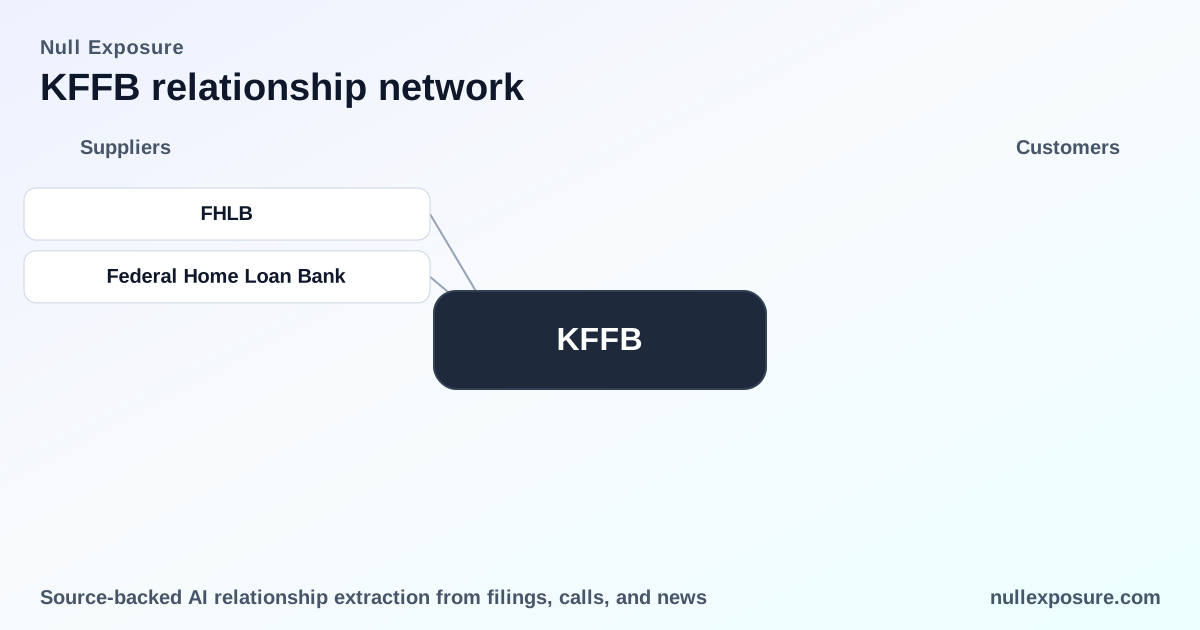
KFFB — Funding Signals from the FHLB That Investors Should Price In
Kentucky First Federal Bancorp (KFFB) operates as a small regional bank holding company, monetizing through traditional spread-based banking: collecting deposits, originating loans and securities, and managing net interest income along with modest noninterest income. Liquidity management and the mix between core deposits and borrowings from the Federal Home Loan Bank (FHLB) materially drive short-term earnings volatility and balance sheet leverage, making the FHLB relationship a live, strategic input to valuation and scenario analysis. For a concise supplier-risk view and relationship map, visit https://nullexposure.com/.
Why funding mix matters for a community bank like KFFB
KFFB’s public disclosures show a clear, active playbook on funding: when deposits grow it reduces reliance on FHLB advances; when asset growth or liquidity needs accelerate it uses FHLB borrowings to bridge funding. That gives management optionality but also creates a counterparty concentration and short-term interest-rate exposure—FHLB advances are cheap, available liquidity but they are borrowed funds that affect leverage and funding cost when used materially.
- KFFB’s reported RevenueTTM (~$10.08M) and modest profitability mean that funding shifts quickly translate into visible EPS effects.
- Insider ownership is high (over 62%), institutional ownership is very low (~3.4%), so financing choices reflect local control and influence how external investors should assess governance and strategic trade-offs.
For more supplier intelligence on regional banks, see https://nullexposure.com/.
What the public record says about KFFB’s FHLB relationship
Below are every identified reference to KFFB’s relationship with the Federal Home Loan Bank (FHLB) in the collected results. Each entry is a concise plain-English reading of the mention and a short source citation.
- Several FY2026 disclosures report that FHLB advances climbed $8.7 million (20.3%) to $51.4 million to fund asset growth, signaling a tactical increase in borrowed funding late in the period (Quiver Quant, press coverage of Q2 FY2026 filing). Quiver Quant, March 2026.
- A GlobeNewswire press release in May 2025 states total liabilities increased to $332.6 million with deposits up $21.2 million while FHLB advances decreased $15.6 million, consistent with a deliberate reduction of reliance on borrowed funds in that fiscal window. GlobeNewswire, May 12, 2025.
- The official FY2026 earnings release repeats the FY2026 increase: FHLB advances rose $8.7 million to $51.4 million to support asset growth, underscoring that borrowing resumed as balance-sheet growth accelerated. GlobeNewswire, Feb 10, 2026.
- International wire coverage of the FY2026 release also highlights the $8.7 million rise in FHLB advances, reflecting consistent message distribution across press channels. The Manila Times (via GlobeNewswire), Feb 11, 2026.
- A third-party reprint of the FY2026 release on Sahm Capital reiterates the $8.7 million increase to $51.4 million in FHLB borrowings, indicating wide syndication of the company statement. Sahm Capital, Feb 10, 2026.
- A September 2025 GlobeNewswire item covering fiscal year results notes total liabilities fell to $322.8 million as FHLB advances decreased $26.2 million, while deposits climbed $21.4 million, a prior-period strategic shift to bootstrap funding with deposits. GlobeNewswire, Sep 19, 2025.
- TradingView coverage of KFFB’s SEC 10-Q confirms a period in which deposits rose $6.9 million while FHLB advances fell $7.2 million, again documenting active replacement of borrowed funds with core deposits in FY2025 filings. TradingView (SEC 10-Q summary), FY2025 filing coverage.
- A November 2025 earnings release includes a numeric snapshot showing FHLB Advances at roughly $43,784 (vs $42,760 in a prior period), consistent with modest absolute levels and period-to-period movement in advances. GlobeNewswire, Nov 6, 2025.
Operating constraints and how they shape KFFB’s behavior
The public commentary and filings constitute a clear constraint signal: the FHLB functions as an active service provider to KFFB—management borrows from the FHLB-Cincinnati to “supplement investable funds and meet deposit withdrawal requirements.” That single sentence changes how to view KFFB’s contracting posture, concentration, criticality and maturity:
- Contracting posture: pragmatic and opportunistic — management shifts between deposit-led funding and FHLB advances depending on growth and liquidity; the firm reduces advances when deposits are available and taps FHLB lines when assets grow.
- Concentration and criticality: meaningful but manageable — FHLB advances can be sizable relative to KFFB’s balance sheet (tens of millions on a ~$300M liability base), making the relationship a critical but standard counterparty for a small regional bank.
- Maturity and standardization: institutional and mature — borrowing from FHLB is a common, long-standing facility for U.S. community banks; the relationship is operationally standardized and not exotic, but it is material to near-term funding and yields.
These constraints are company-level signals: they explain why KFFB’s liquidity lines and deposit mobilization are central inputs for any investor stress test.
Investment implications and risks to underwrite
- Positive: FHLB access gives KFFB a reliable liquidity backstop to fund growth and protect against deposit volatility—valuable for a small bank with low institutional ownership.
- Negative: Reliance on borrowed funding when assets grow increases interest-rate exposure and compresses net interest margin if deposit repricing is slower than advance costs; swings in FHLB usage have directly influenced quarterly balance sheet and EPS dynamics.
- Governance note: With high insider ownership, strategic choices on deposit acquisition versus borrowings reflect concentrated control and could reduce the speed with which external shareholders influence capital allocation.
For a deeper supplier-risk and relationship map, go to https://nullexposure.com/ to review how counterparties affect small-bank funding profiles.
Actionable next steps for investors
- Read the FY2025–FY2026 filings and press releases cited above before modeling liquidity scenarios (links included in the relationship section).
- Stress-test earnings under scenarios where deposits reprice or fail to grow, forcing heavier FHLB usage and testing margin compression.
- Monitor deposit trends and successive quarterly disclosures for directionality: deposit growth replacing FHLB advances lowers funding risk; conversely, renewed FHLB drawdowns imply balance-sheet growth or deposit pressure.
For a concise supplier-risk briefing and scenario templates tailored to regional banks, visit https://nullexposure.com/.
KFFB is a classic small-bank story: local-control governance, modest scale, and an FHLB line that is both a safety valve and a lever for growth. Investors should price in funding optionality and counterparty concentration when valuing the stock or underwriting new exposure.