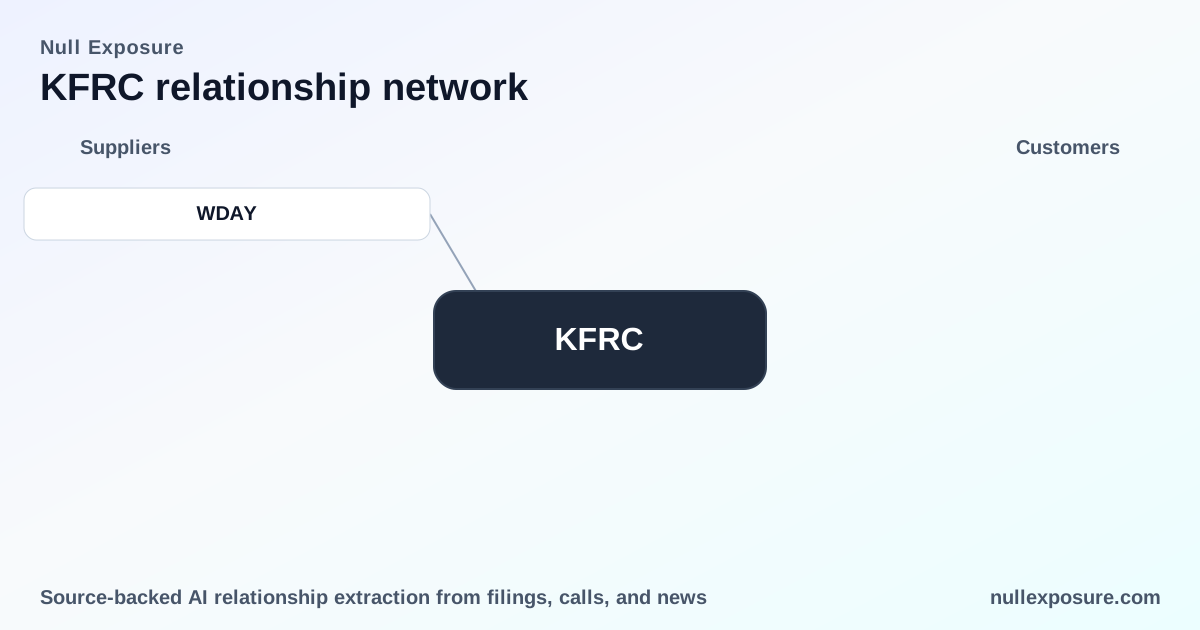
Kforce Inc. (KFRC): Strategic supplier map and what it means for investors
Kforce is a U.S.-focused professional staffing firm that monetizes by placing skilled billable consultants and delivering managed services to corporate clients; revenue converts through utilization and margin on bill rates, while the company layers recurring service revenue and back-office efficiencies as gross margins expand. Kforce is actively investing in an enterprise cloud backbone and offshore/nearshore delivery to lower delivery costs and standardize operations — a change that converts large, multi-year software and services commitments into a strategic lever for margin expansion. Learn more about supplier risk intelligence and peer comparisons at https://nullexposure.com/.
Why the Workday implementation is central to the thesis
Kforce has publicly prioritized Workday as the replacement enterprise platform for human capital and financial systems. This is not a tactical IT upgrade; it is a capitalized transformation that touches payroll, staffing workflows, billing, and financial reporting, and therefore affects operating leverage and margin timing. The implementation converts a set of vendor relationships (software licensing and hosting, implementation partners, and nearshore/offshore suppliers) into a consolidated, long-term vendor posture that investors should treat as both a cost and a source of scalability.
Documented supplier mentions: every recorded relationship item
-
Kforce's investor release describing fourth-quarter 2025 results states the company advanced the implementation of Workday as its future-state enterprise cloud application for human capital management and financials, and that offshore delivery capability in India evolved as part of the "One Kforce" integration. Source: Kforce press release reported on Yahoo Finance (March 10, 2026).
-
The Q4 2025 earnings call transcript reiterates that Workday will be the unified system for HCM and financials and ties the program to nearshore/offshore delivery expansion and capability integration across service lines. Source: Earnings call transcript posted on InsiderMonkey (March 10, 2026).
-
A summary of Kforce’s SEC 10-K and related commentary notes that Workday is a prioritized investment within the back-office transformation program and that investments include nearshore and offshore delivery capabilities. Source: TradingView coverage of the Kforce SEC 10-K (March 2026).
-
A separate TradingView news post covering Kforce’s fourth-quarter and full-year 2025 financials references the implementation of Workday as the enterprise cloud application for HCM and financials. Source: TradingView report on Kforce Q4 and FY2025 results (March 10, 2026).
-
A European market report summarizing Kforce’s earnings describes the company advancing Workday as a unified cloud platform for finance and human resources as part of 2025 strategic initiatives. Source: ad-hoc-news.de coverage of Kforce earnings (March 2026).
What the constraints tell investors about operating posture
Kforce’s supplier-related disclosures create a coherent picture of vendor strategy and exposure:
-
Contracting posture is long-term and committed. The company reports approximately $30.7 million of unconditional purchase obligations with initial or remaining terms beyond one year, which places Kforce squarely in a multi-year vendor commitment profile rather than short-term ad hoc procurement.
-
Kforce treats third parties as service providers to extend delivery capacity. Public commentary ties nearshore and offshore third-party suppliers to the firm’s delivery model, signalling a deliberate reliance on external service providers to scale client-facing operations.
-
Spend magnitude is meaningful but not outsized. Reported unconditional obligations (~$30.7 million) fall in the $10–100 million spend band, large enough to be operationally significant yet unlikely to dominate balance-sheet flexibility.
-
The procurement mix is software and services-heavy. Commitments are primarily related to software licenses, online application hosting, and services that support staffing operations and financial/HCM systems.
-
Relationships are active and operational. Disclosures state Kforce has ongoing commitments and purchase obligations in the ordinary course of business, which translates to an active, integrated supplier base rather than one of transient vendors.
These constraints combine into a strategic vendor model: long-term software and services contracts that are integral to delivery scale, moderated concentration risk because obligations are material but not dominant, and a maturity profile consistent with a mid-market firm implementing enterprise packages.
Investment implications: risk, runway, and upside
-
Execution risk is concentrated in the transformation timeline. Workday implementations historically create one-time costs and revenue-disruption windows; investors should expect near-term cadence effects on margins as integration and cutover costs are realized against the run-rate benefit of standardized workflows.
-
Cost leverage is real and measurable. The shift to consolidated cloud systems and expanded offshore/nearshore delivery is expressly intended to lower operating costs and increase utilization scalability; this aligns with Kforce’s objective to lift operating margin beyond the current ~2.6% operating margin and improve return on equity.
-
Vendor concentration is a managed exposure. The $30.7 million of long-term obligations is material relative to Kforce’s free cash flow profile but does not create single-vendor dependency from the disclosed information; investors should monitor the share of that obligation assigned to any single platform vendor or integrator in subsequent filings.
-
Visibility improves with public mentions. Multiple public filings and earnings commentary point to the same supplier strategy, offering investors transparency about the transformation’s scope and the likely horizon for benefits to flow through to EBITDA and EPS.
Explore how supplier relationships affect portfolio risk and sourcing strategy at https://nullexposure.com/.
Practical next steps for investors and operators
-
Review forthcoming quarterly filings and the Form 10-K notes for breakout of implementation costs and staged payment schedules tied to the Workday rollout; these will show the timing of cash flows tied to the $30.7 million obligation.
-
Track utilitarian KPIs that management will disclose: billable utilization, average bill rate, and G&A as a percent of revenue—all will show the degree to which the cloud transformation and offshore delivery are improving unit economics.
-
For operational partners and potential suppliers, position proposals around staged implementation support and managed hosting offerings that align with long-term licensing commitments and the nearshore/offshore staffing model.
Bottom line: Kforce is executing a purposeful, multi-year vendor and platform strategy centered on Workday and expanded offshore/nearshore delivery. That strategy creates near-term execution risk but delivers credible margin expansion pathways if management hits integration milestones. For active investors, the next 2–4 quarters of disclosure will determine whether the capitalized investments convert to durable operating leverage.
For deeper supplier risk profiles and tailored vendor intelligence, visit https://nullexposure.com/.