Kinross Gold (KGC) supplier relationships — what investors need to know
Kinross Gold operates as a global gold producer that acquires, explores and develops gold properties and monetizes primarily through the sale of produced gold and value from joint-venture operations and optioned exploration projects. Its commercial model combines operating mines and satellite deposits with option agreements and third‑party service providers that underpin exploration and processing activity. Understanding supplier and partner linkages — from accredited assay labs to exploration optionees and joint‑venture operators — is essential to assess operational continuity and incremental production risk. For a focused supplier-risk view and ongoing monitoring, visit https://nullexposure.com/.
High-level takeaways for investors
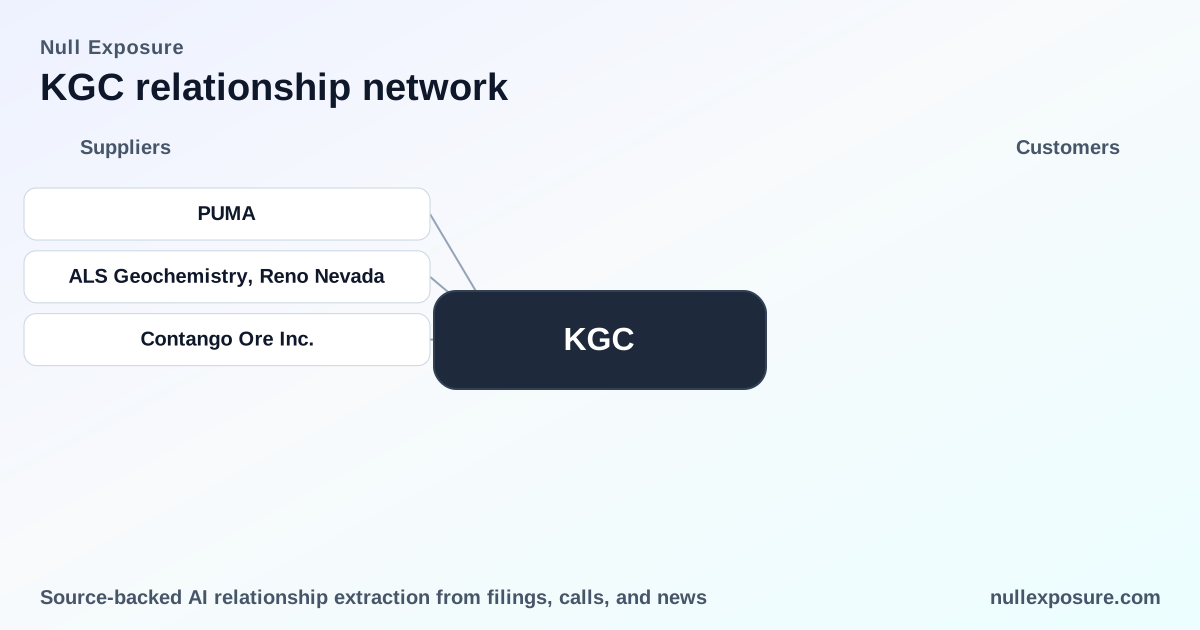
Kinross’s supplier footprint in the recent sample shows three distinct partner types: an early‑stage exploration option partner (Puma Exploration), an accredited analytical services provider (ALS Geochemistry), and a producing joint‑venture counterparty (Contango Ore via Peak Gold). That mix indicates a contracting posture that blends short‑term option agreements, reliance on accredited third‑party service providers for technical validation, and long‑term JV arrangements that directly affect mill feed and near-term production. No explicit supplier constraints were captured in the available source excerpts; the signals below are company‑level interpretations drawn from the relationship evidence.
- Contracting posture: Option agreements for greenfields exploration, accredited third‑party labs for sample validation, and equity JVs for satellite production.
- Concentration and criticality: Sampled relationships are not numerous but include a JV that feeds production (critical) and exploration partners important for reserve replacement (material to longer‑term growth).
- Maturity: Relationships span early exploration (option stage) to established lab services and an operating JV — a multi‑stage supplier ecosystem.
Puma Exploration — an exploration option that feeds Kinross’s pipeline
Puma Exploration is operating under an option agreement with Kinross at the Williams Brook Gold Project in northern New Brunswick; Puma launched a Winter 2026 drilling program under that arrangement, showing Kinross’s strategy to advance targets via optioned junior partners rather than direct in‑house drilling at every prospect. According to InvestingNews (March 10, 2026), Puma’s Winter 2026 program formally began under the Option Agreement with Kinross.
Puma also reported 2025 drill results from 15 holes at the Lynx Gold Zone during Year 1 of the same Option Agreement, demonstrating early‑stage success that could convert to further option expenditures or project transfer depending on outcomes. That update was reported by Junior Mining Network (March 10, 2026).
ALS Geochemistry, Reno — independent lab support for exploration validation
Kinross submitted samples to ALS Geochemistry in Reno, described as a certified and accredited independent laboratory used to validate soil and rock geochemistry at the Riley Golds PWC Project in Nevada. A company release on Newsfile (March 10, 2026) notes ALS’s role in processing and certifying the samples, which is a standard industry control to ensure assay integrity and defensible resource work. Third‑party laboratory independence reduces technical risk around assay bias and supports regulatory disclosures.
Contango Ore / Peak Gold JV — direct feed into Fort Knox production
Contango Ore participates in the Peak Gold joint venture (Kinross 70% / Contango 30%), which operates the Manh Choh satellite that provided high‑grade ore contributing to Fort Knox output. MiningNewsNorth reported (February 20, 2026) that year‑over‑year production dynamics at Fort Knox reflected processing of high‑grade Manh Choh ore from the Peak Gold JV, underlining how JV partners can materially affect mill throughput and quarterly production. Joint‑venture counterparty performance is therefore operationally material for Kinross’s North American production profile.
What these relationships say about operational resilience
Kinross’s supplier and partner mix in the sample communicates a deliberate allocation of risk and responsibility:
- Exploration outsourcing through option agreements (Puma) distributes early‑stage discovery cost and technical risk to juniors while preserving upside for Kinross through staged earn‑ins.
- Use of accredited independent labs (ALS) enforces technical rigor in assays and geochemistry, which supports credible reserve and resource reporting and lowers the risk of technical surprises in feasibility work.
- Equity JV arrangements (Peak Gold with Contango) internalize processing benefits and give Kinross control over operations where it holds majority equity, but JV partners remain operationally relevant where they supply ore or manage satellite mines.
These patterns reflect a mature operating model that combines ownership and contractor relationships to manage capex and exploration budgets while protecting production continuity.
Risk factors investors should track
- JV dependency on third parties for feedstock: Satellite mines run through partners like Contango can swing quarterly production if feed grades or timeliness change; monitor JV operator performance and capital plans.
- Exploration optionality concentration: Option agreements concentrate discovery upside into a small number of junior partners; a string of unsuccessful option earn‑ins would slow the replacement pipeline.
- Assay chain integrity: While ALS is accredited, sustained reliance on a limited set of labs creates exposure to capacity or quality issues; continuity plans for assay processing deserve attention.
- Disclosure and cadence: Public updates from Puma and Kinross on option milestones, drill results, and JV production splits are the primary ways investors will see supplier impacts on reserves and near‑term output.
For a systematic supplier‑risk scorecard or to monitor changes in these relationships in real time, see https://nullexposure.com/.
Practical checklist for investment diligence
- Confirm the terms and milestones of option agreements (expenditure schedules and transfer/earn‑in triggers).
- Verify assay QA/QC protocols and whether multiple labs are used as redundancy.
- Review JV governance documents for decision‑making rights, capital calls, and tolling arrangements that affect feed into Kinross mills.
- Track the timing and magnitude of satellite‑mine contributions to company production guidance.
Final read and next steps
The recent relationship set shows Kinross executing a blended strategy: optioned exploration to seed its pipeline, independent labs to validate technical work, and majority‑held JVs to convert satellite deposits into near‑term production. Each relationship class carries different leverage to production and reserve outcomes; investors should emphasize JV performance and exploration milestone delivery in near‑term monitoring. For ongoing supplier intelligence and to align these relationship signals with financial forecasting, visit https://nullexposure.com/ for additional analysis and tracking tools.
Bold, focused supplier oversight will separate passive commodity exposure from an active operational story — and for Kinross that oversight starts with the partners named above and the contractual mechanics that convert their work into gold in the ground and gold on the market.