Kolibri Global Energy (KGEI): What the Computershare relationship tells investors about governance and operational risk
Kolibri Global Energy operates as an upstream and marketing-focused energy company, generating revenue from oil and gas exploration, production and sales while gradually integrating cleaner energy initiatives into its portfolio. The company monetizes reserves through production and marketing contracts and delivers shareholder value via operating cash flow (Revenue TTM ~$60M; Operating Margin ~37.6%) and disciplined capital allocation. For investors and operators assessing supplier relationships, the primary signal in NullExposure’s supplier results is a governance-services linkage—specifically to a major transfer agent—which speaks directly to investor communications, meeting mechanics, and continuity risk. For more supplier-level diligence tools, visit https://nullexposure.com/.
Why a transfer agent matters more than it looks
A transfer agent like Computershare does upstream work that is invisible on the P&L but essential to public-company operations: maintaining the shareholder register, processing proxy materials, and enabling special-meeting mechanics. This is a low-revenue but high-criticality supplier relationship—disruption would not halt production, but it would impair shareholder voting, regulatory compliance, and the company’s ability to execute governance actions (e.g., share-limit resolutions or contested meetings). The fact that Kolibri uses a global provider indicates a standard outsourcing posture: reliance on a mature, incumbent vendor rather than in-house capabilities.
- Contracting posture: Outsourced, standard industry practice for public entities.
- Concentration and maturity: Use of a major transfer agent suggests low supplier concentration risk at the industry level; however, single-vendor dependency is typical and operationally concentrated for registry functions.
- Criticality: High for governance and investor-relations continuity; low for core production operations.
- Commercial impact: Minimal direct revenue effect, material to shareholder engagement and corporate actions.
What the supplier data shows (every relationship in the dataset)
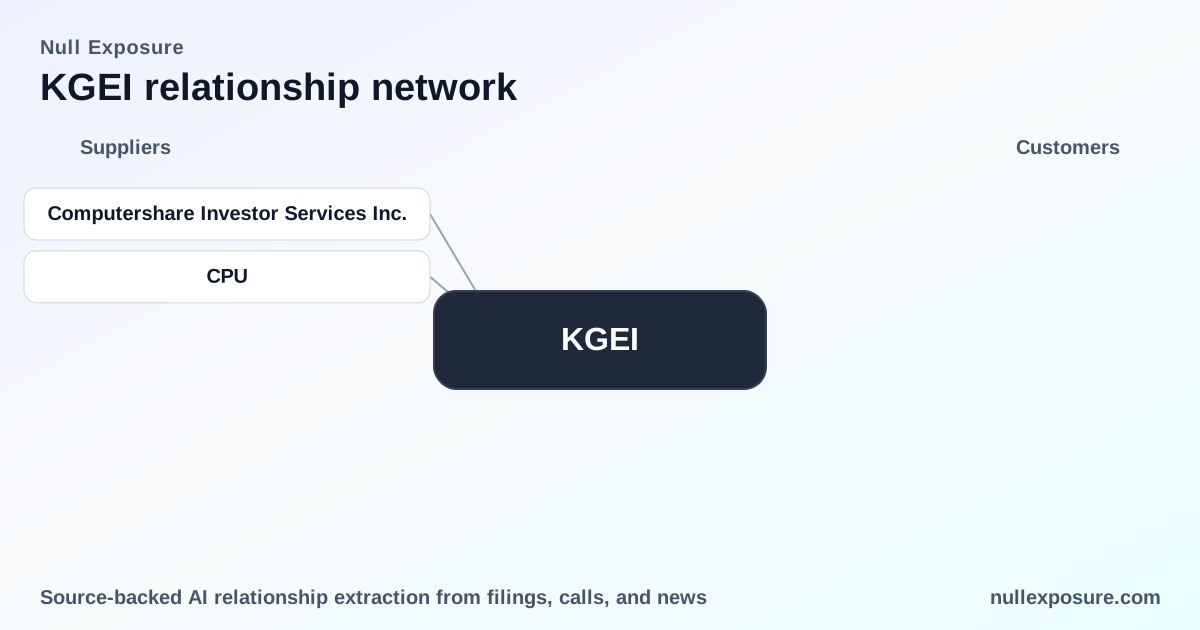
NullExposure’s results list Computershare Investor Services Inc. in two discrete news-sourced items related to Kolibri’s shareholder communications and a requisitioned special meeting.
-
Computershare Investor Services Inc. — Registered-shareholder notices and proxy instructions were routed through Kolibri’s transfer agent as described in the company’s management information circular distributed in FY2025, with registered shareholders instructed to use Computershare’s investorvote portal for online voting. According to a management information circular filed in FY2025 and distributed via Business Wire/FinancialContent (October 15, 2025), Computershare maintained Kolibri’s share register and the circular directed registered holders to Computershare’s online voting platform.
Source: Business Wire / FinancialContent distribution of Kolibri management information circular (FY2025). -
Computershare Investor Services Inc. — A parallel copy of the circular and shareholder voting instructions was hosted on a second news outlet in March 2026, reiterating the transfer agent’s role in enabling the requisitioned special meeting and proxy mechanics. An item reproducing the circular content appeared on Aijourn in March 2026 and reiterated instructions for registered shareholders to use Computershare’s online voting portal.
Source: Aijourn post reproducing Kolibri’s management information circular (first seen March 10, 2026).
Both entries describe the same operational responsibility—maintenance of the share register and facilitation of shareholder voting—documented across multiple FY2025–FY2026 communications channels.
What that means for counterparty and governance risk
The supplier signal here is not commercial exposure but governance exposure. Investors should treat the transfer-agent linkage as part of Kolibri’s control environment rather than as a conventional vendor spend item. Practical implications:
- Voting integrity and timing: Any failure or delay at the transfer-agent level can materially affect the outcome of shareholder actions, especially during contentious items like share limit resolutions or requisitioned meetings.
- Regulatory and disclosures continuity: Transfer-agent errors can spawn regulatory filings, restatements of meeting results, or additional disclosure obligations—creating short-term governance risk even if operational cash flow is unaffected.
- Low supplier churn but single-vendor dependency: The choice of a global, established transfer agent reduces the chance of vendor failure but concentrates a critical function in a single third party.
Investors monitoring governance events should watch proxy mailings, voting portal uptime, and any service-advisory notices from Computershare as precursors to governance risk materialization.
For deeper supplier intelligence tools and monitoring of governance-related vendors, go to https://nullexposure.com/.
Quick risk and opportunity checklist
- Confirm recent notices and the timing of the requisitioned special meeting; voting windows drive immediate governance risk.
- Verify that proxy and mailings were distributed correctly to registered and beneficial holders; miscommunication can invalidate vote counts.
- Monitor Computershare advisories for regional service interruptions or cyber incidents; transfer agents have been targeted in past governance disputes.
Constraints and company-level signals
NullExposure returned no explicit supplier constraints for KGEI in this scope; that absence itself is a signal. At the company level, the available data implies:
- Standard public-company supplier configuration with outsourced governance services and no flagged contract disputes or constraints in the supplier feed.
- Operational maturity consistent with a small-cap NASDAQ-listed E&P: core production operations are primary, governance services outsourced to an experienced vendor.
- Concentration profile: Institutional ownership is meaningful (~69% institutional), which elevates the importance of accurate transfer-agent processing during activist or special-meeting events.
These are company-level observations and not sourced to any constraint excerpt.
Practical next steps for investors and operators
For investors evaluating supplier and governance risk at Kolibri:
- Confirm the timing and outcome of the requisitioned special meeting via SEC filings and the management information circular referenced above.
- Monitor Computershare service notices and the company’s investor relations page for any corrections or supplemental mailings.
- Factor governance continuity into near-term event risk modeling rather than into production forecasts; governance disruptions are transient but can create outsized share-price volatility.
For operators or vendor managers within Kolibri, ensure contractual SLAs for transfer-agent services include uptime guarantees for voting portals and clear escalation channels for contested-meeting scenarios.
If you want a structured supplier-risk briefing or ongoing monitoring set-up for Kolibri and similar small-cap E&P suppliers, visit https://nullexposure.com/ for service options and analyst support.
Conclusion — the supplier takeaway is simple: Computershare provides an essential governance service to Kolibri; the relationship is operationally critical for shareholder actions but non-material to production economics. Investors should treat this as a governance monitoring point—important for event-driven risk and vote outcomes, less so for long-term production forecasts.