Kodiak Gas Services (KGS): Supplier relationships reshaping a capital‑intensive service business
Kodiak Gas Services operates contract compression infrastructure and now expanded distributed power assets, monetizing through long‑term service and equipment rental contracts, recurring maintenance revenue, and strategic acquisitions that increase fleet utilization and cross‑sell opportunities. The company’s model is capital‑intensive and supplier‑dependent: growth depends on timely delivery of compression and power equipment, strong OEM partnerships, and occasional external advisory support for M&A. For investors evaluating supplier counterparty risk and opportunity, the recent Distributed Power Solutions (DPS) acquisition and the vendor map around Caterpillar are the most consequential developments.
Explore supplier coverage and signals at NullExposure
Why the DPS deal changed the supplier story
Kodiak agreed to acquire Distributed Power Solutions for roughly $675 million, adding a 384 MW fleet completely powered by Caterpillar engines and turbines. That transaction immediately shifts Kodiak’s supplier profile from being primarily a compression‑equipment buyer to also operating a large distributed power fleet with deep OEM dependence. The strategic rationale: equipment commonality with Caterpillar simplifies parts, service and resale channels, while increasing revenue diversification into data‑center and off‑grid power markets. (See CityBiz, March 10, 2026: https://www.citybiz.co/article/802973/kodiak-gas-services-to-acquire-distributed-power-solutions/; and TS2.Tech coverage of the $675M figure, March 2026: https://ts2.tech/en/kodiak-gas-services-stock-jumps-on-675-million-dps-buy-as-data-center-power-demand-bites/.)
Detailed look at every named relationship and what it means for operators and investors
-
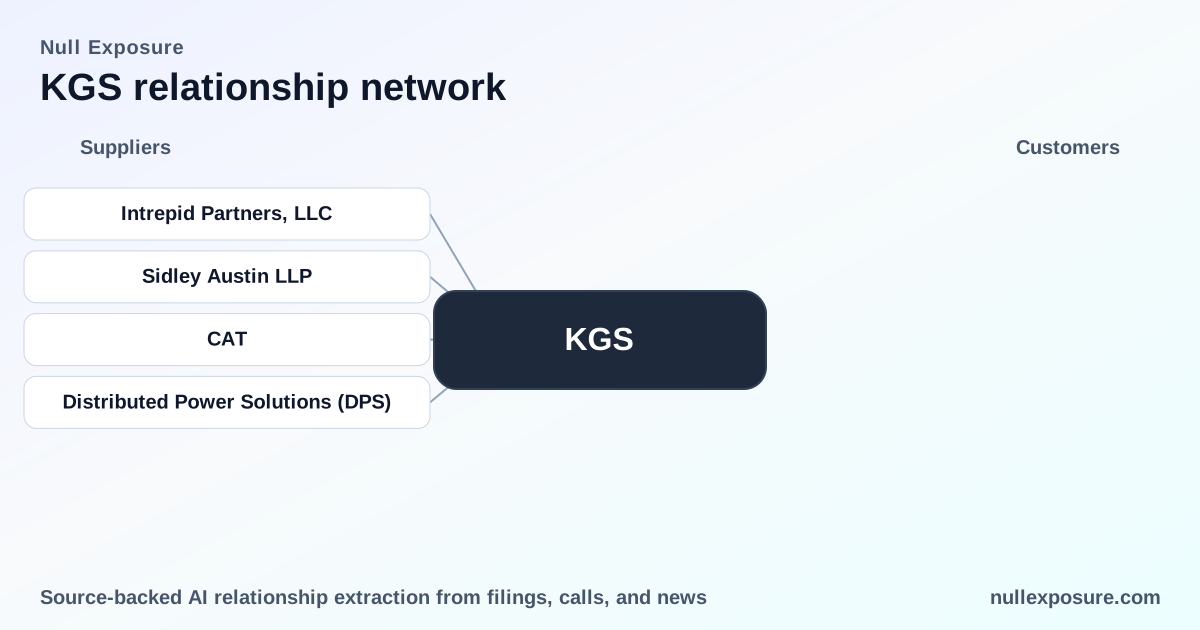
Intrepid Partners, LLC — Intrepid is serving as Kodiak’s exclusive financial advisor on the DPS acquisition, a standard engagement to manage pricing, financing and transaction execution. (CityBiz, March 10, 2026: https://www.citybiz.co/article/802973/kodiak-gas-services-to-acquire-distributed-power-solutions/.)
-
Sidley Austin LLP — Sidley Austin is Kodiak’s legal advisor on the DPS deal, providing transaction and regulatory counsel that reduces execution risk in a complex purchase of operating assets. (CityBiz, March 10, 2026: https://www.citybiz.co/article/802973/kodiak-gas-services-to-acquire-distributed-power-solutions/.)
-
Caterpillar Inc. (CAT) — Kodiak disclosed that the DPS fleet is 100% Caterpillar‑powered, and management cites existing Caterpillar supplier relationships as integral to integrating and scaling the new business. That positions Caterpillar as a critical OEM partner for parts, service and future capital replacement. (Yahoo Finance press coverage, March 2026: https://finance.yahoo.com/news/kodiak-gas-services-buy-dps-092728346.html; GasCompressionMagazine, February 2026: https://gascompressionmagazine.com/2026/02/09/kodiak-enters-distributed-power-generation-market/; InsiderMonkey Q4 2025 call transcript summary, March 2026.)
-
Distributed Power Solutions (DPS) — Kodiak’s target acquisition, DPS brings the fleet and revenue streams that underpin the purchase price (~$675M) and immediate operational scale in distributed power generation. The transaction is the proximate cause of new supplier dependencies and advisory engagements. (TS2.Tech on the transaction, March 2026: https://ts2.tech/en/kodiak-gas-services-stock-jumps-on-675-million-dps-buy-as-data-center-power-demand-bites/; CityBiz coverage, March 10, 2026.)
What the constraints signal about Kodiak’s operating model
Kodiak’s supplier constraints paint a clear portrait of a company where procurement timing and vendor concentration are core strategic risks and levers:
-
Contracting posture is mixed but capital‑intensive. Kodiak records significant short‑term purchase commitments — $168.8 million expected to settle within 12 months — driven by orders for new compression units. That indicates aggressive fleet replenishment and a near‑term cash outflow profile tied to equipment delivery schedules.
-
Critical supplier concentration is embedded in the model. Kodiak relies on a small number of vendors to manufacture and assemble compression equipment, and the DPS fleet’s 100% Caterpillar equipment concentration increases single‑OEM exposure for parts, service rates, and lead times. This is a company‑level signal of heightened supply‑chain risk.
-
Subscription and license relationships indicate operational SaaS dependencies. Kodiak has a master services agreement with IFS North America for an ERP system license and cloud hosting, reflecting a modern operating stack where external software vendors are operationally important and, therefore, part of supplier risk management.
-
Spend is lumpy and ranges across bands. The firm’s documented purchase commitments (> $100M), a separate $11.4M finance agreement to finance compression equipment, and other agreements totaling roughly $9.4M since inception show that Kodiak’s supplier spend profile covers large one‑time capital commitments and smaller recurring obligations. These are company‑level spending signals that affect liquidity and procurement strategy.
Taken together, these constraints make Kodiak a capital‑heavy operator whose margins and growth are sensitive to OEM lead times, price inflation, and the availability of financing for equipment purchases.
Investment implications — upside, downside, and what to watch
-
Upside: Equipment commonality with Caterpillar is a practical operational advantage. It simplifies spare parts inventory, technician training and potential bulk purchasing terms, which supports higher utilization and lower per‑unit service cost over time. Positive margin expansion is credible if management executes on integration synergies.
-
Downside: Concentration risk and near‑term capital commitments create execution drag. The $168.8M in near‑term purchase obligations and the material DPS purchase raise the importance of supplier resilience and access to capital markets; supply disruptions or OEM price increases would pressure margins and near‑term cash flow.
-
Key monitors: OEM lead times and parts availability for Caterpillar equipment; effective integration of DPS revenue and cost bases; progress on any financing obligations related to recent acquisitions; and any disclosures about additional supplier commitments or contingency plans.
Review broader supplier intelligence and signals at NullExposure
Final read: how to position
Kodiak is now a hybrid operator — compression services plus distributed power — that monetizes through recurring equipment service and rentals while remaining exposed to capital cycles and supplier concentration. For investors, the DPS acquisition offers a clear growth vector with operational logic (Caterpillar commonality) but also elevates execution and supply‑chain risk through large near‑term purchase commitments. Focus due diligence on OEM relationships, capex timing and covenant headroom. The next 12 months of parts procurement, integration milestones and any follow‑on financing will determine whether the strategic bet captures value or simply increases capital intensity.
Go to NullExposure for continuous supplier monitoring and alerts