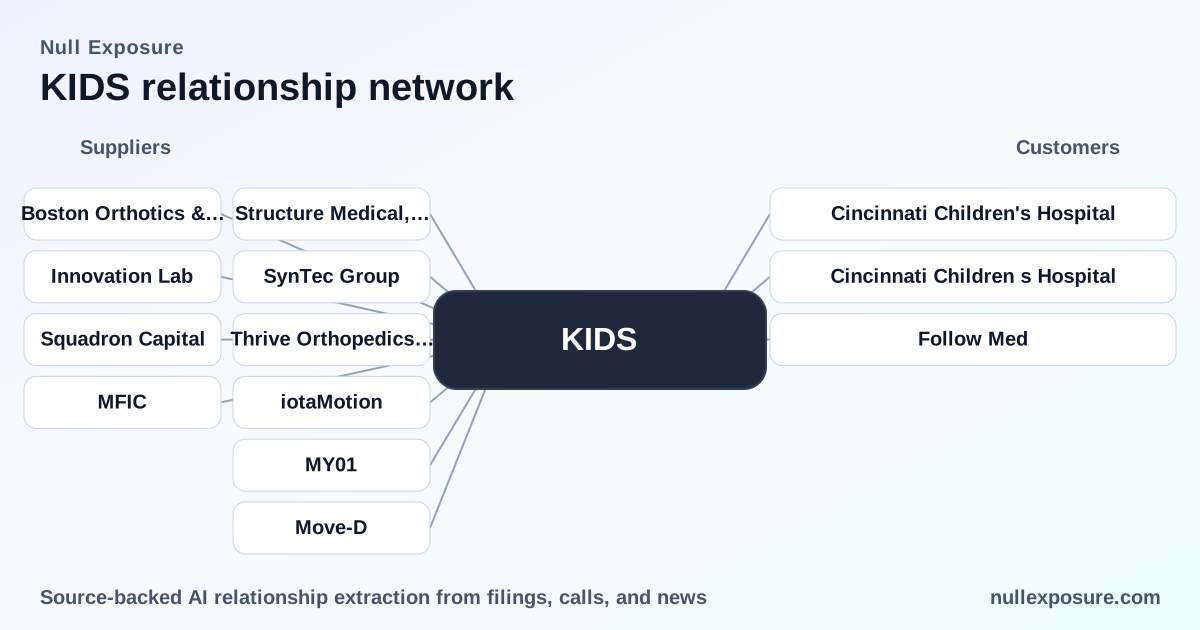
KIDS Supplier Map: Orthopediatrics’ Partner Footprint, Concentration Risks, and Commercial Levers
OrthoPediatrics (NASDAQ: KIDS) designs, markets, and distributes specialty pediatric orthopedic implants, bracing and related enabling technologies, monetizing primarily through product sales, exclusive distribution agreements, and selective licensing. The company combines an asset-light contract manufacturing model for implants with in‑house bracing and a broad network of distribution and licensing partners, generating revenue through direct sales and channel-enabled reach. Investors should evaluate the supplier roster for concentration, contract tenure, and how partnerships extend the company into non‑orthopedic adjacencies. Learn more or explore the supplier intelligence hub at https://nullexposure.com/.
How the supplier picture defines the business model
OrthoPediatrics runs a hybrid operating model that leans on third‑party manufacturers for implants while retaining bracing production in‑house and outsourcing sales distribution. This creates a set of persistent business characteristics:
- Contracting posture: The company discloses maintaining long‑term contracts with key suppliers, which supports supply stability but increases switching friction. This is a company-level signal drawn from management disclosures in regulatory filings.
- Concentration and criticality: Sales channeled through third‑party sales agencies and distributors are material to revenue (management reported that those agencies represented 59% and 66% of global revenue in 2024 and 2023). High channel concentration equates to outsized operational and commercial exposure.
- Role diversity and maturity: OrthoPediatrics uses contract manufacturers for implants, operates in‑house bracing lines, and acts as licensee/distributor for select external technologies — a mature mid‑market specialty device model that balances capital intensity against growth via partnerships.
- Strategic stretch: Recent partnerships show deliberate expansion into adjacent enabling tech (robotics and diagnostic tools), signaling a move to diversify product offerings and capture higher value procedural workflows.
These characteristics are a company-level synthesis from filings and public announcements and should be treated as primary lenses for vendor risk and opportunity assessment. For a quick supplier risk scan, see https://nullexposure.com/.
Relationship roll call — each partner, one short take
Structure Medical, LLC
OrthoPediatrics disclosed in its FY2024 10‑K that it uses Structure Medical as one of its suppliers, indicating reliance on third‑party contract manufacturing partners for components or assemblies. (Source: FY2024 10‑K filing.)
SynTec Group
Management referenced the Halo Gravity traction system in partnership with SynTec on the FY2025 Q4 earnings call, signaling a product collaboration to extend traction therapy offerings. (Source: Q4 2025 earnings call transcript.)
Thrive Orthopedics LLC
In January 2025 OrthoPediatrics’ OPSB division announced a distribution agreement with Thrive Orthopedics focused on three pediatric orthotic solutions, expanding the company’s specialty bracing distribution reach. (Source: Globenewswire news release, Jan 22, 2025.)
iotaMotion
OrthoPediatrics has an existing partnership with iotaMotion to commercialize a robotic‑assisted insertion system for cochlear implant surgery in pediatric patients, and management described movement toward full commercial launch of this non‑orthopedic technology in FY2026 communications. (Sources: Globenewswire release, Feb 3, 2026; FY2026 earnings commentary reported by InsiderMonkey.)
MY01
A September 2025 distribution partnership with MY01 positions OrthoPediatrics to offer an innovative perfusion‑diagnostic device for limb injuries, broadening diagnostic and point‑of‑care capabilities in its portfolio. (Source: Globenewswire news release, Sep 5, 2025.)
Move‑D
OrthoPediatrics announced a collaboration to bring MOVE‑D™ bracing products to market, characterizing Move‑D as a product development and commercialization partner for specialty bracing. (Source: Globenewswire news release, Dec 5, 2024.)
Innovation Lab
OrthoPediatrics entered license, supply and distribution agreements with Innovation Lab to commercialize the MOVE‑D brace, reflecting a licensing and manufacturing relationship that feeds the company’s bracing lineup. (Source: Globenewswire news release, Dec 5, 2024.)
Boston Orthotics & Prosthetics (Boston O&P)
OrthoPediatrics acquired Boston O&P’s product portfolio, including bracing and orthotic prosthetic technology, financed in part by debt — an acquisition that strengthens proprietary bracing offerings and vertical control. (Source: Healio reporting on the acquisition, Jan 2024.)
Squadron Capital
Public reporting indicates a replaced credit facility relationship where a previously unused $50 million line of credit from Squadron Capital was superseded, signaling management’s refinancing activity around the Boston O&P acquisition. (Source: RYOrtho coverage, Feb 2024.)
MidCap Financial (MFIC)
OrthoPediatrics closed a debt financing with MidCap Financial providing up to $80 million through a term loan and revolving loan to replace the prior unused credit line, underpinning acquisition and working capital needs. (Source: MassDevice reporting on FY2024 financing.)
What these relationships mean for investors and operators
The supplier and partner roster demonstrates a balanced growth strategy: acquire and internalize core bracing IP, outsource implant manufacturing, and license/distribute adjacent enabling technologies. Key implications:
- Revenue leverage through channels: Heavy reliance on third‑party sales agencies and distribution partners means top‑line volatility tracks partner performance; yet long‑term contracts provide commercial runway.
- Supply chain fragility vs. flexibility: Contract manufacturing limits capital deployment but raises single‑source risk when a small number of partners assemble the majority of implants. This is an operational constraint investors should quantify in diligence.
- Strategic diversification: Partnerships with iotaMotion and MY01 transition KIDS into diagnostic and robotic adjacencies, increasing addressable market and the potential for higher‑margin procedural enablers.
- Financing footprint: Debt financing from MidCap and replaced facilities connected to Squadron Capital indicate active balance sheet management tied to M&A — monitor covenant structures and liquidity headroom.
If evaluating OrthoPediatrics commercially, prioritize supplier auditability, contingency plans for single‑source manufacturers, and the revenue sensitivity to channel partner disruptions.
Explore additional supplier risk indicators and supplier‑level histories at https://nullexposure.com/ to support investment decisions.
Tactical investor checklist and next steps
- Model channel concentration: Recast revenue sensitivity assuming a 10–20% disruption across major sales agencies; translate into cash flow and covenant impact.
- Validate manufacturing redundancy: Demand supplier lists and capacity plans for implants to assess single‑source risk.
- Track commercial rollouts: Monitor iotaMotion and MY01 launch milestones as indicators of margin expansion beyond legacy implants and bracing.
- Monitor debt metrics: Review MidCap loan covenants and any refinancing activity tied to acquisition integration.
For a deeper supplier map and actionable signals connected to OrthoPediatrics’ partner network, visit https://nullexposure.com/. Investing requires both financial and operational insight; the supplier footprint here is as consequential as product pipeline in assessing KIDS’ trajectory.