Classover Holdings (KIDZ): supplier map, strategic posture, and operational risk for investors
Classover Holdings monetizes by selling interactive, AI-enabled K‑12 online courses and related credentialing; the company combines proprietary AI tutoring with third‑party real‑time communications and blockchain credentialing to drive recurring revenue and course sales. Revenue derives from course subscriptions and tokenized credential services while gross margins reflect a software- and content‑heavy model with negative operating margins as the company scales. Explore supplier exposures and partner implications at https://nullexposure.com/.
The company in a paragraph investors need
Classover is a small‑cap education‑technology operator listed on NASDAQ under KIDZ, reporting roughly $3.7 million in trailing‑twelve‑month revenue and a negative operating margin consistent with early commercial scale. Key balance‑sheet and operating signals: limited institutional ownership, concentrated insider stake, and early‑stage partnerships launched in FY2025–FY2026 that shift the company from a pure content provider toward an AI/tokens-enabled platform. For ongoing supplier intelligence and deal mapping visit https://nullexposure.com/.
How partners are playing functional roles in product delivery
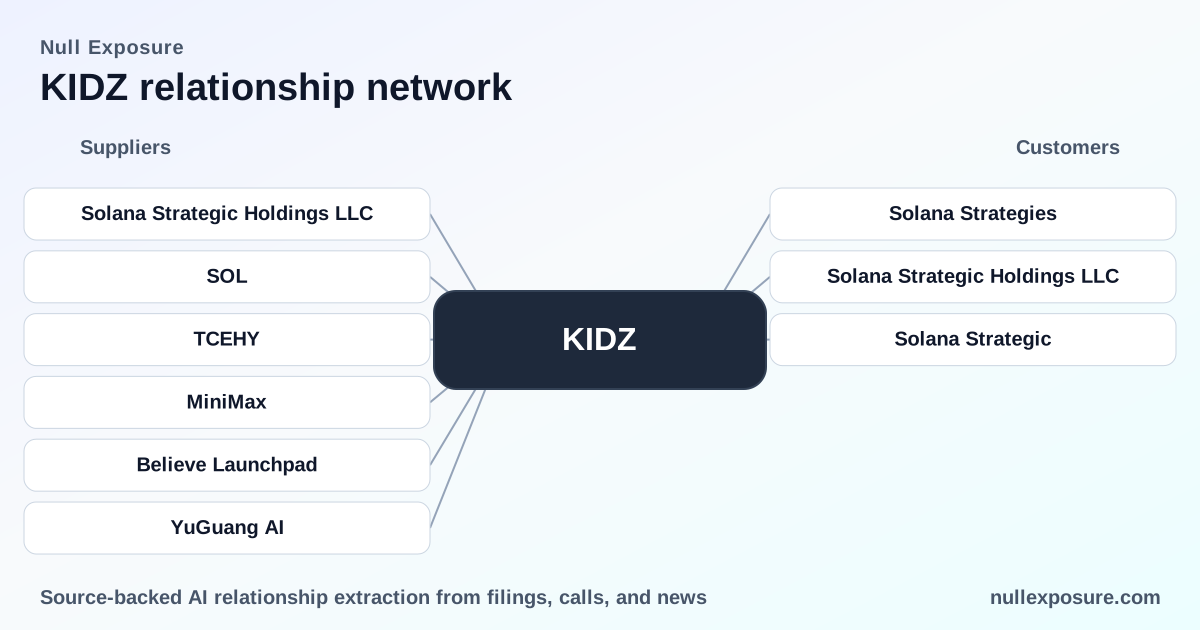
Classover’s supplier relationships split into three functional buckets: real‑time communications (user experience), AI content and curriculum (course production), and blockchain/credentialing (proofs of learning and token initiatives). Each of the named partners contributes a discrete operational capability that Classover leverages to deliver its product.
MiniMax — AI tutor core development
Classover announced upgrades to its Real‑Time AI Tutor in collaboration with MiniMax, positioning MiniMax as a core product development partner to improve interactivity and multilingual scalability. According to a January–March 2026 company release, the MiniMax collaboration underpins readiness for scaled global deployment (https://markets.financialcontent.com/stocks/article/accwirecq-2026-1-12-classover-expands-minimax-partnership-upgrading-real-time-ai-tutor-for-higher-engagement-global-scale-and-multilingual-deployment).
Tencent Real‑Time Communication (Tencent RTC) — low‑latency voice and live features
Classover has begun integrating Tencent RTC to provide ultra‑low latency two‑way voice, improved audio for speech recognition, and a platform for future synchronized classroom features such as whiteboards and screen sharing; this is a direct operational dependency for global live tutoring quality. Accesswire covered the March 2026 announcement noting the integration’s role in improving AI Tutor performance under weak or noisy network conditions (https://www.accessnewswire.com/newsroom/en/computers-technology-and-internet/classover-begins-collaboration-with-tencent-rtc-to-support-its-ne-1123891).
Solana Strategic Holdings LLC — terminated equity purchase facility
Classover terminated a previously disclosed $400 million Equity Purchase Facility with Solana Strategic Holdings LLC, formally ending its Solana‑focused digital asset treasury strategy. The termination was reported in March 2026 and removes a previously announced financing and treasury channel tied to digital assets (https://www.galvnews.com/classover-terminates-equity-purchase-facility-to-pivot-from-digital-asset-treasury-strategy/article_5afd2fe2-457b-5dad-bf04-87f205d83bc7.html).
Solana network — credential infrastructure (ODLCs)
Separately from the terminated facility, Classover launched on‑chain Digital Learning Credentials (ODLCs) on the Solana blockchain to create a verifiable education identity layer where achievements are AI‑verified and recorded on chain; this was announced in October 2025 and frames a product strategy for interoperable credentials (Markets FinancialContent, October 2025: https://markets.financialcontent.com/stocks/article/accwirecq-2025-10-14-classover-launches-on-chain-digital-learning-credential-the-first-ai-verified-education-token-framework-on-the-solana-network).
Believe Launchpad — issuance conduit for credential tokens
Classover uses Believe Launchpad to mint and issue credential tokens that are immutably anchored on Solana, establishing an issuance pathway and an external partner for token distribution and provenance. The October 2025 release described Believe Launchpad as the issuing mechanism for the credential tokens (https://markets.financialcontent.com/stocks/article/accwirecq-2025-10-14-classover-launches-on-chain-digital-learning-credential-the-first-ai-verified-education-token-framework-on-the-solana-network).
YuGuang AI — curriculum and intelligent content production
Classover announced a strategic collaboration with YuGuang AI to advance AI‑driven curriculum and intelligent content production, positioning YuGuang as a supplier of AI‑assisted instructional content and course production capabilities in early March 2026 (https://markets.financialcontent.com/stocks/article/accwirecq-2026-3-4-classover-announces-strategic-collaboration-with-yuguang-ai-to-advance-ai-driven-curriculum-and-intelligent-content-development).
What these supplier links imply for operations, contracting posture, and risk
- Contracting posture: Classover is architecting a partner‑centric product stack — core learner experience components are outsourced to specialist providers rather than built exclusively in‑house. This reduces near‑term capex but increases operational integration risk and vendor management burden.
- Concentration and criticality: Real‑time communications (Tencent RTC) and AI tutor core development (MiniMax) are mission‑critical — degradation or loss of either supplier would directly impair product quality and retention. Credentialing on Solana and issuance through Believe Launchpad are strategically important for differentiation but less immediately revenue‑critical than live tutoring.
- Maturity: Partnerships are recent (FY2025–FY2026) and therefore in an early commercial phase; uptime SLAs, scale testing, and global regulatory alignment remain workstreams to watch.
- Company‑level governance signal: Classover’s public disclosures indicate an auditor relationship established in 2025, which is a positive governance signal reflecting a move toward standard external controls and auditability.
For dedicated due diligence and ongoing supplier tracking, see https://nullexposure.com/ for a consolidated view.
Investment implications — what investors should prioritize
- Operational dependence on third parties creates execution risk. Prioritize vendor continuity and SLA transparency for Tencent RTC and MiniMax integrations.
- The terminated Solana equity facility reduces digital‑asset treasury exposure but leaves the company committed to Solana for credentialing; evaluate custody, compliance, and regulatory risk tied to blockchain credentialing.
- Revenue scale and margins require successful product adoption. With modest revenue and negative operating margins, Classover must convert its platform enhancements into paid subscriptions at scale to justify a platform valuation.
- Governance and controls are improving. The 2025 auditor relationship is a material governance improvement for a small public company and should support more credible financial reporting going forward.
Closing view and next steps
Classover is executing a hybrid product strategy that blends outsourced real‑time infrastructure, third‑party AI content production, and blockchain credentialing to create a differentiated K‑12 offering. That architecture reduces initial development cost but places outsized importance on supplier execution, contract clarity, and integration reliability. For a deeper supplier map, contract flags, and monitoring tools tailored to education‑tech portfolios, visit https://nullexposure.com/.
If you want a concise supplier risk brief or a custom watchlist for KIDZ partners, NullExposure provides targeted monitoring and advisory — start at https://nullexposure.com/.