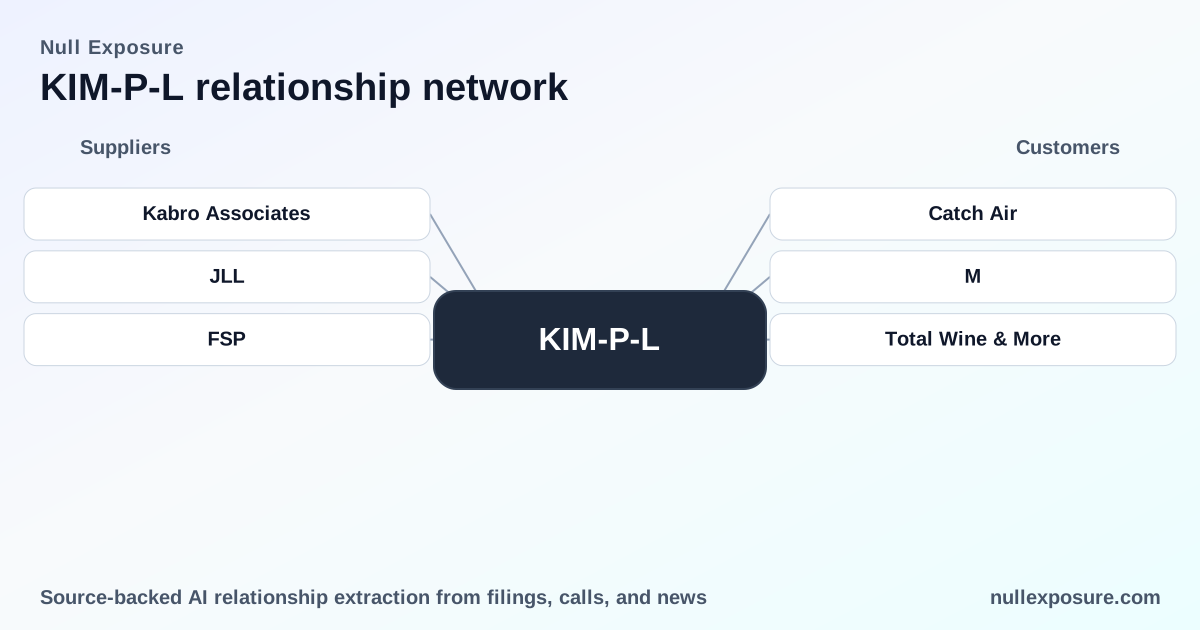
KIM-P-L: Supplier relationships that drive a landlord’s revenue engine
Thesis — KIM-P-L (Kimco’s supplier-facing footprint) operates as a retail real estate landlord that monetizes through property acquisitions and leasing national and regional tenants; the company executes growth and occupancy through third‑party dispositions/acquisitions and professional leasing brokers rather than solely in‑house channels. This playbook converts capital deployment and leasing activity into stabilized cash flows and rent roll growth — a straightforward monetization route for investors focused on rent collection, tenant mix, and asset rotation.
Explore more on partner exposure and supplier mapping at https://nullexposure.com/.
What the public record shows about active counterparties
The extracted reporting on KIM-P-L lists direct transactional counterparties and leasing representatives involved in Kimco’s portfolio moves. Below are the relationships the market has recorded and the plain-English takeaways investors need.
-
Kabro Associates — In November 2022 Kimco acquired eight retail assets in Nassau County from Woodbury‑based Kabro Associates for $375.8 million, reflecting an acquisitive posture to consolidate suburban shopping-center holdings. According to The Real Deal (Nov 11, 2022), the transaction covered eight assets spread across Nassau County and was reported at $375.8 million. (Source: The Real Deal, 2022)
-
JLL — Multiple reports from 2023 attribute leasing activity for Kimco to JLL brokers Brian Quinn and Bryan Cunningham, who secured a Macy’s small‑format lease in Santee and a 30,000 sq ft store in Southern California on behalf of the landlord. Both ConnectCRE and ShoppingCenterBusiness note that JLL acted as leasing agent for Kimco in those deals (FY2023 reporting). (Sources: ConnectCRE, 2023; ShoppingCenterBusiness, 2023)
-
Franklin Street — Local reporting in 2025 identifies Franklin Street as a leasing representative for Kimco in the Jacksonville market, indicating the use of regionally focused brokers alongside national firms. The Jax Daily Record (June 27, 2025) states that Franklin Street served as the leasing representative for Kimco in River City Marketplace transactions. (Source: Jax Daily Record, 2025)
Each entry above is recorded from public news coverage and reflects counterparties that facilitated acquisition or leasing activity for Kimco. These relationships illustrate the supplier and broker ecosystem Kimco leverages to execute property-level strategy.
What the relationship set implies about Kimco’s operating model
Taken together, these counterparties reveal an operating model built on external execution specialists:
-
Contracting posture: Kimco consistently uses third‑party brokers and local leasing agents to place national tenants and to monetize assets — a contracting posture that emphasizes scalability and market access. Using established brokerage platforms reduces the need for a disproportionately large internal leasing organization and helps rapidly deploy tenant demand into specific markets.
-
Supplier concentration and diversity: The mix of national firms (JLL) and regional brokers (Franklin Street) signals deliberate supplier diversification rather than dependence on a single provider. That balance preserves negotiating leverage while ensuring local market execution.
-
Criticality: Leasing agents are operationally critical suppliers because tenant acquisitions and lease terms directly affect occupancy, rent cadence, and revaluation. The presence of high‑caliber brokers suggests Kimco prioritizes execution quality for anchor and national tenant placements.
-
Maturity: The nature of counterparties—institutional brokers and third‑party sellers—aligns with a mature commercial real estate operator that outsources transactional work while maintaining capital and asset management in-house.
Note: the underlying dataset included no explicit contractual constraints or supplier restrictions to report, so these signals are company‑level inferences rather than documented contractual limits.
Risk profile — what investors should price
These supplier relationships create distinct risk vectors investors must price into valuation and covenant analysis:
-
Execution risk: Reliance on external brokers concentrates execution capability in third parties; any broker-market dislocation or misalignment of incentives can slow lease-up or reduce headline rents. Active performance monitoring of broker outcomes should be part of counterparty due diligence.
-
Concentration risk by tenant type: Transactions with national tenants like Macy’s change tenant mix and cash-flow durability; such deals can improve traffic but also increase exposure to single-tenant performance. Investors should watch tenant credit and store-format economics.
-
Integration risk for acquisitions: Asset purchases (for example, the Kabro assets) require successful integration—leasing, capex optimization, and tenant retention—to convert purchase price into accretive cash flow. Acquisition financing and underwriting assumptions should be stress-tested.
-
Local market execution: Use of regional brokers helps local penetration but increases variability in execution standards across markets; governance and standardized KPIs for leasing agents reduce heterogeneity in outcomes.
For a granular read on partner impact and supplier concentration for portfolio risk, visit https://nullexposure.com/.
Practical investor takeaways
- Broker partnerships are a feature, not a bug: Kimco outsources leasing to leverage specialized market access and reduce fixed overhead. Assess the consistency of broker performance and alignment of incentives with landlord objectives.
- Acquisitions require watchful underwriting: Large portfolio purchases should be evaluated for near‑term lease-up potential and required capital expenditure to reach stabilized cash flow.
- Local/regional coverage matters: The blend of national and regional brokers preserves flexibility but mandates robust oversight to ensure uniform execution standards.
If you want a deeper counterparty map or a supplier-risk score tailored to KIM-P-L, begin your analysis at https://nullexposure.com/.
Conclusion — what to watch next
Kimco’s recorded supplier relationships underline a transactional, execution‑oriented supplier model where acquisitions and leasing are handled through established external partners. For investors, the key monitoring points are broker performance metrics, tenant credit trends, and the success of asset integrations post-acquisition. These factors will dictate near‑term cash‑flow realization and revaluation potential.
For ongoing updates on supplier exposure and to track changes in broker or counterparty relationships over time, return to https://nullexposure.com/ — the fastest route to supplier-centric intelligence for real estate investors.