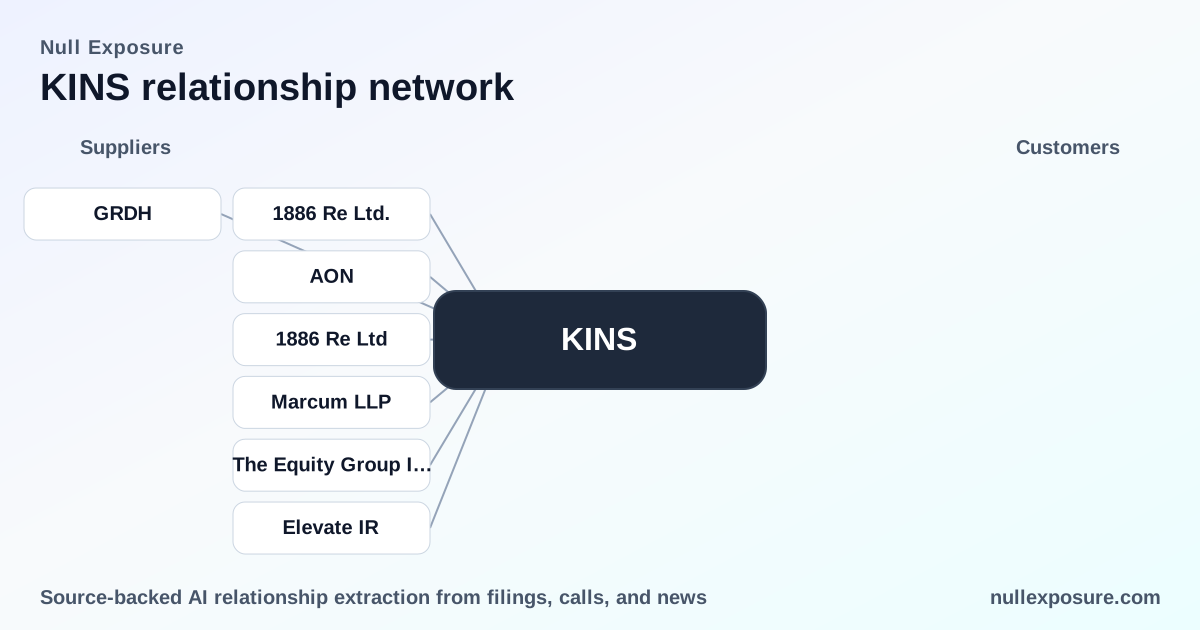
Kingstone (KINS): Supplier relationships that shape capital, reinsurance and short-term liquidity
Kingstone is a regional insurer that monetizes underwriting and distribution in the Northeast through a blend of traditional reinsurance, capital markets transfers and selective financing arrangements. The company offsets catastrophe exposure and supports growth by ceding risk under quota-share treaties, buying excess-of-loss cover and tapping the cat-bond market — while generating ceding commissions and underwriting leverage as recurring revenue components. For investors, the supplier map is a direct read on Kingstone’s risk-transfer sophistication and near-term liquidity posture. For a concise view of comparable supplier intelligence and relationship signals, visit https://nullexposure.com/.
Why supplier choice matters for Kingstone’s economics
Kingstone’s suppliers are not peripheral vendors; they are the plumbing that determines volatility of loss experience and working capital flexibility. Capital market transactions (cat bonds), traditional brokers/placement agents, accounting and investor-relations partners, and cedant/insurer counterparties each change the firm’s risk profile in a measurable way. The recent Series 2025-1 catastrophe bond, structured into a Bermuda special-purpose insurer, is a case in point: it replaces or augments treaty capacity with fully collateralized protection, trimming solvency volatility while creating a new fixed-cost spread against capital.
- Key business-driver: reinsurance and cat-bond placement lower earnings volatility and free regulatory capital for premium growth.
- Key risk: reliance on short-window treaty renewals and capital markets pricing creates timing and basis risk in high-loss years.
If you evaluate partners and counterparties when sizing underwriting exposure, start with the capital-market and reinsurance relationships documented below. For a deeper roll-up of supplier influence across the insurance value chain, see https://nullexposure.com/.
Relationship roster — what each supplier does for Kingstone
1886 Re Ltd.
Kingstone sponsored the 1886 Re Ltd. Series 2025‑1 catastrophe bond to secure $125 million of multi‑year named‑storm protection, priced in the lower half of guidance and offered on an indemnity, per‑occurrence trigger covering Northeast U.S. states. This transaction provided Kingstone with a four‑year source of fully‑collateralized reinsurance capacity. According to Artemis and Reinsurance News coverage in March 2026, the issue was upsized 25% and priced around 4.5%. (Artemis, March 2026; Reinsurance News, March 2026)
Aon Securities LLC (AON)
Aon Securities structured and placed the notes that underpin the 1886 Re Ltd. cat bond, arranging coverage across four annual risk periods from July 1, 2025, through June 30, 2029 — demonstrating Kingstone’s use of large broker/dealer placement capacity for capital‑markets reinsurance. According to Reinsurance News’ March 2026 report, Aon handled the structuring and placement. (Reinsurance News, March 2026)
Marcum LLP
Marcum LLP was ratified as Kingstone’s independent registered public accounting firm for fiscal-year 2017, reflecting its role in external financial reporting and controls during that period. The appointment was reported in a 2017 local press notice. (CityBuzz/NewYork, 2017)
The Equity Group Inc.
The Equity Group Inc. functions as an investor-relations contact for Kingstone; filings and press releases list Karin Daly of The Equity Group as an outreach contact for investor communications around third-quarter and other earnings events. (The Globe and Mail ACCESS release, FY2025)
Elevate IR
Elevate IR is Kingstone’s current investor-relations contact, repeatedly referenced on company press releases in early 2026 for dividend and preliminary financial communications and contact routing. Several January–February 2026 press distributions list Elevate IR as the IR provider and contact point. (GlobeNewswire and other January–February 2026 releases)
Guard (GRDH)
Kingstone cited support from policies written under a Guard renewal‑rights agreement, indicating a distribution or portfolio relationship that supplies policy flow and renewal economics to Kingstone’s book since September of the referenced year. Marketbeat’s Q4 2026 earnings highlights noted the contribution from Guard‑sourced policies. (MarketBeat, March 6, 2026)
What the constraints say about Kingstone’s operating model
Company filings and event disclosures reveal a mix of contractual time horizons, active service‑provider posture, and recent treaty change activity — all of which shape capital flexibility and counterparty criticality.
- Mix of long‑term and short‑term contracting: Kingstone has multi‑year financing commitments (an equipment financing schedule at a fixed 5.86% over 60 months) alongside one‑year quota‑share treaties for personal lines (the 2024/2025 Treaty runs Jan 1, 2024–Jan 1, 2025). These dual horizons imply a company that blends durable financing with rolling reinsurance coverage to adjust capacity annually. (Company filing excerpts)
- Service‑provider posture: The business uses sale‑leaseback financing, ceded reinsurance for regulatory capital management, and market placements for catastrophe protection; these are not passive suppliers but active financial counterparties integral to capital management. Filings detail equipment sale‑leaseback transactions and ceding‑commission economics tied to quota‑share arrangements. (Company filing excerpts)
- Active relationship stage: Kingstone’s reinsurance treaties and excess‑of‑loss programs were renewed and effective July 1, 2024, and quota‑share arrangements were updated for 2024/2025, indicating live counterparties and an active risk‑transfer program. (Company filing excerpts)
- Liquidity and ratings sensitivity: Historical withdrawal from A.M. Best’s interactive rating process constrained certain borrowing options, leaving Kingstone with intermittent overnight borrowing access at points in time; that operational constraint directly affects short‑term liquidity under stress. (Company filing excerpts)
These are company‑level signals, not relationship‑specific attributions, and they frame how investors should weight supplier risk and timing.
Investment implications and what to watch next
- Positive: The cat bond with 1886 Re Ltd. and the use of Aon to place it show access to diversified capital markets capacity, reducing single‑point reinsurance exposure and smoothing capital volatility.
- Negative: Concentration risk remains: Northeast named‑storm exposure is the core hazard transferred, and renewals (annual treaties) create windows of repricing risk during hard markets. Short‑term borrowing constraints tied to rating status increase sensitivity to capital shocks.
- Action drivers: Monitor cat‑bond market spreads and placement cadence, the renewal terms of quota‑share treaties, and any public updates from Elevate IR regarding liquidity management and dividend policy.
If you track supplier counterparties to size counterparty and placement risk across insurers, examine our broader supplier intelligence to compare how counterparties influence capital outcomes: https://nullexposure.com/.
Kingstone’s recent actions show a deliberate shift toward capital‑markets reinsurance to lock multi‑year protection while still using short‑term quota share capacity where distribution economics warrant. Investors should price in both the stability benefits of fully‑collateralized capacity and the timing risk of annual treaty renewals. For a complete view of supplier relationships and comparative exposure metrics across insurers, visit https://nullexposure.com/ for detailed supplier analysis and sourcing.