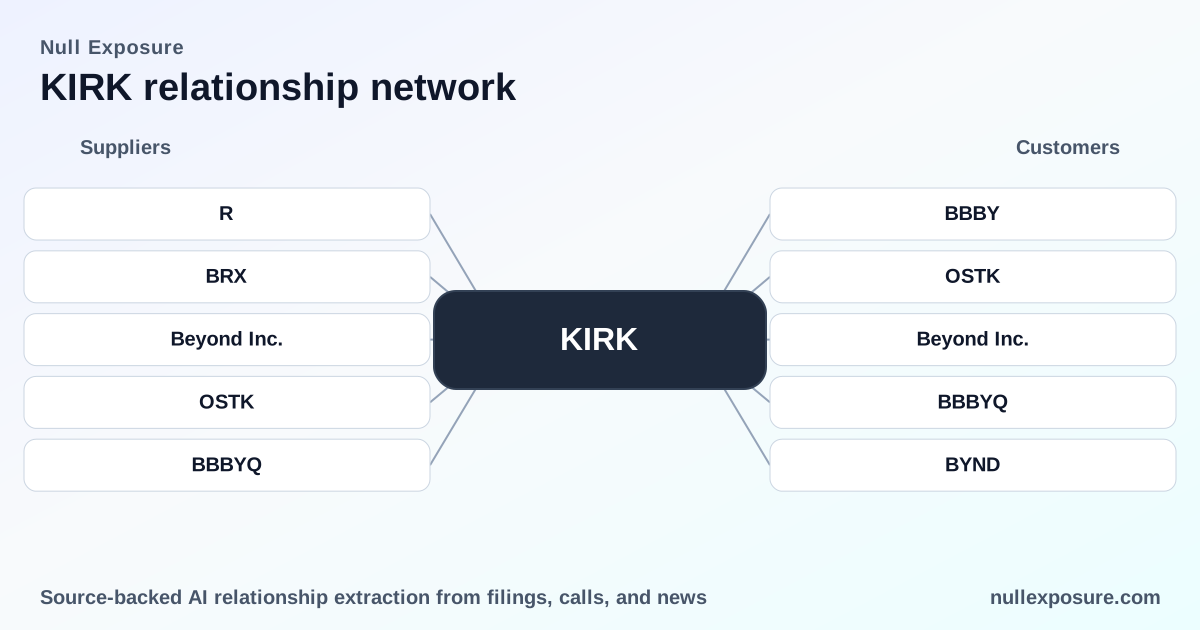
KIRK supplier map: logistics, landlords and credit lines that shape the turnaround
Kirkland’s (ticker KIRK) is a specialty home furnishings retailer that monetizes through a mix of in-store sales, targeted store conversions and e-commerce, supported by third‑party logistics and short‑term credit facilities. Its operating model tilts toward asset-light partnerships—leasing physical footprints, outsourcing delivery and tapping external credit lines—so supplier relationships drive execution risk and near-term liquidity. For investors evaluating counterparty risk, the vendor list signals where operational continuity and financing flexibility are concentrated. Learn more on the NullExposure research hub: https://nullexposure.com/.
What the relationship map tells you about how KIRK runs the business
Kirkland’s operating posture is transactional and partnership-driven: the company relies on external logistics and platform expertise to execute a furniture growth strategy, leases third‑party retail space rather than owning distribution real estate, and leans on incremental credit from non‑bank partners to smooth working capital. These characteristics create a mix of advantages—lower fixed capital intensity and faster footprint changes—and risks tied to credit covenant compliance and provider continuity.
- Contracting posture: KIRK contracts for core capabilities (delivery, assembly, e‑commerce platform work) rather than building in-house capabilities, making supplier service continuity critical to customer fulfillment and conversion plans.
- Concentration signals: Multiple mentions of the same finance partner (Beyond Inc.) and targeted logistics relationships indicate points of counterparty concentration that matter for covenant negotiation and operational resilience.
- Criticality and maturity: Relationships with established logistics players and large REIT landlords suggest mature, commercially standard contracts for delivery and leasing, but the presence of emergency credit talks shows capital structure fragility.
- Implication for investors: Supplier performance and the availability of small incremental credit lines will directly influence near‑term inventory flow, store conversion plans, and e‑commerce replatform timing.
Explore deeper supplier profiling and counterparty risk scoring at NullExposure: https://nullexposure.com/.
The supplier relationships you need to know
Ryder System — outsourced last‑mile and assembly for furniture expansion
Kirkland’s signed a partnership with Ryder to roll out in‑home delivery and light assembly as the retailer expands its furniture business, outsourcing a critical last‑mile capability to a national logistics provider. Source: HomePageNews reporting on the Ryder arrangement (FY2022) — https://www.homepagenews.com/home-housewares/decor/kirklands-adds-ryder-delivery-to-support-furniture-expansion/.
Brixmor Property Group — landlord for store footprint expansion
Kirkland’s leased a location in Park Shore Plaza, confirming ongoing reliance on national shopping‑center landlords to execute store openings and re‑entries into regional markets. This underscores the retailer’s dependence on third‑party property owners to scale or contract its physical footprint. Source: Naples Daily News coverage of the planned store opening (FY2017) — https://www.naplesnews.com/story/news/columnists/tim-aten-in-the-know/2017/04/10/know-kirklands-returning-naples-market/100255724/.
Beyond Inc. — e‑commerce partnership and incremental credit provider
Beyond (the operator linked with Bed Bath & Beyond and Overstock initiatives) is serving both as an e‑commerce collaborator—Kirkland’s paused its replatforming to leverage Beyond’s expertise—and as a short‑term lender in credit talks. In FY2024 KIRK paused its website replatform to collaborate with Beyond on e‑commerce; by FY2025 the parties were in discussions for an additional $5 million in credit to support working capital and location conversions. Sources: RetailWire on the replatform pause (FY2024) — https://retailwire.com/discussion/bed-bath-beyond-partners-with-kirklands-and-the-container-store/; Furniture Today reporting on the FY2025 credit talks — https://www.furnituretoday.com/e-commerce/tariff-issues-tied-to-kirklands-uncertainty-about-its-future/.
Overstock — partner for store conversions and merchandising reach
Kirkland’s announced plans that include conversions of some Kirkland’s Home locations to Overstock stores as part of its broader retail reconfiguration and financing strategy, expanding merchandising channels through alliance with an online‑first retailer that also operates physical outlets. Source: Furniture Today coverage of store conversion plans linked to credit arrangements (FY2025) — https://www.furnituretoday.com/e-commerce/tariff-issues-tied-to-kirklands-uncertainty-about-its-future/.
Bed Bath & Beyond — conversion target amid restructuring and credit support
Kirkland’s has earmarked some store conversions to Bed Bath & Beyond as part of its working capital deployment when negotiating additional credit, signaling strategic alignment on retail brand partnerships to preserve revenue in reworked locations. Source: Furniture Today on the proposed $5 million credit extension and conversion plans (FY2025) — https://www.furnituretoday.com/e-commerce/tariff-issues-tied-to-kirklands-uncertainty-about-its-future/.
What these relationships imply for risk and execution
- Liquidity and covenant risk are first‑order investment considerations. News reports document active covenant noncompliance and short‑term credit negotiations, making access to incremental facilities a gating factor for inventory purchases and conversion programs.
- Operational continuity is dependent on third‑party suppliers. Outsourcing delivery and e‑commerce platform work accelerates execution but places control of customer experience in vendor hands; any service disruption will have immediate sales and reputational consequences.
- Real estate flexibility enables rapid footprint changes but also creates exposure to landlord terms. Lease arrangements with REITs allow rapid scaling but transfer lease renewal risk to KIRK, especially if traffic or sales fall below thresholds that support rent economics.
- Counterparty concentration is meaningful. Repeated references to the same e‑commerce and finance partner (Beyond Inc.) concentrate negotiation leverage and execution risk.
Investors should weigh the upside of an asset‑light expansion strategy against the downside of concentrated short‑term financing and outsourced fulfillment.
Recommended investor actions
- Review covenant status and the terms of any incremental credit agreements disclosed in the latest filings or press coverage; credit availability directly impacts near‑term solvency.
- Monitor execution metrics from the Ryder partnership and replatform collaboration with Beyond for signs of improved delivery economics and online conversion rates.
- Track store conversion progress to Overstock and Bed Bath & Beyond to assess revenue stabilization and occupancy cost trajectories.
For a consolidated view of KIRK’s supplier exposures and to set up alerts on material counterparty developments, visit NullExposure: https://nullexposure.com/.
Final takeaways
Kirkland’s operating model leans on third‑party logistics, landlord partnerships and incremental credit to execute a furniture‑led growth plan while preserving a flexible capital footprint. The twin levers to watch are supplier execution (delivery and e‑commerce) and the stability of short‑term financing; either can swing the company from recovery to renewed stress. For portfolio managers and operators, supplier diligence and covenant monitoring are the most effective levers to anticipate operational drag or upside. More actionable supplier intelligence is available at NullExposure: https://nullexposure.com/.