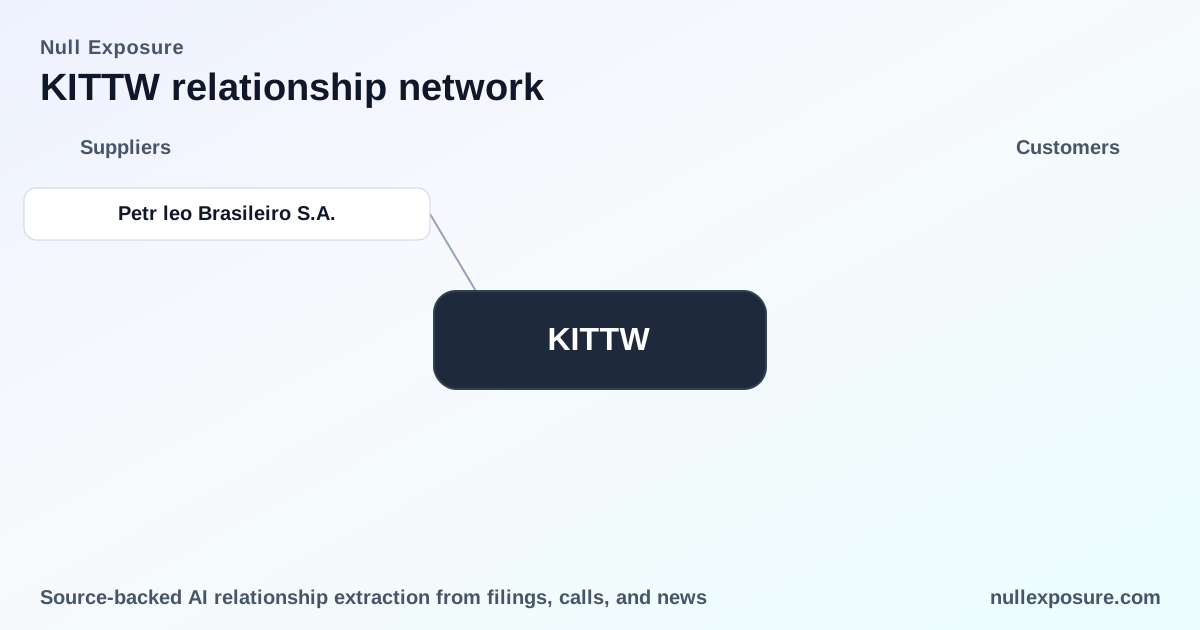
KITTW supplier profile: what investors need to know about counterparty exposure and operational signals
Thesis: KITTW monetizes by contracting as a supplier and service provider into the subsea robotics and related marine-technology value chain, earning revenue from contracted product supply and professional service agreements with OEMs and operators. The public record shows KITTW relies on a mix of specialized component suppliers and outsourced professional services; contract terms, vendor oversight, and mid‑single‑digit million annual service spend drive both operational leverage and counterparty risk.
If you want a structured, transaction‑level view of supplier exposure and related-party dynamics, start here: https://nullexposure.com/
What the filings actually say about suppliers and agreements
The dataset of filings for KITTW (supplier scope) contains a discrete contractual disclosure: an agreement executed between Nauticus Robotics Brazil Ltda. and Petr leo Brasileiro S.A. on May 23, 2023. This appears in the company's FY2024 10‑K filing and is the primary named counterparty in the public supplier record for that period. According to the FY2024 10‑K, the agreement was included verbatim as an exhibit-level disclosure tied to supply/operational arrangements in Brazil (10‑K, fiscal year ended 2024).
Supplier relationship: Petr leo Brasileiro S.A.
Petr leo Brasileiro S.A. is listed in the FY2024 10‑K as a contractual counterparty to Nauticus Robotics Brazil Ltda., with an agreement signed on May 23, 2023; the filing identifies this as an active contractual relationship disclosed in the annual report (10‑K FY2024). The disclosure is singular in the supplier results for KITTW, making Petr leo Brasileiro the only relationship explicitly surfaced in the supplier results set (10‑K, FY2024).
Other named third parties and service relationships called out in the filing
Beyond the Petr leo agreement, the filings and extracted constraints name other counterparties and service modalities that shape operational risk and vendor governance:
-
Flexible Consulting, LLC — related-party service provider: The company discloses Flexible Consulting as a related party providing accounting and finance services since January 2023, with $1,015,558 of services recorded for the year ended December 31, 2024 and $160,366 of accounts payable outstanding at year‑end (10‑K FY2024). The filing further states Flexible Consulting is considered a related party from December 1, 2023, and participates in quarterly reporting and M&A-related finance work (10‑K FY2024).
-
SubCTech — German battery supplier referenced in supply‑chain discussion: The filing discusses a Li‑ion battery subsystem sourced from SubCTech, identified as a German supplier, as part of the broader supplier ecosystem supporting Aquanaut subsea vehicles (10‑K FY2024 supply‑chain discussion). The filing characterizes the battery as a key component but notes a variety of suppliers are available to provide the subsystem.
How these disclosures translate into operational constraints and business-model signals
The extracted constraints from the filing surface several company-level signals that materially influence KITTW’s supplier exposure and contracting posture:
-
Geographic footprint includes EMEA suppliers. The filing explicitly references a German battery supplier (SubCTech) when describing the energy storage stack used in subsea vehicles, signaling an active supplier footprint in EMEA and import/sourcing considerations tied to European component vendors.
-
Raw material purchases are immaterial to operations. The company states that direct purchase of raw materials is not material because a substantial portion of manufacturing is outsourced to third parties; structurally, this points to a supplier-centric manufacturing model rather than vertically integrated raw‑material procurement.
-
The company uses third‑party service providers with a risk-based oversight model. Filings describe a formal, risk‑based approach to onboarding and overseeing third‑party providers — including cyber risk assessments and contract security terms — which signals institutionalized vendor governance rather than ad hoc procurement.
-
Related-party service spend is nontrivial (mid‑single‑million range). The recorded spend with Flexible Consulting (just over $1.0M in FY2024) places certain professional services in the $1M–$10M annual spend band, implying concentrated vendor economics for finance/accounting functions.
-
Active relationships with established suppliers and service providers. The company reports active, ongoing engagements with both related-party advisers and external component suppliers, which indicates operational continuity but also bilateral counterparty dependencies.
What this means for investors and operators
-
Concentration risk is mixed: On one hand, the company’s outsourcing model reduces exposure to raw‑material price swings; on the other hand, material related-party spending for core finance and reporting services concentrates operational risk in a small number of providers (Flexible Consulting recorded >$1.0M in FY2024).
-
Critical components are managed but not captive: The battery subsystem is essential to subsea vehicle performance, yet the filing notes a variety of suppliers are available (SubCTech is one example), suggesting substitutability for certain components while also requiring active supplier qualification and supply‑chain redundancy.
-
Contracting posture and vendor governance are explicit strengths. The company documents a risk‑based onboarding process, cyber assessments, and the inclusion of security terms in contracts, which reduces legal and cyber exposure associated with third‑party access.
-
Regional sourcing introduces geopolitical and logistics considerations. The presence of EMEA suppliers (Germany cited) introduces cross‑border trade, compliance, and logistics vectors that should be modeled into scenario analyses for delivery risk and cost inflation.
If you want a transaction‑level supplier map or invoice‑level exposure analysis, check our tooling at https://nullexposure.com/ to accelerate diligence.
Practical monitoring checklist for KITTW counterparty risk
- Track payments and accounts payable to related parties (Flexible Consulting balance and annual spend).
- Monitor supplier diversification for battery subsystems and long‑lead components (SubCTech relational footprint).
- Validate contracting language for security and performance SLAs, given third‑party access to sensitive engineering and operational data.
- Model delivery and FX risk associated with EMEA sourcing lanes.
For a deeper supplier-risk scorecard tailored to this filing set, visit: https://nullexposure.com/
Bottom line and investor actions
KITTW’s supplier disclosures show a supplier-driven manufacturing model with active related-party professional services and a mid‑single‑million spend concentration that requires monitoring. Key risks are counterparty concentration in professional services and cross‑border component sourcing, while strengths include explicit vendor governance and multiple sourcing options for at least some critical subsystems. Investors should prioritize contract review, AP aging to related parties, and supply‑chain continuity plans in diligence.
Want to convert these signals into portfolio actions or operational remediation? Start here: https://nullexposure.com/