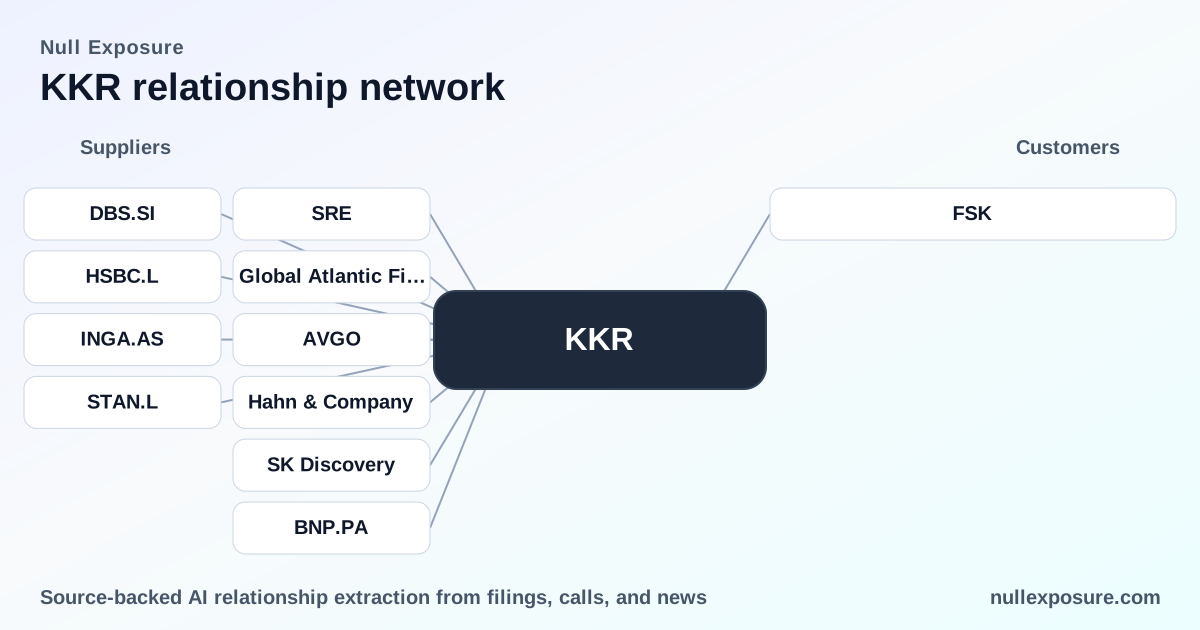
KKR Supplier Relationships: What Investors and Operators Should Price In
KKR is a global investment manager that monetizes through asset management fees, carried interest, direct investments, and balance-sheet financing across private equity, credit, infrastructure and insurance. Its supplier relationships range from banks that underwrite acquisition financing to industrial and corporate sellers that provide recurring deal flow; these relationships translate directly into fee pools, co-investment exposure, and capital recycling opportunities for limited partners and KKR’s balance sheet.
For a deeper view of KKR’s counterparty map and how each relationship feeds fees, deal risk and financing capacity, visit the Null Exposure research hub: https://nullexposure.com/.
How to read this: what the relationships reveal about KKR’s operating model
KKR runs a distributed deal and capital-sourcing platform that relies on three practical operating characteristics:
- Contracting posture — flexible, deal‑level commitments with some framework agreements. Evidence shows forward-flow and purchase commitments in insurance channels alongside traditional syndicated financing for acquisitions.
- Concentration and criticality — relationships are relationship-driven rather than vendor‑concentrated; banks and strategic sellers are transactional but critical for deal execution. Key bank groups lead financing syndicates for acquisitions while large strategic disposals supply assets to KKR’s funds.
- Maturity and spend profile — commitments sit at scale. Public filings and press reports point to multi‑hundred‑million dollar financing capacities and purchase commitments ranging into the tens-to-hundreds of millions.
For background on the full coverage and signals I used, check Null Exposure: https://nullexposure.com/.
Deal-by-deal: the counterparties in the recent signals
Sempra Energy — infrastructure stake purchase
KKR is participating in the approximately $10 billion sale of a 45% stake in Sempra Infrastructure Partners, a capital-recycling transaction that funds Sempra’s buildout while supplying KKR with a large, infrastructure‑scale asset and potential recurring management fees. According to a MarketMinute report (March 2026), KKR and the CPP Investment Board are finalizing the transaction. (Source: markets.financialcontent.com, March 2026)
Global Atlantic Financial Group — insurance distribution and product management
KKR’s insurance subsidiaries operate retirement, life and reinsurance products under Global Atlantic; the relationship includes forward‑flow and purchase arrangements that feed investment inventory and fee income for KKR’s insurance platform. A 2026 press item notes Global Atlantic as the manager of these insurance products. (Source: Yahoo Finance Singapore coverage of KKR at RBC Capital Markets, March 2026)
Broadcom — strategic acquisition of an end‑user computing unit
KKR agreed to acquire Broadcom’s End‑User Computing unit for roughly $4 billion, a buyout that expands KKR’s software and services portfolio and creates cross‑sell and cost‑takeout opportunities for portfolio optimization. InformationWeek reported the transaction and the $4 billion price tag in March 2026. (Source: InformationWeek, March 2026)
Hahn & Company — co‑seller in SK Eternix transaction
KKR agreed to acquire stakes in SK Eternix from Hahn & Company, a deal‑specific purchase that adds portfolio assets and attendant fees without transforming KKR’s overall business mix. MarketBeat flagged the transaction as neutral in impact in early March 2026. (Source: MarketBeat filing alert, March 2026)
SK Discovery — seller in the same SK Eternix deal
KKR acquired stakes in SK Eternix from SK Discovery, supplementing KKR’s industrial and chemicals exposure via a deal that is primarily accretive at the asset level. MarketBeat recorded the same transaction context for SK Discovery. (Source: MarketBeat filing alert, March 2026)
BNP Paribas — lead bank on acquisition financing
BNP Paribas is among the banks leading a proposed $500 million loan to finance KKR’s bid for a majority stake in XCL Education, demonstrating how KKR syndicates acquisition financing across large global banks. TradingView/Gurufocus coverage outlines BNP Paribas’s involvement in March 2026. (Source: TradingView/Gurufocus summary, March 2026)
DBS Bank — regional financing partner for the XCL Education purchase
DBS is listed among the banking group negotiating a $500 million facility to support KKR’s XCL Education acquisition, underlining KKR’s use of Asia‑based relationship banks for regional transactions. TradingView/Gurufocus reported DBS’s role in March 2026. (Source: TradingView/Gurufocus summary, March 2026)
HSBC Holdings — global financing syndicate participant
HSBC appears as a syndicate bank working on the same $500 million loan for KKR’s XCL Education deal, reflecting KKR’s habit of assembling multi‑jurisdictional financing groups for larger buyouts. TradingView/Gurufocus documented HSBC’s participation in March 2026. (Source: TradingView/Gurufocus summary, March 2026)
ING Bank — participant in acquisition financing
ING is included among the banks leading the financing discussions for the XCL Education transaction, consistent with KKR’s pattern of diversifying financing across European and global lenders. TradingView/Gurufocus noted ING’s involvement in March 2026. (Source: TradingView/Gurufocus summary, March 2026)
Standard Chartered — another syndicate bank on the XCL Education loan
Standard Chartered is also named as part of the bank group negotiating the $500 million acquisition loan for XCL Education, reinforcing a cross‑border lending strategy that blends regional and global bank capacity. TradingView/Gurufocus referenced Standard Chartered in March 2026. (Source: TradingView/Gurufocus summary, March 2026)
What these relationships say about KKR’s supplier risk and opportunity profile
- The platform relies on large, deal‑specific sellers and bank syndicates. Strategic disposals from corporates (Sempra, Broadcom, SK entities) feed KKR’s direct investment pipeline and create one‑time fee and carry opportunities. Banks provide execution capacity rather than ongoing supplier lock‑in.
- Insurance operations have structured forward-flow exposure. Global Atlantic’s forward‑flow agreements are explicit and include repricing, due diligence and performance provisions — that creates both scalable origination and contingent liquidity/credit risk tied to pool quality (evidence from Global Atlantic’s disclosures). (Company filing excerpts, 2024–2025 disclosures referenced in March 2026 signals.)
- Spend and commitment scale is material. KKR and its affiliates disclose financing arrangements with multi‑billion dollar capacity and purchase commitments that fall in the $10m–$100m and $100m+ bands, signaling significant counterparty exposure and operational procurement scale. (Company financial and disclosure excerpts through FY2024–FY2025 cited in relation signals.)
For a practical, counterparty‑level mapping that links these relationship signals to procurement and risk posture, see Null Exposure’s supplier intelligence center: https://nullexposure.com/.
Investment takeaways and operational recommendations
- Fee growth is tied to continued access to large corporate disposals and bank syndication capacity. KKR’s ability to scale management fees and balance‑sheet investments depends on sustaining these counterparty channels.
- Insurance channel structures create predictable inventory but inject contingent funding and underwriting risk. Forward‑flow frameworks improve origination velocity while exposing KKR to pool performance and repricing mechanics.
- Investor focus should be on execution risk in financings and asset integration post‑acquisition. Syndicate composition and bank appetite will determine financing cost and timing for deal closings.
To explore counterparty heat maps and drill into documented exposures by counterparty, start with our research portal: https://nullexposure.com/.
KKR’s supplier footprint illustrates a classic private‑markets ecosystem: large, one‑off asset purchases sourced from strategic sellers plus recurring insurance and financing relationships that amplify fee and balance‑sheet returns. For portfolio managers and operations teams, the priorities are execution robustness and active monitoring of forward‑flow and financing commitments. If you want a tailored supplier risk brief for KKR counterparties, Null Exposure offers bespoke intelligence and mapping services: https://nullexposure.com/.